
These days the subject of artificial intelligence, or AI, is all over the media. It’s all over CUNY, too. Academics worry about what role it is already playing in colleges and schools. Is new technology harming student learning and encouraging cheating? Will AI put CUNY’s instructional and classified staff out of their jobs in the future? Will new advancements make the classroom difficult to manage or change the nature of academic teaching and research?
These are questions PSC members ask every day. The union is looking for answers and for new ways to talk about and confront these issues through collective bargaining, governance, advocacy, and other means. It’s urgent and timely work; CUNY already has more than 200 “AI-related” initiatives.
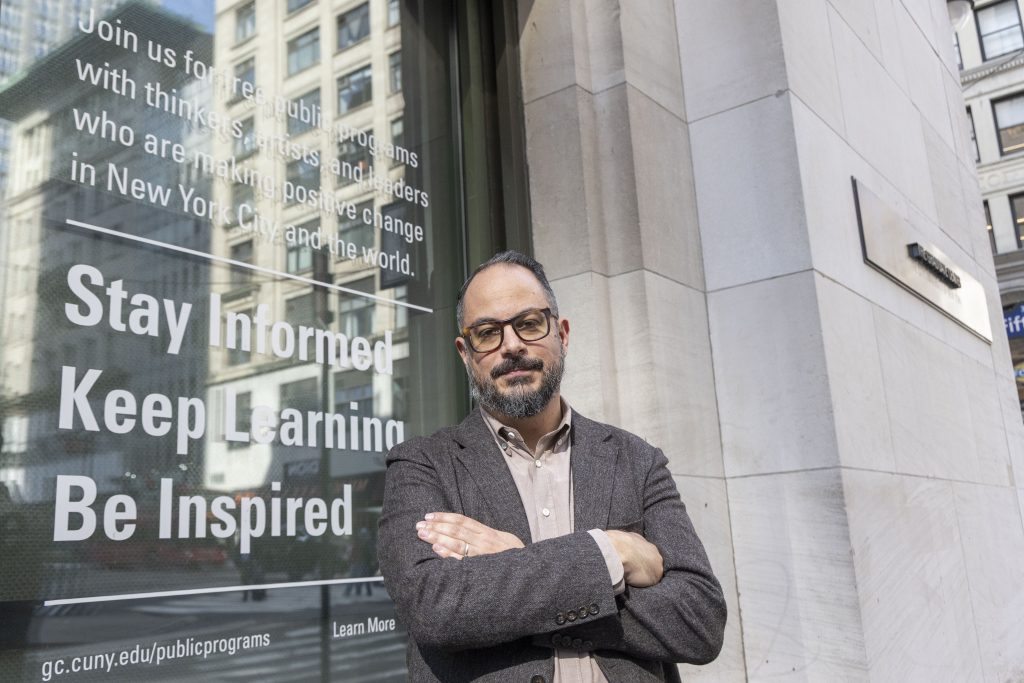
Luke Waltzer, a PSC eye on AI (Photo: Gina Randazzo).
Luke Waltzer, director of the Graduate Center’s Teaching and Learning Center and a member of the PSC Ed Tech Labor-Management Committee, moderated a panel titled “AI and the Future of Education” on October 14 at the Graduate Center. Joshua Brumberg, president of the GC, said of Waltzer, “He is very much on the front lines of these issues.”
Waltzer’s work involves “examining AI as a sociotechnical system,” he said, noting that, “This means that we’re seeking to understand the contexts and ideas from which this technology emerges.”
“We’re studying its material origins, and material impacts. We’re looking at how the technology itself works,” he said. “We’re exploring its interactions with social systems and asking what those interactions tell us about the technology and those systems themselves. And we’re tracking its cognitive and epistemological impacts; on how we learn, and how we come to know.”
For Waltzer, this is a critical moment.
“How our educational systems respond to historic change tells us much about how we see young people in our society, which in turn tells us much about how we see the future,” he said. “My colleagues and I here at the Graduate Center are not neutral observers. We believe that analysis of AI’s impacts must center human agency, human possibility, and human being-ness.”
“We’re seeing people with very strong emotional reactions” to the use of AI in education, he said, with those reactions ranging from enthusiasm to deep dread.
Panelist Stephen Jackson, Cornell University professor of information science and science and technology studies, said he doesn’t buy into AI “catastrophism.” For him, the rapid adoption of AI in education gives reasons for hope and cause for concern.
Jackson said that those exploring the use of AI in education need to approach it as “something we try, and learn from, take the evidence and take the lessons.” This experiment in education should, he said, “center a lot of our work on the faculty-student relationship.”
Jackson observed that all fields are different and need different pedagogical approaches. One uniform AI approach to teaching won’t work. He went on to say that, “We do not believe that AI will cause or should cause teaching to become more the same. If teaching becomes more the same across disciplines and fields, then we have failed, and the way we have done AI has failed.”
“Pluralism is essential to what we do,” Jackson said, adding that educators need a “recognition of AI goods and harms, and any reasonable person sees good and sees harms in AI.”
Natasha Singer, who covers technology in schools for the New York Times, said recent historical developments show “there isn’t rigorous evidence” that new technology improves education. She urged some “pausing” when it comes to the drive to embrace the newest educational technology in the classroom.
Singer warned that AI enthusiasts envision a world where robots will be able to help create customized learning tools for each student. “The people who invent these tools are well meaning. I think AI is going to be a major infrastructure change, but at the moment what we see with AI, it has enabled industrial scale cheating,” she said, noting that studies show that students who use AI assistance in studying retain less knowledge than those who don’t.
In fact, she recalled an interaction with an eighth-grade student in New Jersey who said she sat in the front row at school because she loved to learn and didn’t use AI, while the kids in the back row used generative AI and read Googled answers when the teacher asked them questions.
Eighth graders like that are called “AI refuseniks,” Singer recalled one parent saying. As the eighth grader said of AI to Singer, “I don’t want it to rot my brain.”
Aankit Patel, CUNY dean for technology and computer and information sciences, asked “Whose voice are we lifting up?” He elaborated that he believed that the discussion about new technology in schools often fails to prioritize the needs of educators. “There’s a history of technology in schools where we start with the technologists instead of the writing faculty or the early childhood educators,” he said. “How do we lift up the educators?”
Patel said that educators at each CUNY campus should be at the forefront of figuring out how these tools can be used. “Baruch has been doing great work on this. Queensborough Community College has been doing great work on this front. York has been doing great work,” Patel said. “It starts there, not with the technology.”
Patel was optimistic that educational institutions can still focus more on what educators need rather than the device or software itself. “It’s not about the tool,” he said. “Stop looking at the hype, focus on what we know about our communities, take time to do this, and I think we will be fine.”
With that in mind, some policy makers have been wary of the rush to integrate AI into the classrooms. The Mamdani administration announced “a one-year moratorium, effective in the 2026-2027 school year, on student-facing generative AI for children in 2-K through 8th grade.”
The PSC’s approach to AI is about protecting members’ rights and livelihood and defending the integrity of a CUNY education. The expertise of union members like Luke Waltzer is our most critical resource.
In addition to the GC talk, Waltzer joined fellow PSC Ed Tech committee members Matthew Gartner, an associate professor of English at Kingsborough Community College, and Helen Keier, Blackboard administrator at John Jay College, at the Higher Ed Labor United convening “Against the AI Campus: Building Power in Higher Ed” on October 23-24 in Chicago.
Waltzer will also serve as the PSC’s designated member to the CUNY A.I. Guidance Working Group, led by Evan Silberman, CUNY senior university dean of academic innovation and chief academic technology officer.
PSC President James Davis detailed other PSC efforts to confront AI in a recent message to chapter leaders. “Individual CUNY colleges are beginning to formulate their own A.I. guidelines, such as this one for the Graduate Center,” he wrote.“ PSC has urged University Provost Alicia Alvero to develop university-wide guidelines regarding A.I. rather than leave everything to the colleges.”
Davis also informed members about the PSC’s endorsement of HELLA, the Human Education Labor and Learning Alliance. The new coalition of faculty, staff, students, and community members has a mission to “organize for inclusive decision-making around AI’s impacts on our campuses, economy, and environment.” Their points of unity are described as “digital sovereignty, human learning, technology for everyone, and dignified work,” he said.
The PSC’s “national affiliates have worked to map the landscape and provide guidance to locals,” Davis said. The American Federation of Teachers’ guiding principles, the American Association of University Professors’ tools for AI activism, the AAUP report on AI and academia, and the AAUP’s resource guide on AI-related contract demands are some of the affiliate resources that are available.
The union is working to protect members in the AI revolution in other ways. Governor Hochul signed a union-backed amendment to the Legislative Oversight of Automated Decision-making in Government Act (LOADinG Act) that will protect CUNY jobs. Last year, the union’s Delegate Assembly passed a resolution committing the union to fighting negative impacts of AI, including on academic workers and the environment. A contract provision won in the last round of bargaining ensures that “The teaching faculty/instructor of record for every course offered in The City University of New York, regardless of modality, will be in an Instructional Staff title,” ensuring that PSC members’ teaching may not be outsourced to non-union members or replaced by an AI agent.