For many years Tomoko Hagane-Mullins, a senior college laboratory technician in the chemistry department at Hunter College, has been wondering how she would ever be able to afford to take her parents on a trip back to their native Japan. Airfare. Trip insurance. Lodging. To say the least, it’s a lot.
But the long awaited trip is happening this winter in large part thanks to the $5,000 lump sum payment CLTs are set to receive in November as a part of equity payments negotiated by the PSC in the current contract with CUNY. “It’s going to help me fund that trip,” Hagane-Mullins said. “I don’t know if I would have decided to take this trip if it weren’t for that.”
The CLT title series is one of the lowest paid full-time professional staff title series at CUNY. They are receiving the largest equity raise for full-timers in the current contract, but they aren’t alone when it comes to equity gains. As Clarion previously reported, assistants to higher education officer will receive a $1,000 equity payment in November and CLIP and CUNY Start instructors will receive $2,000. Graduate assistants A and B will receive $4,000 in December, while graduate assistants C and D will receive $1,000. The amounts will also be added to the base salary in March. (Most adjunct instructors received a 12% equity increase in January with an additional raise on September 1, and a final increase coming in June.)
This is a pay boost for more than 3,500 full-time PSC members, according to the union’s records, in addition to the more than 12,500 teaching adjuncts who also received equity increases.
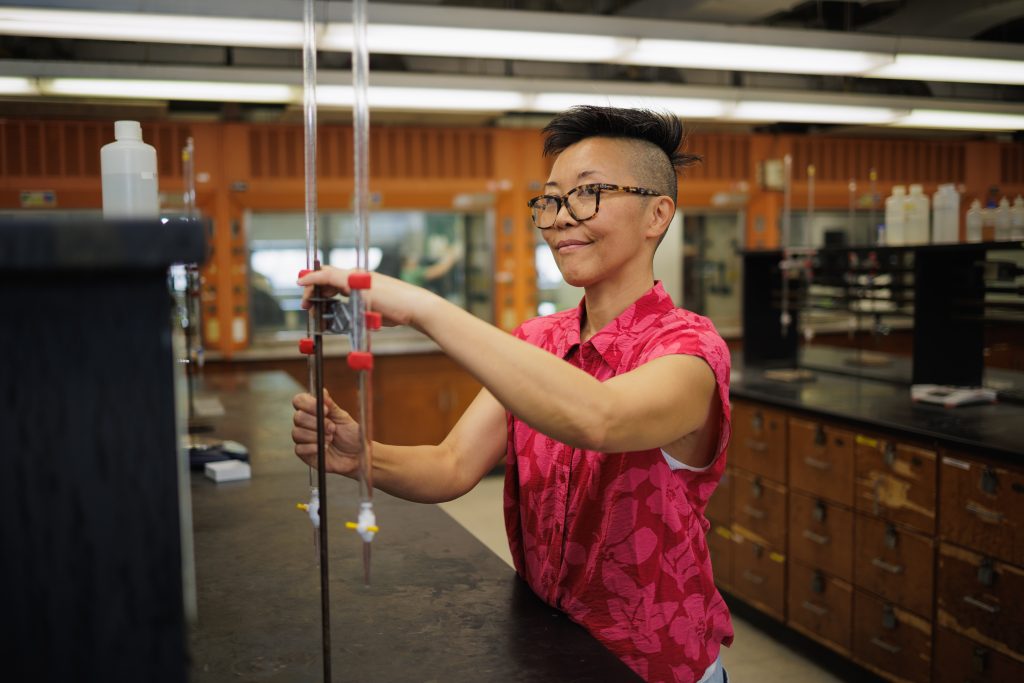
College laboratory technicians like Tomoko Hagane-Mullins are seeing a boost under the current contract (Photo: Paul Frangipane).
“At a time of immense financial pressure on our members, I feel proud of the discipline and creativity the PSC bargaining team demonstrated throughout eighteen months of contract negotiations,” said PSC President James Davis. “Their commitment to making life more affordable for all our members regardless of job title was admirable and set a foundation on which to build in the next round.”
Members in these titles hit a similar tone.
“The $5,000 lump-sum payment is a welcome recognition of the essential work CLTs perform across CUNY and a significant collective bargaining achievement. It provides much-needed financial relief amid rising living costs,” said Amy Jeu, a CLT in geography and environmental science at Hunter College. “More importantly, its incorporation into base salaries effective March 1, 2027, represents a permanent structural improvement addressing longstanding compensation inequities.”
For many CLTs, assistants to HEO, graduate assistants and CLIP and CUNY Start instructors, this is real money that is making a difference in their lives during a time of soaring costs and inflation. These payments are also a part of a continuing effort to lift up salaries for the lowest paid titles in our union.
Jeu, who served on the PSC contract bargaining committee, said, “I plan to invest the money in continuing my research on green technologies for sustainable living, particularly solar and wind energy as viable alternatives to Puerto Rico’s dependence on fossil-fuel-based electricity generation,” a project that “focuses on addressing the island’s persistent energy insecurity and the long-term impacts of Hurricane Maria.”
For other CLTs, the lump sum payment was welcome, helping them keep their heads above the economic water.
Jeanette Batiz, the chair of the PSC CLT chapter, said members received these pay bumps at a time when workers need them. “The rising cost of food and other necessities has placed a financial burden on many families,” she said. “This lump-sum payment will help cover essential expenses and pay bills. I am extremely grateful for this support, which will help me continue to meet my financial obligations and manage the challenges of the increasing cost of living.”
Martha Sanchez, a senior CLT in technology services at Bronx Community College, when asked about her plans for the money, said, “Food. Basic needs, basically.”
“This was just to bring us to be more equitable with others, because we were way too low,” Sanchez said, who like many CLTs, still believed they needed to fight for more equity raises in the next contract. “I have a hopeful feeling that we will get more.”
Mitch Patrick, a chief laboratory technician at Brooklyn College, said, the “lump sum matters to me a lot, especially right now given the economy and rising cost of living over the past six months,” adding that, “Right now I plan to invest in my brokerage/savings and my Roth.”
There was conflict over the payments for first-year graduate assistants, however. The PSC’s Graduate Center chapter circulated a petition written by their new colleagues noting that the offer letters issued in the spring to incoming graduate workers “communicated a clear and specific commitment to incoming Graduate Assistant Bs that they would receive a $4,000 lump-sum payment,” but that CUNY implementation guidance restricted the process so that “incoming first-year graduate assistants were not placed on payroll until August,” and the chapter said “we express our concern of being excluded from receiving the payment promised in our offer letters, despite having received those offers months earlier.”
The petition continued, “We believe that students should be able to rely on the written terms of their official financial aid offers.”
In a labor-management meeting following the petition, the Graduate Center administration confirmed that first-year graduate assistants would, in fact, be paid the promised lump sums, according to the PSC Graduate Center chapter.
The chapter is still working to ensure that graduate assistant appointments funded through other campuses will also receive the payments, that the commitment extends to all first-year GA titles, and that students who transitioned between graduate assistant titles receive the full amount they are owed, union sources said.
Assistants to HEO, who are in the lowest paid title in the HEO series, are also receiving a financial boost with the lump sum payment and the equity raises in March, and they received an equity bump in the previous contract, too.
“As an assistant to a HEO, my salary was not enough to keep pace with the cost of living in New York City before our contract wage increases took effect. When my apartment building in Brooklyn was sold in 2024, my roommates and I were forced to move to New Jersey because we could no longer afford to live comfortably in the city, and I could not afford an apartment on my own,” said Joey Snavely, a campus coordinator for the CUNY Explorers program at Hostos Community College.
But the wage increases helped bring Snavely back to the city, the Bronx specifically.
“Throughout my time in New Jersey, one thought stayed with me: I was a city employee who could no longer afford to live in the city where I worked. Returning to New York was a significant improvement in my quality of life,” Snavely said. “This equity payment will provide additional financial stability and allow me to increase my retirement savings. I believe this is a good start, but with the cost of living continuing to rise in New York City, our next contract should help ensure that CUNY employees can afford to live in the city they serve.”
Other assistants to HEOs looked positively on the lump sum payments.
“The extra money would help with covering everyday expenses,” said Henrietta Jones, an administrator at the nursing school’s undergraduate programs at Hunter College. She added that the equity boosts were a “step in the right direction” for people in her title.
Karen Platt, an administrative coordinator at City College’s office of information technology, was glad assistants to HEO received a boost in the current contract.
“I’ll probably use it to pay bills,” she said.
CLIP and CUNY Start instructors are also relieved by the lump sum payments.
“The timing of this lump-sum payment is great,” said Daniel Casey, a CLIP instructor at Hostos Community College. “I plan to spend the money on a short holiday trip to Boston with my spouse and kids.”
He added, “The November $2,000 lump sum would be appreciated even if it were a stand-alone, but this is actually the first of three compensation increases that CLIP and CUNY Start Instructors will be getting in the near future. In January, we will reach our annual step, and then in March we will receive another contractual raise. These three bumps up in quick succession will raise our incomes considerably.”
Chrystelle Voigt, a math instructor at Queensborough Community College’s CUNY Start program, told Clarion, “My car got stolen two years ago, so I’m using this money to finally put towards the down payment of a new car.”