The staff at Queens College’s Delany Hall are finally back on site after fighting debilitating health hazards in the building for more than a year. Recent air quality tests proved that management has finally met their demands for a healthy workplace and it’s safe for workers to return. For the PSC as a whole, this is a testament to what union power and collective action can achieve at the workplace.
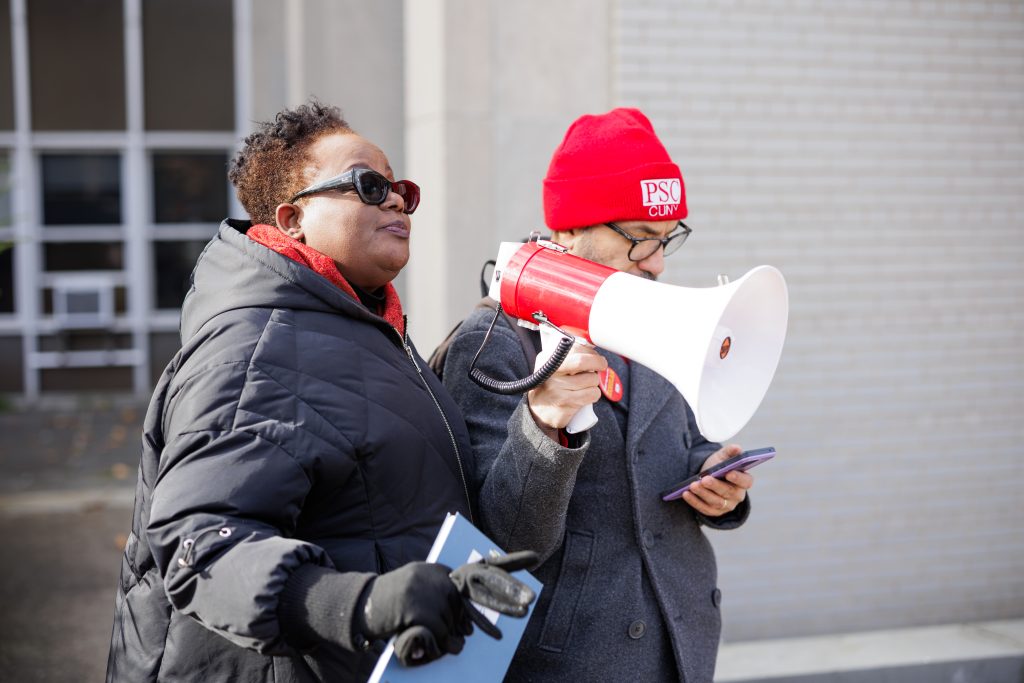
Norka Blackman-Richards leads a rally for safety at Delany Hall last year (Photo: Paul Frangipane).
“We would not have gotten back to Delany had it not been for the protesting, the organizing and the letter writing. It was because of the strength of the PSC,” said Norka Blackman-Richards, director of Queens’ SEEK program– the Search for Education, Elevation, and Knowledge. “It took the force of the people. It took the force of the union to get where we are now,” she continued.
Starting in June of 2025, staff in Delany Hall “raised the alarm about asbestos work in Delany Hall, demanding information about the health risks,” Clarion reported, noting that dust levels had caused at least one fire alarm and numerous staff members experienced respiratory illness as a result.
The building is dedicated to serving the needs of students of color–“Lloyd Delany, the hall’s namesake, was the SEEK program’s first Black director,” according to Inside Higher Ed. SEEK was the nation’s first publicly funded college opportunity program, and the building remains largely dedicated to programs ensuring college access and success for students of color. For this reason, many workers at Queens saw the health and safety issues at Delany as a form of environmental racism. Believing that the administration was ignoring concerns about asbestos and other toxins in the building, PSC members needed to act.
The struggle has been a long one. In the summer of 2025, according to a timeline supplied to Clarion by campus activists, “SEEK leadership requested safety protocols for the construction on behalf of occupants. No response was ever received, despite phone follow-up with the new project manager.” Delany workers faced miserable conditions. “Windows were sealed incompletely, allowing construction and toxic dust into offices. Occupants cleaned dust from workspaces daily and began experiencing chest and head congestion, headaches, and irritated eyes, ears, and throats, while running SEEK’s and College Now’s summer programs serving roughly 200 incoming students.”
Then, in early September, the union’s Health and Safety Watchdogs walked through the building, identifying vents that didn’t work and confirming problems with the window seals. They interviewed occupants about their symptoms, found conditions “dire,” and recommended relocation. SEEK staff made the independent decision to evacuate first and advised their colleagues in Africana Studies, Research Compliance, and College Now that they were leaving the building. The timeline makes clear, “The College did not relocate any of the occupants; occupants evacuated an unsafe building and had to find their own accommodations on campus.”
Most of Delany’s occupants worked from home immediately after the evacuation, but “remote work wasn’t possible” for this kind of hands-on work, according to Blackman-Richards, because students needed the in-person services of a variety of programs based in the building. The workers eventually occupied space in the main library as a temporary office.
The PSC chapter held a spirited protest on campus in November and the union filed a health and safety grievance. Members joined with students on a frigid day, marching from the quad to the main administrative building just as a hearing on the grievance was about to commence.
Union members kept the pressure on the administration of then-President Frank Wu through the spring and summer, organizing additional walkthroughs and demanding progress and further testing during meetings of a health and safety focused labor-management committee that was established in the current PSC contract.
On August 17 of this year “A college-wide communication declared Delany Hall open for occupancy.” But outstanding items from the Watchdogs walkthrough, and questions about silica levels, airflow, and carpet cleaning had not yet been definitively resolved. SEEK staff disputed the reopening. They responded in writing, calling for an August 24th reopening date and confirmation that the specific health and safety concerns had been addressed. The workers said they “would not send staff or students into the building until those matters were verified [as] addressed.”
Ten days later, according to the timeline, “Updated air quality and silica testing results were shared and approved by the PSC Watchdogs: all sampling (PCM, lead air, silica air, and lead wipe) came back within acceptable safety limits, with silica content decreased compared to the October 2025 baseline and no visible dust observed.”
The outcome was “a hard-won result of sustained advocacy from the PSC and the occupants’ ability to unite, come together to advocate and defend their cause,” a message from SEEK staff stated.
There is joy at Queens now that Delany is safe and open. Working in a temporary space was a hardship. Organizing paid off and the students are getting the in-person services they need. But hard feelings linger.
“It’s bittersweet,” Blackman-Richards said. “But there’s still this thing hanging over my head. There were people who got seriously ill while we were working there. We came to work everyday and were cleaning off mounds of dust. Down the line someone might get cancer, even me.”
And that’s just the physical aspect. The staff feel disrespected that the administration didn’t want to initially heed their warnings about safety.
“The institution betrayed us,” she said.
More than half of students surveyed by the Delany faculty and staff activists said that relocation had a negative impact, while 82% said that SEEK’s mission suffered as a result of being moved to Rosenthal library from Delaney.
The survey found that “82% of students say the college has not reached out, or they cannot recall any outreach, providing a deadline for construction completion” and “60% of students rate the college’s communication as ‘poorly,’ ‘very poorly,’ or ‘no communication at all,’” while “85% of SEEK faculty, counselors, and staff independently describe communication as ‘barely at all’ or ‘insufficient.’”
The survey results are maddening, but Blackman-Richards is adamant that Delany is functioning safely today because of local, rank-and-file union organizing.
Erica Doran, the Queens College PSC chapter chair said, “As a chapter, we are relieved that the work on Delany has been completed. The union-requested testing has been performed indicating that it is safe for our members to return to Delany, and the cleaning and restoration of the offices mean that SEEK, College Now, Africana studies, and other impacted programs can better serve their students now that they are back in their ‘home’ location. We are especially grateful to Dr. Norka Blackman-Richards and the Delany community who tirelessly advocated for the welfare of the Delany Hall occupants and the students they serve throughout this process.”
“While the situation in Delany Hall was difficult, I’m ultimately grateful we had the opportunity to show our students and the alumni and retirees of our programs that we will always uphold Dr. Lloyd T. Delany’s legacy and fight for what’s right,” said Walter Lucken, an assistant professor of English at Queens College and a PSC delegate. “I teach my students that they really can make a difference if they use their voice, so it’s great for them to see how that looks in practice.”
Doran was hopeful that the relatively new interim administration is willing to work on safety and health issues on campus. “Capital improvements on campus, while much needed, must work in sync with academic needs, not undermine them,” she said.