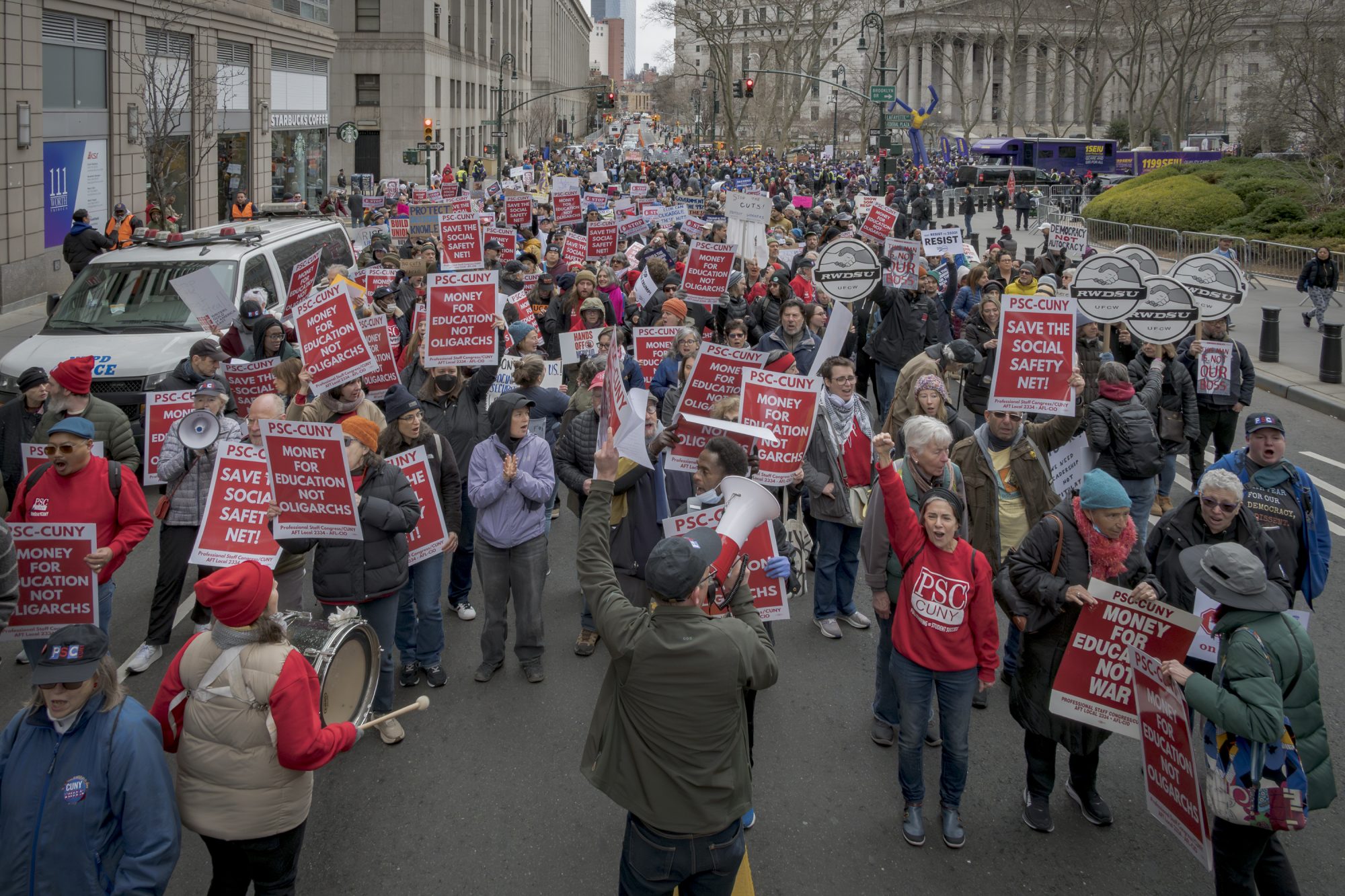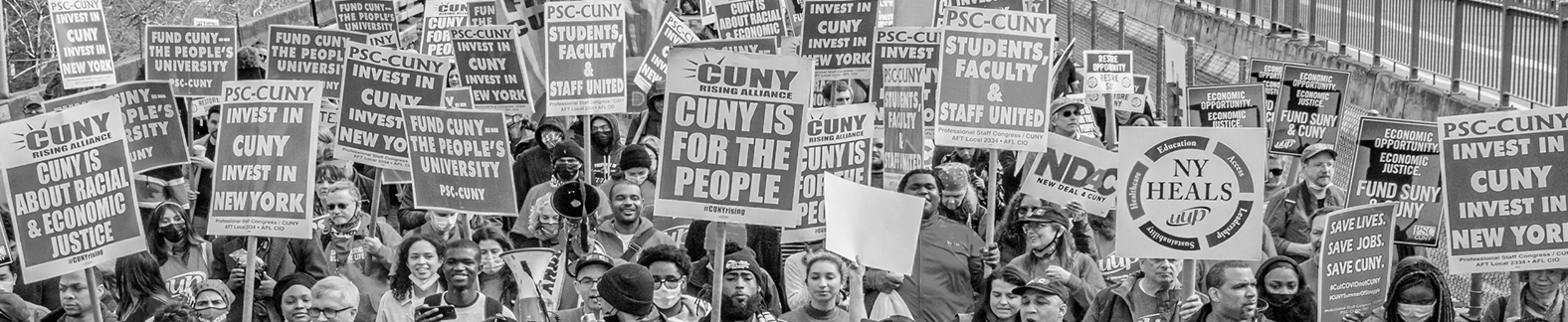
Gianina Chrisman, director of career development at Macaulay Honors College, hadn’t been actively involved with the PSC until November 3, Election Day. She was inspired to hit the streets with her fellow members when she saw an email about the PSC’s work to help the Democrats win the midterm elections. “I wanted to get more involved with my union,” she said.
Chrisman was handing out Working Families Party literature with other PSC members in the Ridgewood section of Queens as voters approached a polling site in the early hours of the day. With commuters rushing to the M train with freshly poured bodega coffees, people walking their dogs, and the local firehouse “the Myrtle Turtles” responding to its first post-dawn call, Chrisman could not have known about the enormity of the historical moment she was participating in on that sunny autumn morning.
By the next day, the news was clear: Democrats swept the midterms by margins that were initially difficult to fathom. The party won the House and the Senate, flipping important Senate seats and governorships in Texas, Georgia, Maine, Iowa, Ohio and South Carolina, just to name a few. In New York, the PSC played a vital role in the national effort to rebuke the authoritarian regime of President Donald Trump and the Republican Party.
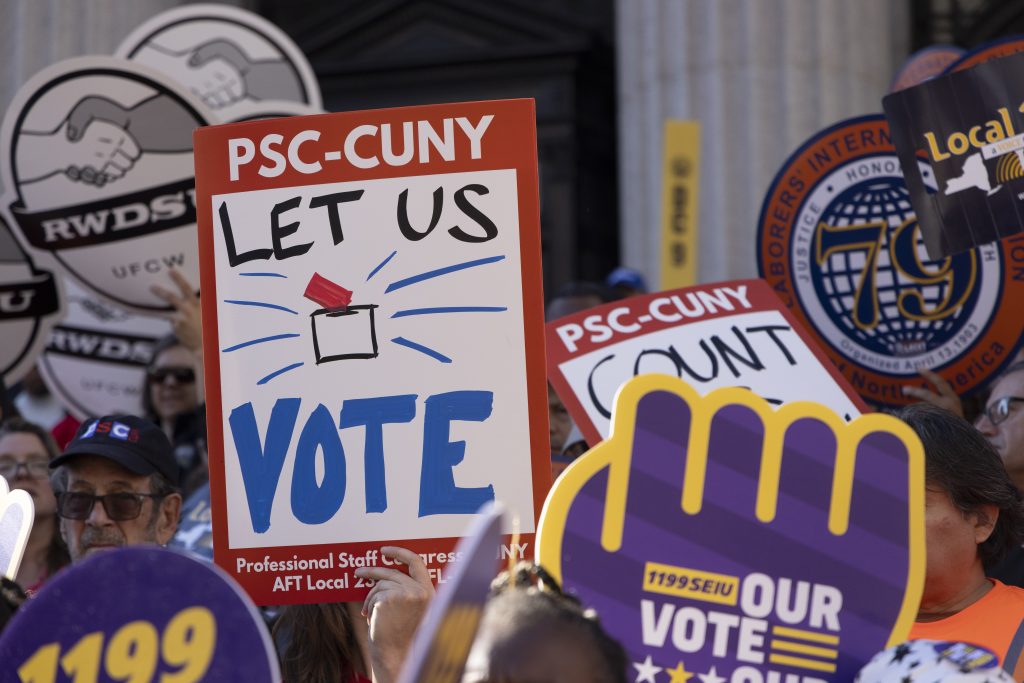
PSC get-out-the-vote and election defense efforts paid off (Photo: Gina Randazzo)
Chrisman was one of nearly 250 PSC members who participated in the union’s “Make it Count” campaign to elect Democrats in the midterms and protect the integrity of the voting process.
The PSC worked closely with other New York unions to flip vital seats locally. Most notably, working with our state affiliate New York State United Teachers, dozens of PSC members phone-banked fellow union members and traveled to Westchester County to door knock union households for Cait Conley, the Democratic challenger who defeated Republican Rep. Mike Lawler, flipping New York’s 17th Congressional District. PSC members also phonebanked to support Mike DeCillis, a Democrat who ultimately challenged but did not unseat Republican Rep. Nicole Malliotakis in south Brooklyn and Staten Island.
At the state level PSC members campaigned for Democrat Chris McCreight, ousting Republican Assembly Member Alec Brook-Krasny in south Brooklyn, helping Democrats secure a supermajority in the state legislature. And perhaps most importantly, PSC members pushed hard to reelect Governor Kathy Hochul with votes on the WFP ballot line. Every vote on the WFP line, union officials and activists said, signals support for Mayor Zohran Mamdani’s affordability agenda, a robust public sector, and fully funded CUNY.
And the union entered into an alliance with other unions and community groups to defend the results of the election from any interference from the Trump administration. PSC members turned out for election protection rallies organized by Hands Off NYC and the NYC Central Labor Council at the James A. Farley Post Office near Penn Station.
On the steps of the Post Office in front of hundreds of city workers in October, PSC President James Davis said, “Generations of workers have fought and bled for the right to have their vote count. Our members understand – and all the city’s workers understand – the gravity of this moment for American democracy.”
PSC members also planned post-election scenarios at an Emergency Workers Summit with dozens of active city unions and mobilized for the March for Our Democracy the Saturday after the election. Thankfully, the results of the election were “too big to rig,” and the scenarios PSC members and union leaders prepared for didn’t materialize.
All of this represents an intensification of the union’s electoral work in the last two years, spawned partly by the enthusiasm of PSC members to confront and resist the attacks on working people, immigrants, and higher education by the Trump administration. This work has paid off, union officials said.
“Thanks to the hard work of many PSC canvassers and phone bankers, we are replacing Mike Lawler with Cait Conley in the US House,” said Liz Stevenson, an ASAP/ACE senior advisor at City Tech and the PSC Action Fund coordinator. “Along with so many other wins, and so much work from members and coalition partners, we will see a Democratic congress and senate that can stand up to Trump and his war on higher ed. Every call, every vote and every seat will count, as we work to abolish ICE,protect academic freedom, and preserve workers’ rights.”
Justyna Jagielnicka, a college counselor and academic support specialist at Borough of Manhattan Community College, who joined other PSC members to campaign for Conley in Westchester last month, said, “I am proud of my union and my PSC siblings who worked tirelessly to flip New York 17 blue. We are part of a historic blue wave, and now the real work begins.”
Susan Kang, an associate professor of political science at John Jay College and a member of the union’s executive council, said, “Turning out Democrats even in blue districts has a reverberating effect. This was a year that Republicans stayed home. Getting Democrats to turn out even in races that aren’t very competitive is important when eventually there are races that are competitive. We contribute to the blue wave because it’s about driving turnout.”
For many members, volunteering on Election Day was a no-brainer. Even in districts where the winner was essentially chosen months before in the Democratic primary, PSC members were urging voters to vote for Democrats on the WFP line. That way, activists have said, the WFP could secure its ballot line and let Democrats know that it was a coalition of unionists and progressives that pushed them to victory.
“I like the way that the PSC is actively partnering with the WFP and working with specific campaigns,” said Kenn Vance, an adjunct lecturer in political science at John Jay who volunteered in Ridgewood.
Votes for the governor on the WFP line are particularly important because they determine the party’s ballot status. All told, Governor Hochul received more than 370,000 votes on the WFP line, more than 10 percent of her total support. And the WFP earned enough votes to move up from row D to row C on the ballot in the next election, surpassing the Conservative Party.
Tom Lee, an academic program coordinator for the Aaron Copland School of Music at Queens College, campaigned in Ridgewood because he believed that even though New York City wasn’t home to swing districts it still played an important role in national elections.
“New York and the results of the election have been a bellwether for the rest of the country,” he said. “People have a sense of hope seeing the New York elections. Mamdani, I see the whole DSA wave and success.”
Other members headed to Brooklyn.
“We don’t need a law professor to understand that the federal constitution has failed. Just look at the free rein ICE has had to kidnap and shoot New Yorkers. We have a vote, but billionaires and businesses have easy access to our politicians and unprecedented, unchecked power,” said Kara Willis, the PSC chair of the School of Law chapter, who was out leafleting in the Bedford-Stuyvesant section of Brooklyn. “So, the question in this election is how New York state will protect us as the failures of the federal government hit home. I was out with my PSC/CUNY union to encourage voting because it is we, the people and our communities, who must guide our state and nation’s future, that is, if we want to retain the ability to honestly call it a democracy.”
Karen Miller, the PSC chapter co-chair at LaGuardia Community College, told Clarion, “I came out because our union work is strengthened when we are able to elect candidates who will support our goals.”
She added, “These include protections for unions, more resources and better funding for public programs like childcare, education, and healthcare.”