When Rocio Rayo was a young girl in Nicaragua she appreciated that every year Irish Catholic missionaries would come and help work in the coffee fields, but she didn’t understand why her war-torn Central American country was so important to their faith. Rayo, a PhD student in cultural anthropology at the Graduate Center and director of transfer services at Hostos Community College, later learned that many Irish Catholics had a special affinity for communities subjected to brutal imperialism. It inspired Rayo to travel recently to Belfast on a PSC-CUNY Research Award to explore the ways Irish Catholics used everyday media–a street wall, a garden statue, old newspaper clippings–to link global politics and Catholicism together.
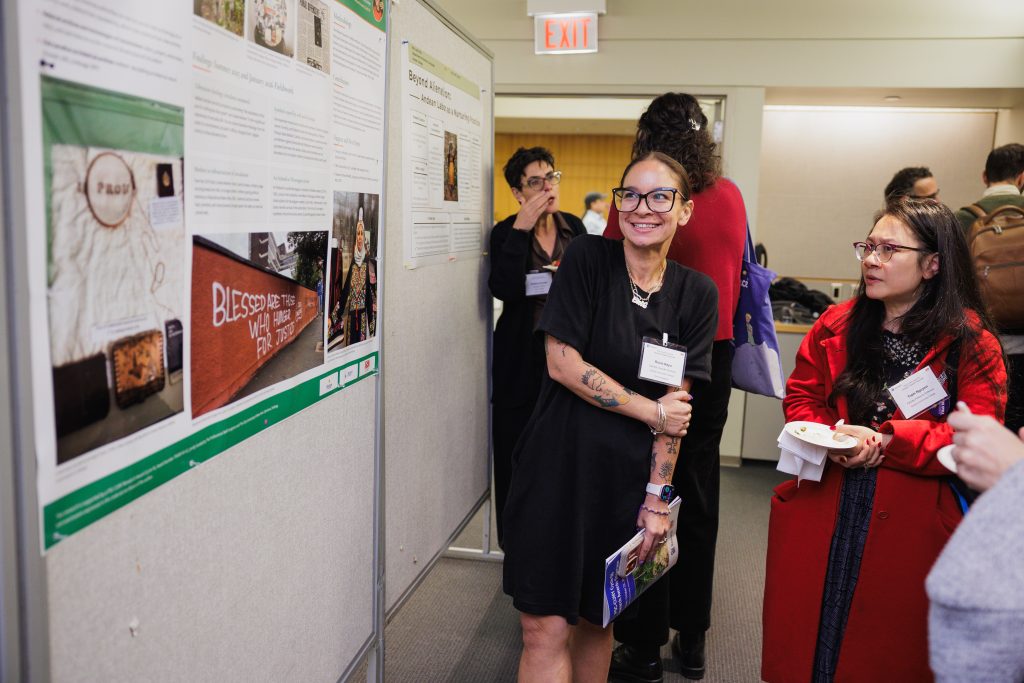
Rocio Rayo (left) showing a display of her research (Photo: Paul Frangipane).
It’s a way to explore how “religion and politics interact to allow us to see the world,” she said during the October 22nd PSC-CUNY Research Awards Showcase, honoring the 757 CUNY scholars who received research grants in the most recently completed cycle.
Rayo is CUNY to the core: in addition to her job and her PhD program, she also has degrees from Hostos and City College. That afternoon she was displaying her work in a room at the Graduate Center with CUNY scholars from all over the city representing dozens of academic disciplines. While this is the 56th cycle of scholars for the labor-management grant program, this is the first time recipients have been honored at a major public event.
“It expresses a shared commitment to research,” PSC President James Davis told the award recipients and other attendees, explaining that the fund is a joint labor and administration effort, a “product of the collective bargaining process.” Davis noted that the awards are open to all full-time members of the instructional staff at CUNY, adding, “It’s a highly democratic part of the contract.”
In fact, the “parties increased funding for the program in the last round of contract negotiations, so that now more than $4 million is available annually,” Davis said in the ceremony’s written program. The PSC-CUNY Research Award provides funds according to two “tracks,” grants of up to $7,000 and between $7,001-$12,000.
Davis also highlighted the special importance of these awards at a time when the federal government is slashing research funding and suppressing academic inquiry all around the country. When one looks at the types of projects presented at the showcase–about LGBT rights, climate change and racial justice and inclusion, among them–these research awards are all the more valued. The science and health projects were a rebuke the MAHA and the attack on scientific research.
Alicia Alvero, executive vice chancellor and university provost, said the award recipients “reflect the diversity” of CUNY scholars, a testament to the breadth of their research, their varied backgrounds, and the communities that they educate and serve.
Alicia L. Hyndman, chair of the state assembly committee on higher education, said in her keynote address that research funds like this are important during a time of “unprecedented damage” to research funding and the broad “assault on higher education” by the right-wing federal government.
The projects on display covered all sorts of disciplines. Take, for example, William Wallace, a professor of biology at the College of Staten Island, whom the showcase featured among the awardees in the category of Climate and Sustainability for his study “Microplastics and Microbes: Exploring the Role of Microplastic and Associated Biofilms in the Ocean Carbon Cycle.”
Wallace told Clarion that his research explored how microplastics in the ocean are often consumed and re-consumed over time, moving up the food chain. His work could lead to more investigation about how climate change affects the spread of microplastics through the ocean food web. It’s the “first step toward understanding the consequences” of plastics in the ocean, he said.
The PSC-CUNY Research Award was pivotal to his work, because it allowed him to hire a PhD student to offer vital research assistance. “That’s where the rubber hits the road,” Wallace said.
Nafiz Shuva, assistant professor of information studies at Queens College, used his grant to explore how senior immigrants from Bangladesh in New York City and Toronto interacted with public library systems. Many Bangladeshi seniors stopped going to New York City libraries, he found, after their kids were grown. This was a huge loss, he said, because city libraries offer mental health support, internet access, and other services from which many seniors could benefit. “Promote library programs and services through local ethnic community organizations and institutions, including religions organizations,” his poster recommended. Shuva plans to promote his study in Bangladeshi media. His insights could help increase library utilization among seniors in his community and others.
There was one somber moment during the ceremony. In the category of History, Culture and Ideas, distinction was awarded posthumously to Baruch College history professor Johanna Fernández for her project “Picturing Revolution: Latinx Radical Youth Movement of the Sixties.” Fernández–who, as her Graduate Center memorial stated, was “a groundbreaking historian and activist who transformed the understanding of Latino history through her scholarship on the Young Lords, the largely Puerto Rican radical group of the 1970s”–died this summer at the age of 55.
The other award winners showcased and recognized for interdisciplinary research were Shawn Rickenbacker (City College) for AI and Emerging Technologies; Quentin Angus (Borough of Manhattan Community College) for Art and Creative Expression: Javier Moreno-Rivero for Cities, Policy and Society; Kimberly Colclough (John Jay College) for Equity, Justice and Inclusion; Barney Yoo (Hunter College) for Health and Human Well-Being; Rebecca Levitan (Brooklyn College) for Language, Literature and Global Perspectives; Carlos Hiraldo (LaGuardia Community College) for Learning and Student Success; and Marom Mikson (City College) for Science and Discovery.
For more information, guidelines and guidance on how to apply, visit this CUNY Research Foundation webpage about the PSC-CUNY Research Award Program. The annual application deadline is December 15.