Professorial faculty sometimes run into strong headwinds after achieving tenure. Newly tenured faculty have exhausted the bulk of their contractual reassigned time. They are often asked to take on new administrative and professional responsibilities. They mentor junior faculty and adjunct colleagues. As important as tenure is as a career milestone and measure of job security, it can also mean that one’s research agenda moves to a back burner or the creative bandwidth narrows.
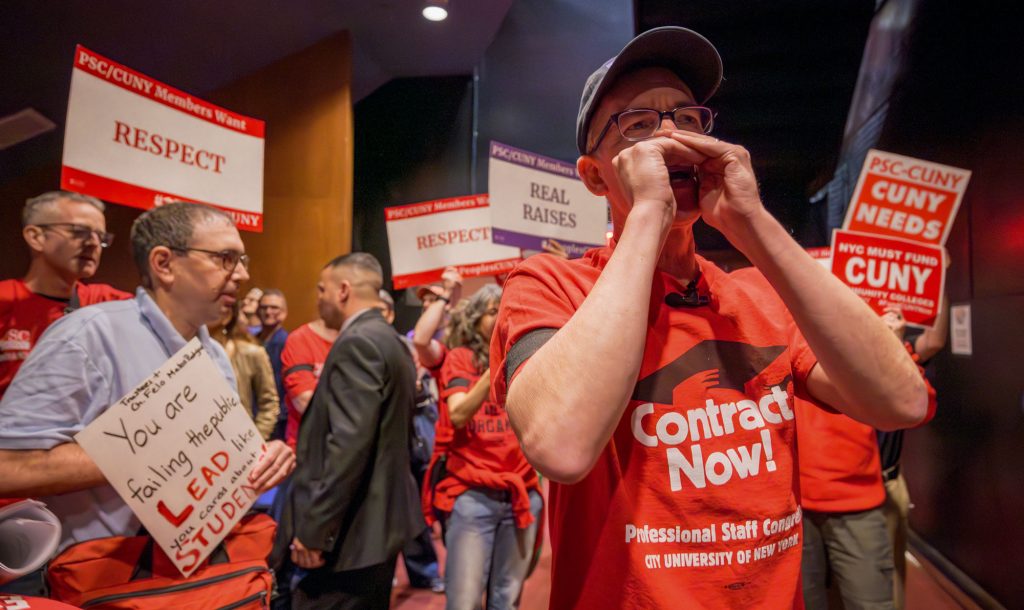
The union fought to improve post reassigned time in the last contract fight. PSC President James Davis leading a contract demonstration in 2024 (Credit: Erik McGregor)
For that reason, it was vitally important that, starting in 2020-2021, the PSC secured a contractual entitlement to six hours of reassigned time to be taken in the first three years after receiving tenure. Heading back to the bargaining table for the 2023-2027 contract, PSC leaders understood that still more was needed for post-tenure faculty. The union’s bargaining team pushed for and won additional support. It was an uphill struggle, but a pilot program was developed to ensure that even beyond the first three years after receiving tenure, professorial faculty could apply for and receive reassigned time to advance toward promotion and professional achievement.
As a result, in the first year implementing this pilot, 79 tenured assistant and associate professors will receive release from some of their teaching responsibilities to pursue research, scholarship and creative work in 2026-2027. They represent a broad range of campuses and disciplines, with approximately two thirds of applicants coming from a senior college and one third from a community college.
The pilot program stipulates that post-tenure senior college faculty are eligible to receive up to 3 hours of reassigned time and post-tenure community college faculty are eligible to receive up to 6 hours. This reassigned time is above and beyond the contractual entitlement to 6 hours within one’s first three years after receiving tenure, provided in Article 15.1.
The same review committees that consider applications for PSC-CUNY Research Awards are responsible for reviewing applications to post-tenure reassigned time under the new pilot program. Priority is given to applicants whose time since receiving tenure is longest and whose proposed projects are deemed meritorious. A broad range of applications were submitted from both community college and senior college faculty, the diversity of disciplines was also broad, and the rate of approval was extremely high.
“I was awarded three hours of post-tenure reassigned time for the 2026–27 academic year, which I’ll be using to pursue a new direction in my research,” said Christina Hagedorn, an associate professor of English at the College of Staten Island. “Much of my pre-tenure work focused on understanding and characterizing speech disorders, and I’m now starting to build on that work in a somewhat different direction, focused more on developing new technologies that can ultimately be used in treatment. Getting a new line of research off the ground takes a significant amount of time and focused attention, which can be difficult to find alongside teaching, mentoring, and service. Having this reassigned time gives me an opportunity to fully invest in that next stage of my work. I think this was a particularly valuable addition to our last contract, and I’m very appreciative of the bargaining team’s work in securing it. Post-tenure reassigned time is a great example of how contractual gains can make a meaningful difference in faculty members’ work. For me, that means having dedicated time to develop a new direction in my research.”
The PSC extends thanks to our members serving on PSC-CUNY Research Award disciplinary review committees for their hard work. We expect the success of the pilot program to yield excellent progress for the reassigned time recipients, and we hope the university and union will expand and codify post-tenure reassigned time in the next round of bargaining as a critical support for all mid-career professorial faculty.