The union’s Immigrant Solidarity Working Group (ISWG), established soon after Donald Trump’s re-election, is focused both on the national struggle against anti-immigration policies and on protecting vulnerable members of the CUNY community. About a third of CUNY’s undergraduate students are foreign born, and many more come from immigrant households.
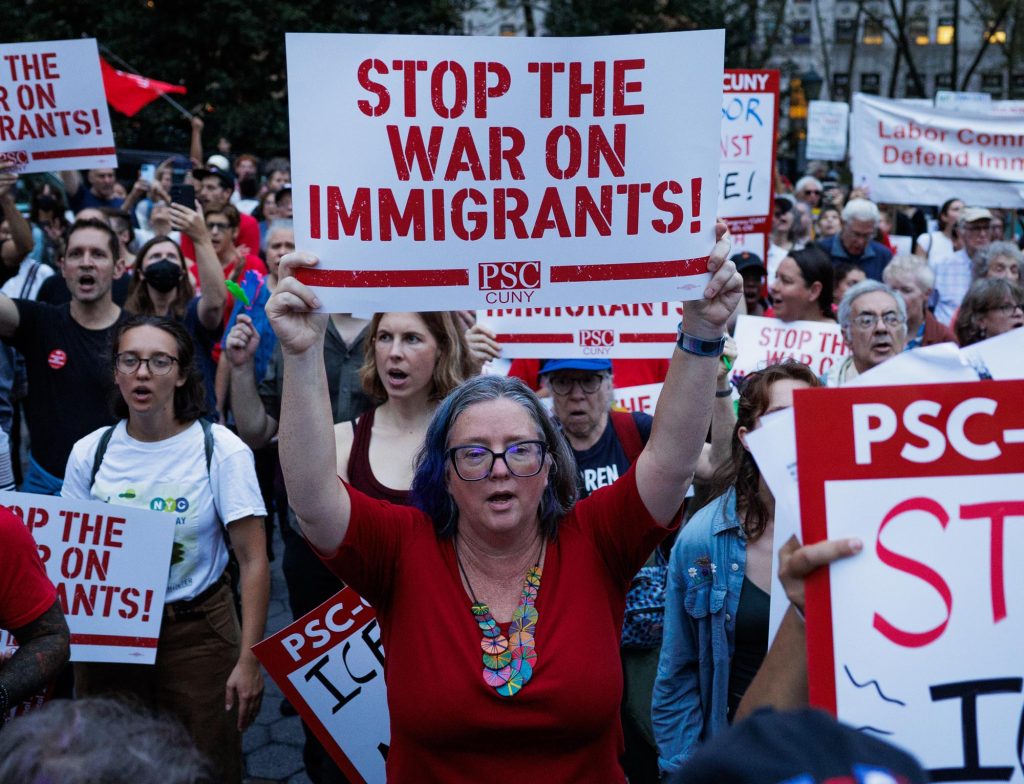
The PSC is organizing for immigrant resources on campus (Photo: Paul Frangipane).
That’s why PSC Secretary Andrea Vásquez said the group was shocked at the relative lack of funding for CUNY Immigrant Student Success Centers–campus-based offices that offer an array of services, including academic support, visa assistance and emergency aid. Only four CUNY colleges currently have fully staffed and resourced centers: Brooklyn, John Jay, Hunter, and City College. LaGuardia Community College recently opened one and the Kingsborough Community College president announced that the administration there plans to open a center. Another three colleges–Guttman Community College, Queens College and Baruch College–have under-resourced, understaffed Immigrant Student Initiatives, and the others CUNY colleges have “liaisons”– members who volunteer to meet some of the needs of these students but often do this work in addition to their regular duties, according to Vásquez.
The centers offer a “safe space intentionally created to help immigrant and first-generation students,” said Jesús Pérez, founding director of the Immigrant Student Success Office at Brooklyn College, who added, “We don’t simply provide resources, we walk alongside our students.”
“It’s one holistic approach,” he said during a mass meeting of PSC immigrant justice activists in August, where centers offer: “immigration legal services with CUNY Citizenship Now!, financial support, academic mentorship with faculty,” as well as mental health and wellness resources, “and community building and career support.”
Recognizing the urgency of addressing immigrant students’ needs, the ISWG felt that CUNY could not delay any longer in establishing Immigrant Student Success Centers on each campus. “We advocate strongly as a union that honors the lives of our students and respects the time, work, and concerns of our members,” Vásquez said.
In Spring 2026, the PSC launched a petition campaign that calls on the central administration to “Immediately hire two permanent full-time staff members on every campus whose jobs are solely to support immigrant students” and “Establish an Immigrant Student Success Center on all campuses that do not already have one with their own dedicated space.” The member-led, student-supported drive for these centers has been gaining momentum. Rank-and-file members and PSC leaders have tabled on their campuses to gather signatures, testified at CUNY Board of Trustees hearings, spoken up in labor-management committee meetings, organized protests, and spread awareness about the issue to faculty, staff and students. So far, the union has collected more than 3,000 signatures.
But it’s not just about getting the signatures. Vásquez said the passion and dedication members are bringing to the petition drive are increasing union participation generally. The Trump administration’s brutal immigrant round-ups have inspired hundreds of members to become active, some for the first time, by joining the union’s efforts to defend immigrant students and communities. “Members want to do something that will make a difference.”
At the August mass meeting, Domino Charlier Juste, a student at Hunter College where students have collected hundreds of signatures, said getting students to sign the petition has been easy. When activists explain to a fellow student what the petition is for, “that person grabs the clip board, starts signing, no questions asked,” adding that “90% of the time, people sign.”
Mirka Cuapio, a John Jay College graduate, said that she first connected with the center as a student and was able to “access support and resources that helped me navigate college as an immigrant and undocumented student,” later becoming a peer advocate fellow at the center, working “with undocumented and immigrant high school and college students through one-on-one advising, workshops, outreach, and connecting students and families to resources.”
She told Clarion, “These centers are important because immigrant and undocumented students are navigating more than just academics. They may be dealing with immigration concerns, financial barriers, family responsibilities, and uncertainty about their future. Having a space where students feel understood and can access resources without having to explain their circumstances is incredibly important. These centers provide not only information, but also community, belonging, and advocacy.”
Geoff Johnson, a CUNY Start instructor and adjunct lecturer in history at the College of Staten Island, said, “It’s frankly shameful that every CUNY campus does not have an Immigrant Student Success Center. Such centers should have already existed, and it’s past time to make it happen. At most campuses, including at the College of Staten Island, full-time staff who already have more than enough on their plates volunteer as ‘immigrant liaisons’ to fill the gap from the absence of a dedicated Immigrant Student Success Center.”
He added, “when tabling we’ll talk with immigrant students who describe their desire to have a specific office—a ‘safe space’ in a sense—where they can get answers to their questions and support specific to their needs. I see the drive for centers as: One, a campaign with overwhelming support from the CUNY community. Two, speaking to a very real need. Three, a campaign that we can win.
There have already been successes. Robert Cowan, a professor of English at Kingsborough Community College and an ISWG leader, lobbied hard on his campus during the last academic year and raised the need with the college president at Labor-Management Committee meetings. The advocacy eventually paid off. “The result is that our center will be opening with a physical space, a website, and a staff person,” Cowan said. “Our new center will apparently provide mental health and wellness support, career opportunities for undocumented students, scholarship information, and help navigating higher ed for first-generation college students.”
Cowan said he met recently with the administration and was informed that a director for the center had been identified. The college administration is applying for grant money for the center and the administration was looking at other CUNY centers like the one at Brooklyn as models, he said.
He added, “As for exactly what programming the center will have each month, that will be determined to a large degree by what students want.”
But more needs to be done system wide. José Miguel Martínez-Torrejón, the director of the Catherine of Bragança Center for Portuguese Studies at Queens College, earlier this year testified to the CUNY Board of Trustees about the lack of staffing at his campus. “How come CUNY does not prioritize student services and in particular immigrant student services? Where is our mission going in this city and this borough?”
Part of the problem, as Vásquez sees it, is that CUNY Central has required the individual colleges to use their local budgets to fund on-campus success centers. There must be a CUNY Central plan to ensure all campuses have these resources, she said. “‘A degree for every dream’ is CUNY’s inspiring slogan. Centers on every campus will help students to fulfill those dreams.”
For people like Cuapio, funding these centers is imperative.
“CUNY should fully fund these centers because immigrant and undocumented students are an important part of the CUNY community, and access to support should not depend on which campus a student attends,” Cuapio said. “Fully funding them means investing in centers and funding dedicated staff that can provide specialized support around immigration, financial aid, resources, and student well-being.”