Brooklyn College can and must decarbonize. Administrators and union activists have outlined an ambitious plan to do just that–and the college has adopted it.
During a panel discussion at the college on October 20, Carrie Sadovnik, the director of sustainability at BC, laid out the problem. The sprawling campus takes up 35 acres, nearly 2 million square feet. Its 15 buildings require a lot of heating and cooling.
“We’re energy hogs,” she said. “We’re using a million metric BTUs. Let’s just say about half of NYU Langone’s consumption.”
Worse, the college relies on four boilers and five chillers that are “fossil-fuel hungry,” running on steam and natural gas. But there is good news: these systems are at the end of their lives and need replacing.
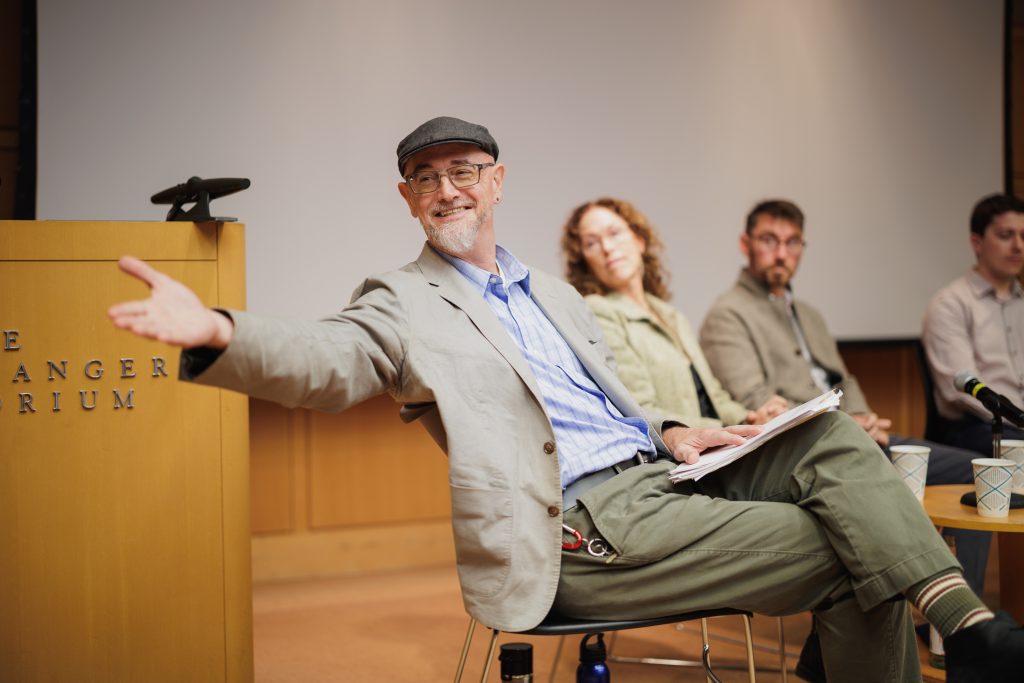
Michael Menser: “This decarbonization project will make us a university leader in renewable energy” (Photo: Paul Frangipane).
“That represents a significant opportunity,” Sadovnik said.
She and other experts at BC are moving forward with a plan to build a new wastewater energy transfer system that can dramatically reduce the college’s energy consumption.
“We have wastewater that is available to us either on campus or nearby,” Sadovnik said, noting that this circulating water could be used for heating. The college will access much of the water it needs through the Metroliptan Transportation Authority (more on that in a moment). “That would help to bring heat and cooling to our buildings.”
She added, “This is a generational opportunity.”
Monty Graham, assistant director of energy at CUNY, said that using these technologies to decrease the campus’s carbon footprint would have an enormous impact. Brooklyn College’s winter-time heating accounts for “18 percent of total case use” of natural gas at CUNY. “Until we meet this problem head on we can’t meet” other CUNY decarbonization goals, he said.
The popularity of wastewater energy recapture is growing and showing positive results for decarbonization, the National Association of Manufacturers reported.
“This is huge,” Sadovnik told Clarion, noting that when implemented this plan to use MTA-linked wastewater could see a 14% carbon reduction in the first five years.
So what’s the catch? Money. Sadovnik was pleased to announce that the BC leadership was dedicated to implementing this plan. “This first phase has been funded by the New York state green bond passed a couple years ago,” said the panel moderator, Michael Menser, associate professor of philosophy at Brooklyn College and a faculty member of the schools’ Urban Sustainability Program. But the plan is being implemented with the assumption that long-term funding will be secured in the years to come, Sadovnik explained. Practically speaking, what that means is that CUNY advocates will need to continue to push the state to increase funding to CUNY’s capital budget.
So how does the MTA fit into all of this? Alek Gulkewicz, senior climate planner at the authority, explained how the New York City subway already moves a tremendous volume of water to keep the underground system dry, and has plans to use that water to cool stations in the summer. But it can also link the water lines to nearby institutions to help heat and cool other buildings. And lucky for Brooklyn College there is a major MTA-managed water source nearby. The two institutions can work together to remove ground water and runoff from the subway and recapture the energy in that water to reduce carbon emissions while maintaining comfortable temperatures.
“Brooklyn College was named one of the most polluting public facilities in New York state in terms of fossil fuel emissions,” Menser said. “This decarbonization project will make us a university leader in renewable energy by switching us off polluting fossil fuels and electrifying energy intensive systems, but also crucially, upgrading our campus thermal energy network and heating and cooling system by integrating both geothermal and waste heat from the adjacent subway line. This will cut energy costs and make our campus and the surrounding neighborhood more resilient. This shows the public sector can innovate and lead and act at scale, and produce broad public benefits and enhance resilience.”
Menser, who is also the co-director of the Graduate Center’s NYC Climate Justice Hub, added, “Going back to the 2010s, faculty, students and staff have been pushing for renewable energy projects on campus to reduce emission and both benefit the campus and make the surrounding community more resilient.”
The announcement at BC was the result of a group effort, Menser noted. “I was involved in the initial conversations of the Building Public Renewables Act with DSA Ecosocialists, which called on the NY Power Authority to support and work with public institutions to decarbonize buildings and the grid,” he said. “And led by the PSC Environmental Justice working group and Public Power NY, we held town halls, testified at hearings, educated our campuses and the public on this issue. We called on elected officials to step up, and our own administration to support CUNY Central’s efforts to make this happen.”
Nancy Romer, co-chair of the PSC’s Environmental Justice Working Group, praised the announcement, saying “the Brooklyn College faculty, staff and students deserve the greatest praise for organizing for this.”
Romer, who is a retiree member of the PSC executive council, noted, “The EJWG organizing, with ongoing active support from PSC leadership and membership, as well as political support from NYSUT, has made ‘decarbonizing CUNY’ into an ongoing campaign with results.”
She added, “Now we join our allies in continuing to expand renewable energy at CUNY and all public buildings in New York state. The EJWG, Health and Safety Watchdogs and PSC at large are working with the Green Healthy Schools campaign to clean up toxins and transform heating and cooling systems in NYC K-12 schools and city-funded CUNY community colleges.”