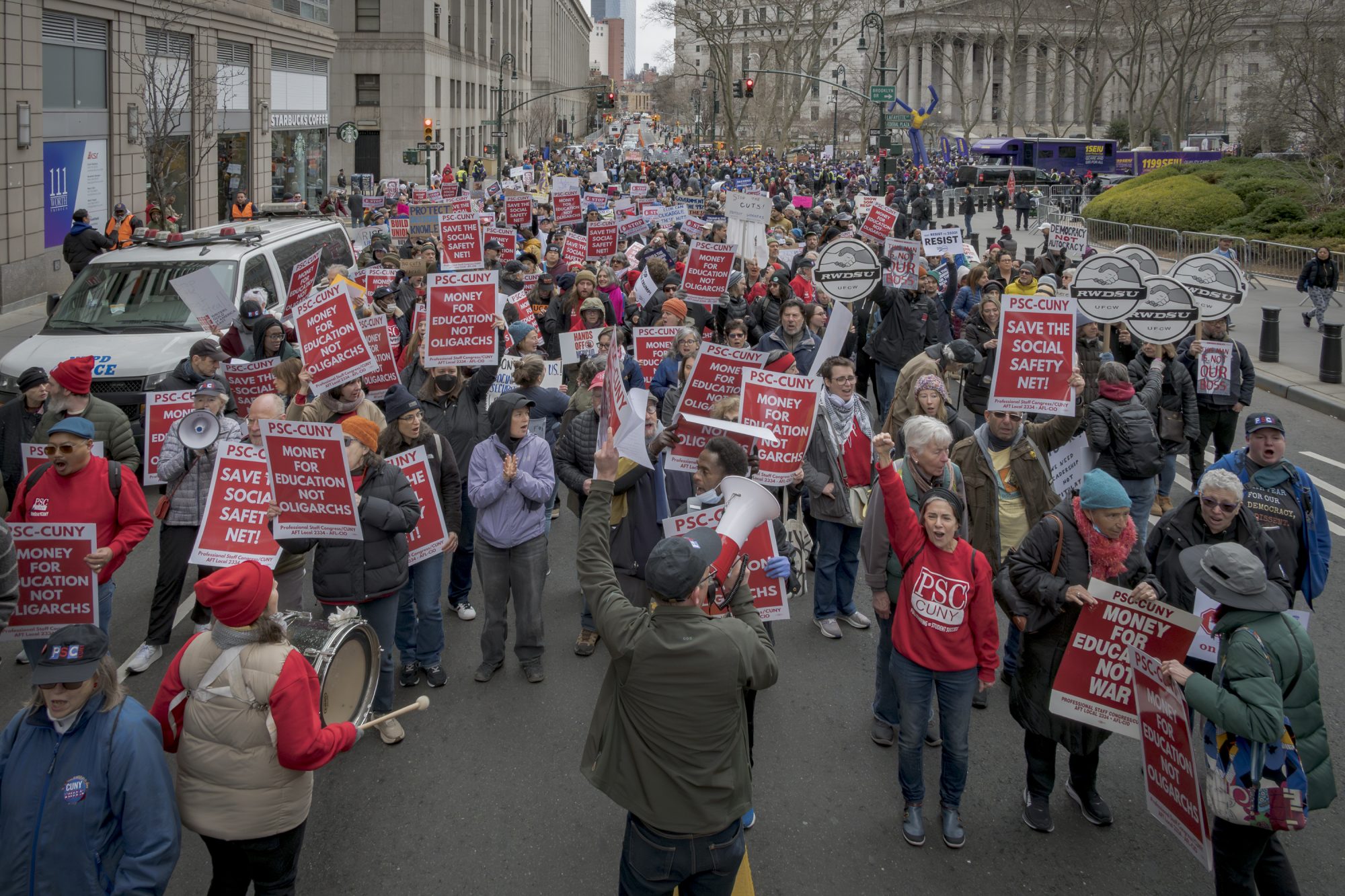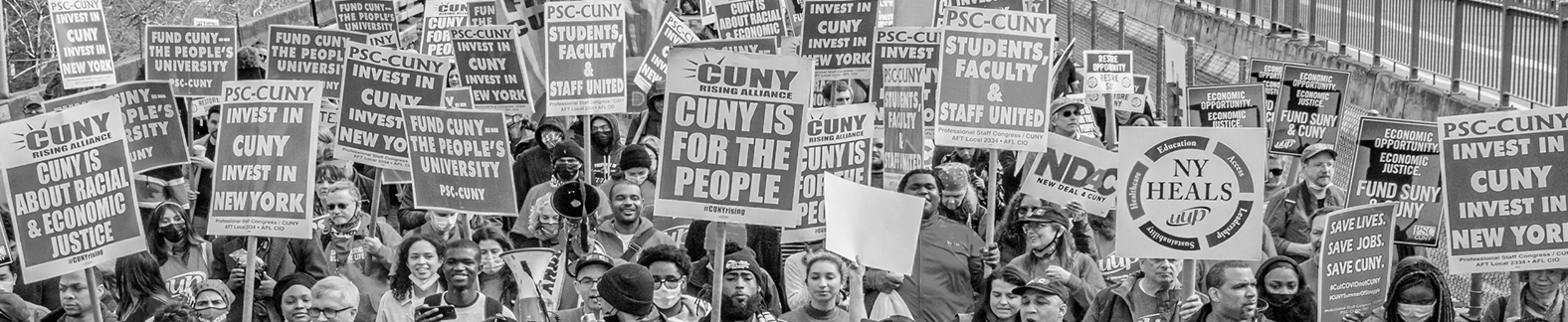
Late adjunct pay is a perennial issue at CUNY–and the PSC will not allow management to treat it as business as usual.
The union has blasted administrators for allowing pay delays for adjunct faculty around the university this semester. “Nearly 200 adjuncts and part-timers have filled out the Part-time Workplace Complaint Form around late pay or other pay problems and course cancellations,” said Lynne Turner, PSC vice president for part-time personnel, in an email to members. And those are just the cases of late pay the union knows about. PSC members have taken to campus quads and the CUNY Board of Trustees (BoT) hearing to say: “Enough is enough–pay us, now.”
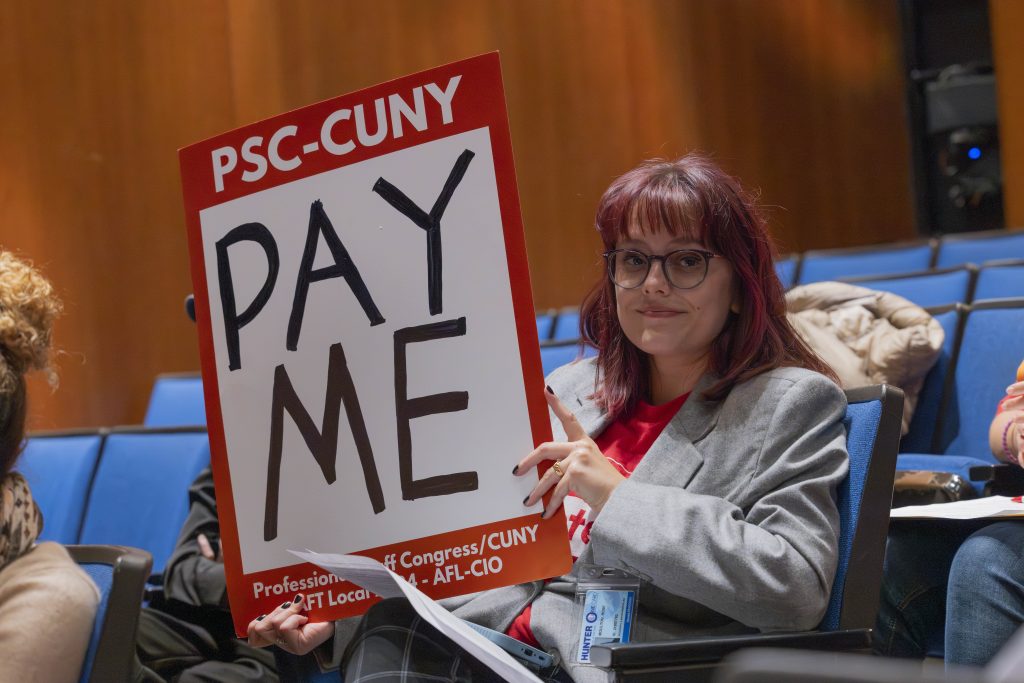
Rose Shelor Moulton and other adjuncts have a simple demand (Photo: Gina Randazzo).
Adjuncts have protested pay delays in the past–more than 1,000 part-time instructors experienced late pay in the past two academic years, union research showed–but the fact this continues to be a problem at CUNY makes it all the more damning from the perspective of adjuncts who rely on this pay to live. During the board hearing October 19 at John Jay College members and advocates spoke about the problems they had encountered.
Juliana Nalerio, an adjunct assistant professor teaching history at City College and Queens College, said these late payments make life worse for adjuncts–and financial life is already bad. She said she has had to rely on Medicaid and food stamps and has delayed retirement savings just to keep going.
“At CUNY, contingent faculty and staff face unpredictable semester gaps, drawing down personal savings, incurring late fees when payroll slips, and absorbing sudden course cancellations with zero compensation for weeks of preparation,” she said in testimony read on her behalf by a PSC organizer at the BOT hearing.. “This financial volatility harms instructor retention and disrupts the continuity our students need.”
Rose Shelor Moulton, adjunct lecturer at Hunter College in the geography and women and gender studies departments, testified that she has been drastically underpaid. “I am owed $13,000 by CUNY,” she said. “No one has ever owed me that much money.”
This debt exists, she said, because her paychecks were missing the jumbo course differential she is contractually owed. “We have not received any of this money,” she told the board. “I have two small children. I have had to put childcare bills on my credit card because I did not have this money to pay the bill that was due in July. I should have been able to pay the daycare their fee in the summer prior to the year starting, but I could not.”
She added, “My five year old daughter told me to tell you, ‘Pay my mom.’”
Members in the audience chanted “Wage theft is a crime, pay your workers on time!” as other members and supporters yelled “shame” to the assembled CUNY administrators on stage as adjuncts testified about late pay.
Kate Peters, an adjunct lecturer in English at Hunter College and other CUNY campuses, testified about her Kafkaesque nightmare of being volleyed between offices and she tried desperately to find an administrator to fix her pay delay. “The back and forth continued. I sent five emails before I was provided with the exact date of the pay period,” she said, “which was the seventh week of the semester.”
Widespread late pay reveals management’s callous disregard for adjuncts. Despite the pay gains and job protections the PSC has won for them over the years, adjuncts are still the most precarious faculty at CUNY. Many are cobbling together a living with multiple courses. They need their paychecks. Pam Stemberg, a part-time personnel officer on the PSC Executive Council, told the board, “You’re running a temp agency, and you won’t acknowledge it.”
Other audience members hissed at the board when adjuncts testified about their financial struggles. “Where is the urgency to make sure your employees are taken care of,” said Jonathan Halabi, an adjunct lecturer and PSC alternate delegate at Queens College, in his testimony. “I think there’s something wrong here.”
PSC President James Davis addressed the issue of late pay to CUNY Chancellor Felix Matos Rodríguez in a letter on September 10. “Your administration must make timely adjunct pay a priority,” Davis said. “You can improve hiring practices, resolve technical issues, and push college payroll offices and deans to treat adjuncts with more respect. You can hire more administrative support for departments and department chairs, and fight for increased funding for full-time positions, ending the University’s reliance on a permanently contingent workforce. ”
On September 16, Kenneth J. Godiner, CUNY’s senior vice chancellor and chief financial officer, replied in writing, “CUNY has been working for some time to alleviate this recurring problem. As a result of these efforts, the number of adjunct faculty who were not paid on time was smaller than in the previous year. However, this reduction still left hundreds of adjunct faculty, unacceptably, without timely first paychecks.”
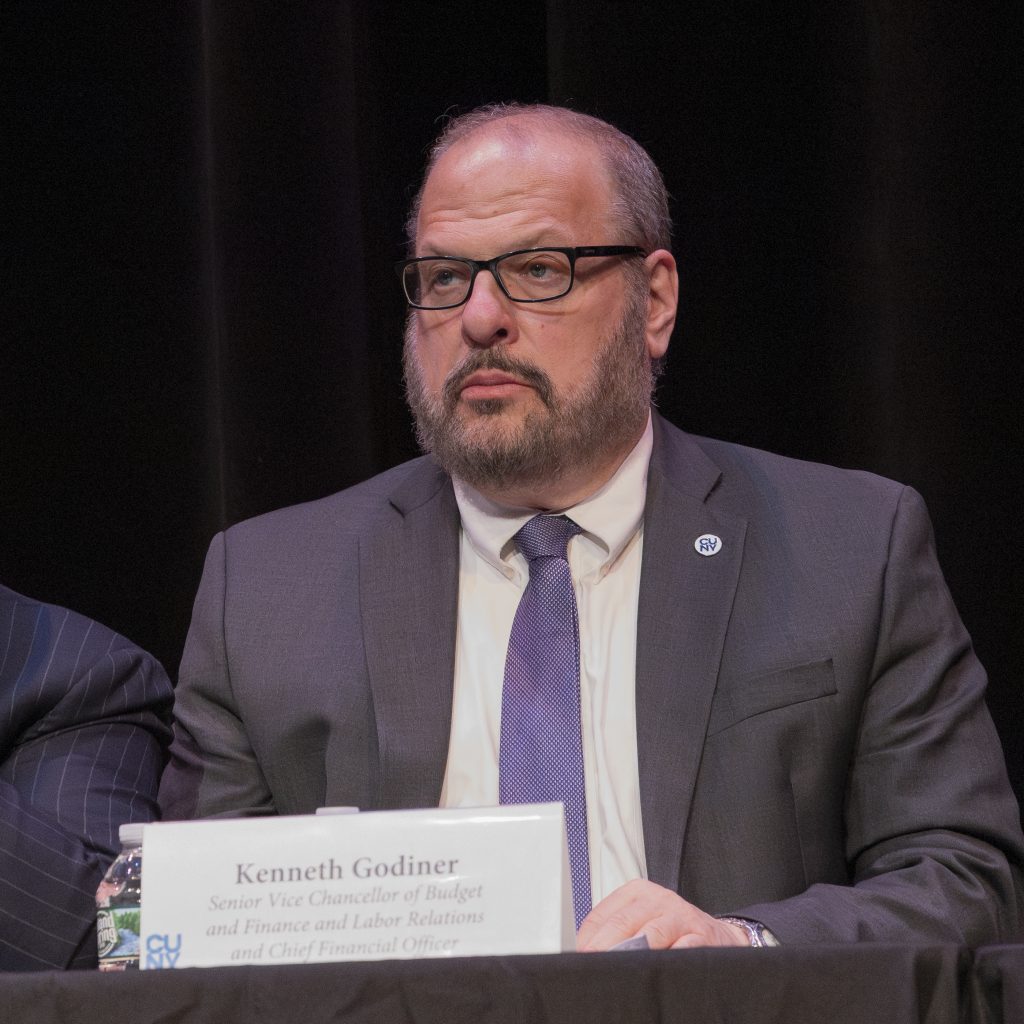
Full-timers and part-timers believe Kenneth J. Godiner, CUNY’s senior vice chancellor and chief financial officer, is trying to pit members against each other (Photo: Gina Randazzo).
He continued, “Reviewing the remaining causes of delayed first paychecks, CUNY discovered that the principal cause of delayed payroll starts is the late submission of required paperwork by department chairpersons. To address this, we are rolling out a communications plan beginning next semester to improve performance in this area. Under the plan, campus HRDs will remind chairpersons of the importance of the timely submission of the required information to onboard their adjunct faculty. We will follow this up with communications from campus provosts and finally, a communication from the college presidents to stress the importance of getting adjunct faculty paid on time.”
Godiner said, “Where delays still occur, we will be encouraging chairpersons to inform adjunct faculty members who are not on the payroll of the procedures for requesting emergency payments.”
Turner rejected this response in her email to members. “In his letter Godiner shirks placing responsibility on CUNY administration for the systemic practice of late payments by shifting the blame to department chairs,” Turner said. “We of course reject this divide and conquer approach in favor of cross-title solidarity.”
David Gerwin, the education department chair at Queens College, testified that any late action by department chairs is not the result of their inability to fulfill their duties, but of poor management, understaffing and unpredictable funding–all of this is the administration’s doing. “I want to be clear about where the problem lies, and it is not with department chairs,” Gerwin said. “And I want to say explicitly that Senior Vice Chancellor Kenneth Godiner might be correct to say that chairs submit paperwork late, but he is wrong to blame us. CUNY creates the conditions that lead to late submission.”
In her testimony, Turner called for action.
She said, “We call on CUNY to: Share data regarding the ‘hundreds of adjuncts’ it acknowledges are paid late each semester. Ensure all CUNY campuses adhere to policies around provision of emergency checks and support letters. We want a meeting with adjuncts, department chairs and higher education officers from our union and Senior Vice Chancellor Godiner to discuss how you will fix this issue. The bottom line is that CUNY must pay adjuncts on time and take responsibility as our employer. If there are delays in onboarding, make sure campuses are equipped to provide payroll up front and get reimbursed by the city or state.”
Turner added, “CUNY must end its ‘gig academy’ business model. No more late payments. We want stable pay, stable jobs, stable lives.”
Nalerio also offered suggestions: “Automated Emergency Payroll: Issue immediate emergency checks whenever onboarding processing lags behind semester start dates” and “Course Cancellation Protection: Guarantee baseline compensation if an assigned course is canceled right before the term begins.”
In fact, according to an April 26 memo to CUNY’s human resource directors from the executive director of CUNY’s payroll office, Jeffrey Ratliff, “In the event a teaching adjunct does not receive one or more installments on a scheduled date or dates, Campus Human Resources staff must process an adjustment for the next pay date for the entire amount of back pay due and the college must notify adjunct faculty members of the availability of an emergency check.”
But PSC members were not made aware of this option. Union sources said that from the survey of adjuncts who have missed paychecks only 1o people were reportedly offered an advance and 46 said they did not know these funds were available.
Other CUNY leaders are responding to union pressure about the pay delays. Before Bronx Community College faculty and staff rallied on campus to protest the delays, BCC President Larry Johnson vowed to take action in an October 5 letter to the campus community.
“I want to acknowledge plainly that this is unacceptable. Employees who have performed their work should be able to depend on receiving their compensation accurately and on time,” he said. “To every colleague affected: I recognize that behind the words ‘payroll delay’ is a person, a family, and obligations that continue regardless of an administrative process. I am deeply sorry for the disruption and frustration this experience has caused.”
Johnson reported work was being done to rectify the problem, saying, “Available checks have been distributed, unresolved cases requiring University action have been escalated,” and “Each identified case is being reviewed individually to determine its status, required action, and path toward resolution.”
Peter Kolozi, a professor of political science at BCC, said the president’s message about the pay delay was significant–it was a sign that PSC pressure on the issue was having an impact on CUNY management.
“He is not completely passing the buck. His framing of this as family… and acknowledges that it impacts human individuals and is unacceptable,” he said in an email to PSC organizers. “it is important that we hold him accountable for what he wrote here. But it is significant that, for the first time that I can remember, a college president sent such an email to the campus community. Our pressure campaign of emails to the president, the rally, the list of demands, and the fact that the rally was well attended is paying off.”
Alex Wolf, a professor of biological sciences at BCC and the PSC chapter vice chair, welcomed the letter but insisted the chapter and the union as a whole needed to see systemic actions to put an end to pay delays.
“Talk is cheap,” he said.