The CUNY Board of Trustees is considering changes to how it conducts presidential searches. A new proposal before the board would allow the board chair to appoint presidential search committee members with little or no connection to CUNY.
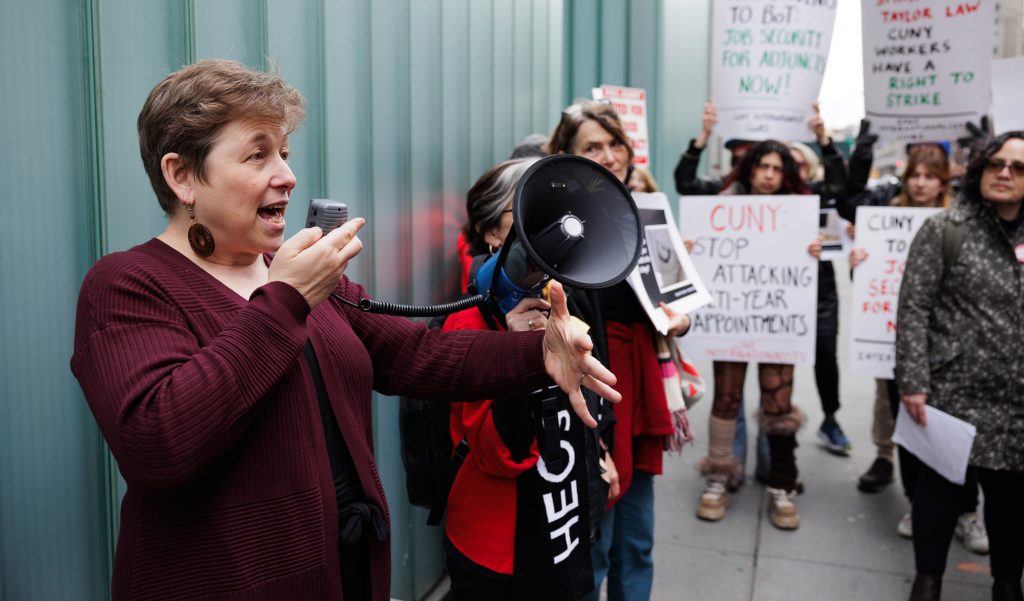
Sarah Chinn of Hunter College raised concerns about the new plan (Photo: PAUL FRANGIPANE).
The PSC is concerned to say the least.
Current CUNY policy allows the board chair to appoint up to five trustees, including former trustees, to serve on a search committee along with a mix of faculty, students, alumni, and other stakeholders.
The resolution, already approved by the board’s governance committee, says the chair’s appointees “may but need not be current and acting members of the Board of Trustees, and may include non-Trustees, former members of the Board of Trustees, and affiliates of the University.” It goes on to say that, “Such affiliates may include, but need not be limited to, individuals who serve as an officer or member in a non-profit corporation, educational organization, or other…higher educational association, aligned with or supportive [of] the mission of the University.”
In a letter to Board Chairperson William Thompson and the members of the governance committee dated October 2, PSC President James Davis flagged concerns about the policy change and insisted on a meeting to “discuss the matter and urge withdrawal of the item.”
“The proposed changes include substituting up to five ‘individuals’ for any or all of the positions currently reserved for the Trustees,” Davis said. “Such individuals need have no relation to the college for which the presidential search is conducted, nor to the university. Indeed, they need have no track record of public higher education service whatsoever.”
Davis also noted that much of the language in the proposal, which is expected for final vote by the board on October 26, made little sense. “The changes as written are dangerously incoherent,” he said.
“What is an independent, outside member of the University?” he asked. “Is the eligibility of an affiliate determined by whatever their organization is ‘aligned with or supportive [of] the mission of the university’? If so, why does the proposed revision unwind this criterion by stipulating that affiliated ‘need not be limited to’ organizations with ‘aligned’ and ‘supportive’ qualities?”
Davis warned of a perilous road ahead.
“[T]he proposed revision threatens to severely attenuate the relationship between search committee members as stakeholders in a college for which they are recommending a presidential appointment,” Davis said. “This strikes me as ill-advised and susceptible to abuse, and I strongly recommend that it be reconsidered.”
Sarah Chinn, a professor of English at Hunter College and a CUNY faculty senator, served on the search committee for the current president, Nancy Cantor, in her capacity as the chair of the Hunter College Senate. “It seems very sketchy to me,” she said of the proposed change. “How does it improve the process?”
Chinn explained that in her experience a search committee involved faculty, another CUNY president, students, trustees, and others. “What I liked about the search process was that the committee was really evenly divided,” she said. “You want someone who is a college president who understands what it requires. You need faculty because they work so closely with the president, and students are the reason why we are doing what we do. Every single member is there for a really good reason.”
Adding these outsiders appears to be a “solution looking for a problem,” Chinn noted, saying that the board has not stated what has been deficient in the current set up of presidential search committees. “Just to have random other people who are appointed even if they have never been part of the CUNY system in any way, it just seems like a recipe for injecting too much politics into the process,” she said.
For her part, Kerin Coughlin, chair of the CUNY University Faculty Senate, said in a statement, “We do have concerns about broadening the eligibility for search committees, which I discussed with Chairman Thompson, and which he addressed by incorporating a three-year review of the new policy to ensure it serves the best interests and mission of the University. We appreciate his doing so, we are hopeful the new policy will serve CUNY’s best interests, and we plan to monitor it to ensure that it does.”
Nonetheless, Chinn believed this expansion could lead to bad outcomes.
“We have seen how disastrous it is when people have no idea how higher education is different from the corporate world or government,” Chinn said. “If you don’t understand that you are not helping.”
Davis told Clarion he believes there may be more presidential searches being conducted now than there are trustees capable of leading and filling presidential search committees. “Several interim presidents now serve in these roles across CUNY,” he said. “However, if that is the underlying problem it’s a temporary one, and the answer is to replenish the board through a rigorous appointment process–not to supplement it with ‘outside members of the university,’ whatever that means.”