
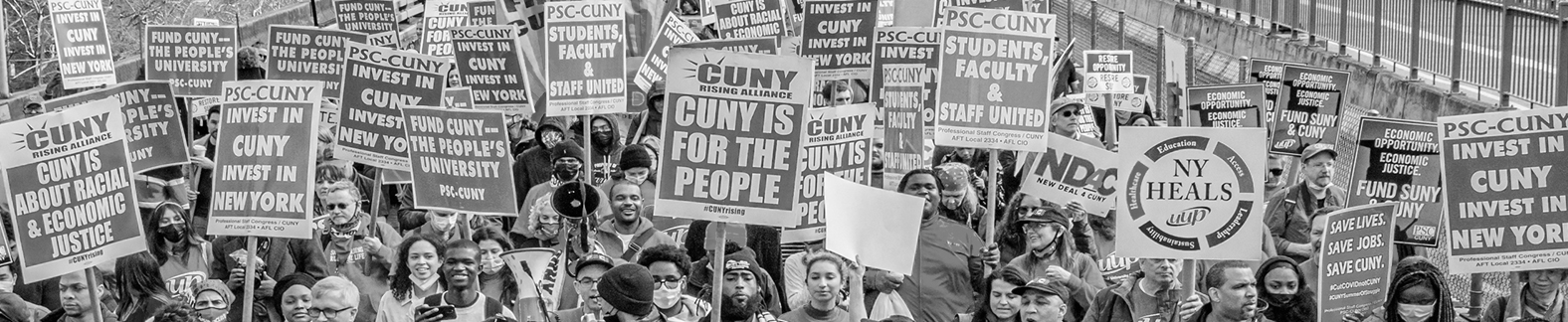
The PSC joined CUNY students, CUNY Rising Alliance, the public advocate and the chair of the city council’s higher education committee to demand a simple thing: full funding to create a CUNY for All.
On the steps of City Hall March 17, the group demanded that the city and state budgets include full funding to make CUNY free, modernize CUNY infrastructure, hire more faculty and staff and subsidize free OMNI cards for CUNY students.
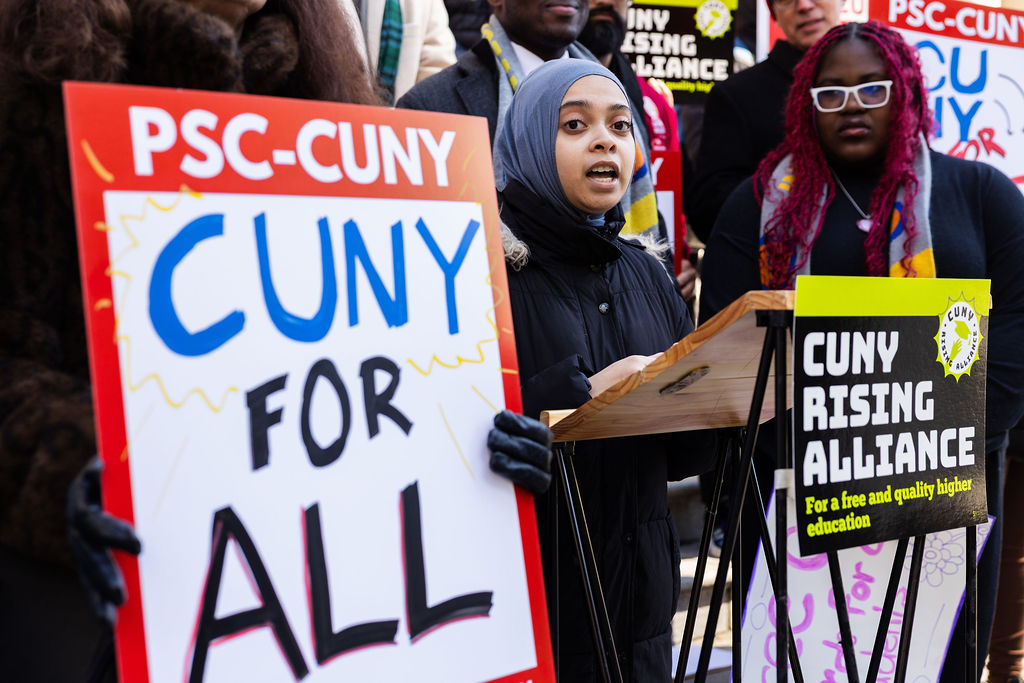
CUNY Rising Alliance Coordinator Zaakirah Rahman at the press conference (Credit: Paul Frangipane).
CUNY’s senior colleges and professional schools are funded mostly by the state. The community colleges are funded by both the city and state, with about 75% covered by the city. The CUNY for All campaign is a city equivalent to the state-level New Deal for CUNY.
“Investing in our students is investing in the future of New York City,” said Rita Joseph, the council’s higher education chair, who had previously served as the chair of the education committee.
She noted that CUNY has been an engine of upward mobility for immigrant and working-class New Yorkers. In particular, she said, programs like Accelerated Study in Associate Programs (ASAP) and Accelerate, Complete, Engage (ACE) have been vital for students to lift themselves up through the CUNY system.
“We must expand them, not cut them,” Joseph said.
PSC President James Davis said that for the third straight year CUNY enrollment has increased, particularly in the community colleges, but staffing levels have not grown along with student headcount.
Four years of budget cuts enacted by former Mayor Eric Adams have left CUNY colleges with nearly 400 unfilled civilian and pedagogical positions. Funding for these positions was restored in Adams’ final budget after years of union and coalition push-back, but CUNY management has not yet filled all of the vacancies. The PSC and allies at the CUNY for All event called on the University to hire additional faculty with the restored funds and urged city leaders to fund an additional 2900 faculty positions.
“The time is now to invest in CUNY. Our students should have the same access to full-time faculty as students at most other colleges and universities.” Davis said.
Akkeem Polack, the chairperson of the University Student Senate, said that his group was demanding the city and state fund public transit costs for CUNY students. Clarion recently ran an op-ed about the importance of funding free transit for CUNY. “For too many CUNY students, the biggest barrier to success is simply getting to class. Transportation access is not a luxury; it is a necessity,” he said in a statement. “Free OMNY cards for CUNY students would remove one of the most immediate financial burdens our students face, increase retention and graduation rates, and directly strengthen New York’s workforce.”
New York’s K-12 students receive free OMNY Cards, but CUNY students do not. As a step toward free transit for all CUNY students, the groups called on the City to provide $700,000 to fund half of a Commuter Grant Pilot Program of free OMNY cards for student parents, students with disabilities, and other high need populations. The state would pay the other half.
The state budget negotiations may conclude this month by the often-missed April 1 deadline, but the outcome of the state budget agreement will have a tremendous impact on negotiations for a city budget, which are due to conclude in the summer.
The coalition’s other city budget demands: “$11.7 million to expand CUNY Reconnect, a program that has helped 47,000 students re-enroll in CUNY; $74 million to hire 352 culturally competent advisors to achieve an advisor-to-student ratio of 1 to 100; $22 million to hire 119 mental health counselors to students to achieve a counselor-to-student ratio of 1 to 500, and $26 million to provide bridge funding to replace lost federal research dollars.”
The coalition, which also includes NYPIRG, Young Invincibles and uAspire, has other city demands as well: “$86 million to double the number of students who attend community college free and receive wraparound support services through ASAP” and “$9.1 million to expand ACE, the senior college version of ASAP” and “increased capital investment to fix CUNY’s crumbling infrastructure and update facilities.”
Public Advocate Jumaane Williams said that his office’s first major report was about the importance of CUNY for upward mobility. For him, there was no excuse for the city and state to short-change public higher education in New York City.
“During the Great Depression we found money for CUNY,” he said.
Published: March 19, 2026