Editor’s note: This story has been updated.
When William “Bill” Herbert opened his first conference on collective bargaining in higher education, he might not have realized what he was getting into. The annual conference is the event of the year for people on both sides of the labor-management table in higher education labor relations.
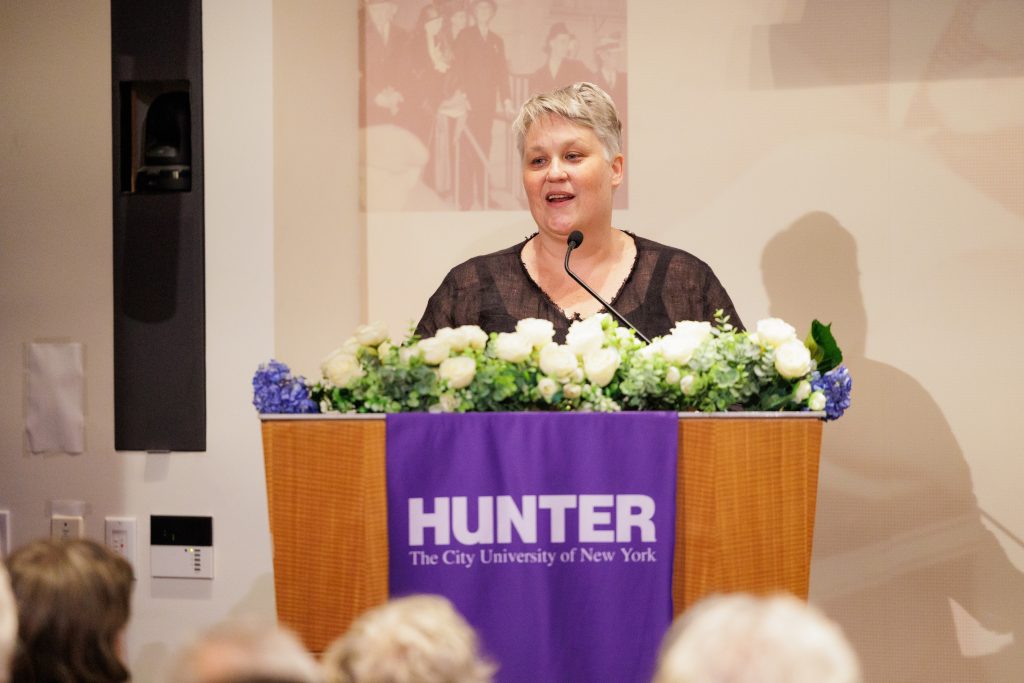
PSC First Vice President Jen Gaboury speaks at Bill Herbert’s memorial service (Credit: Paul Frangipane).
Herbert died this year at the age of 70, and the accolades for and remembrances of him have overwhelmed friends, families and colleagues. As the executive director of the National Center for the Study of Collective Bargaining in Higher Education and the Professions at Hunter College, he was renowned for his encyclopedic knowledge of the subject. At a memorial at the Roosevelt House at Hunter College on June 11, he was remembered for his attention to detail and mix of both tireless dedication to the work and passion for life outside the profession: family, music, theater and friendship.
Karen Stubaus, vice president of academic affairs and administration at Rutgers University and a member of the National Center’s board, said in the last few weeks those who knew Herbert have exchanged their tales about him. “We are collapsing in laughter and loving memory,” she said. “We all have our Bill stories.”
Specifically, Stubaus recalled how Herbert knew she was often awake well before sunrise–he would call her to talk about minute details of the upcoming conference agenda, while he was powering away on his exercise bike. “Bill worked harder than anyone I knew in my life,” she said, adding he became known for “Herbert’s hiring hall,” as he was always devoted to helping colleagues look for jobs in their field.
PSC First Vice President Jen Gaboury recalled how so many people in the world of academic labor had reached out recently to express how connected they felt to Herbert, a labor lawyer who remade himself as an academic at Hunter. The level of connectedness people felt about him, she said, proved he was not simply interacting with people around the country, “it was engagement.”
American Federation of Teachers President Randi Weingarten said Herbert’s legacy will be the National Center itself. “He helped Hunter become a foundation stone” of the academic labor movement, she said.
Jacob Apkarian, an associate professor of sociology at York College and a research fellow at the center, recalled Herbert’s “commitment to his craft,” noting that he truly believed that collective bargaining could be a “tool to achieve social justice.” More than that, he said, Herbert truly believed that in the academic realm collective bargaining didn’t need to be a struggle between two sides but a holistic opportunity for general progress. “He truly saw it as a place where collaboration could occur,” Apkarian said.
What truly impressed Apkarian was that Herbert didn’t believe any task at the center was beneath him–he was its executive but attended to clerical work and data entry like everyone else who worked there. “He got his hands dirty,” Apkarian said. “Bill is someone who thought nothing was impossible. And I saw him make the impossible possible.”
Friends and family recalled his love of music, especially Bob Dylan and Jimmy Cliff, who he looked to for political inspiration as well. Personal friend Susan Solomon noted that he was a member of John Brown Lives and made regular visits to John Brown’s gravesite in Lake Placid.
Herbert’s legacy is living on in many ways. As Gaboury pointed out, the state legislature is considering a bill that would protect academic freedom for New York faculty including adjuncts, a bill that is the result of Herbert’s research and advocacy.
According to his obituary at Hunter College, “He was a co-editor-in-chief of the treatise Lefkowitz on Public Sector Labor and Employment Law and author of articles on electronic privacy, public-sector labor law and history, card-check certification, and electronic voting. He was a fellow of the College of Labor and Employment Lawyers and the recipient of the John E. Gould Medal from the American Geographical Society.
Before joining the Hunter College faculty, he was deputy chair and counsel to the New York State Public Employment Relations Board. Before his tenure at PERB, he was a practicing labor, civil-rights, and tenant’s attorney for more than three decades. During his more than 17 years as a staff attorney for the Civil Service Employees Association (CSEA), Bill was a tireless advocate for the interests of the union’s members.”
It added, “Herbert is survived by his wife, Judith Lee; daughters Lisa and Beth, son-in-law Dan, and granddaughters Annabel and Matilda. Donations can be made in his memory to the National Center, Music Workers Alliance, Arts for Art, and Higher Education Labor United.”