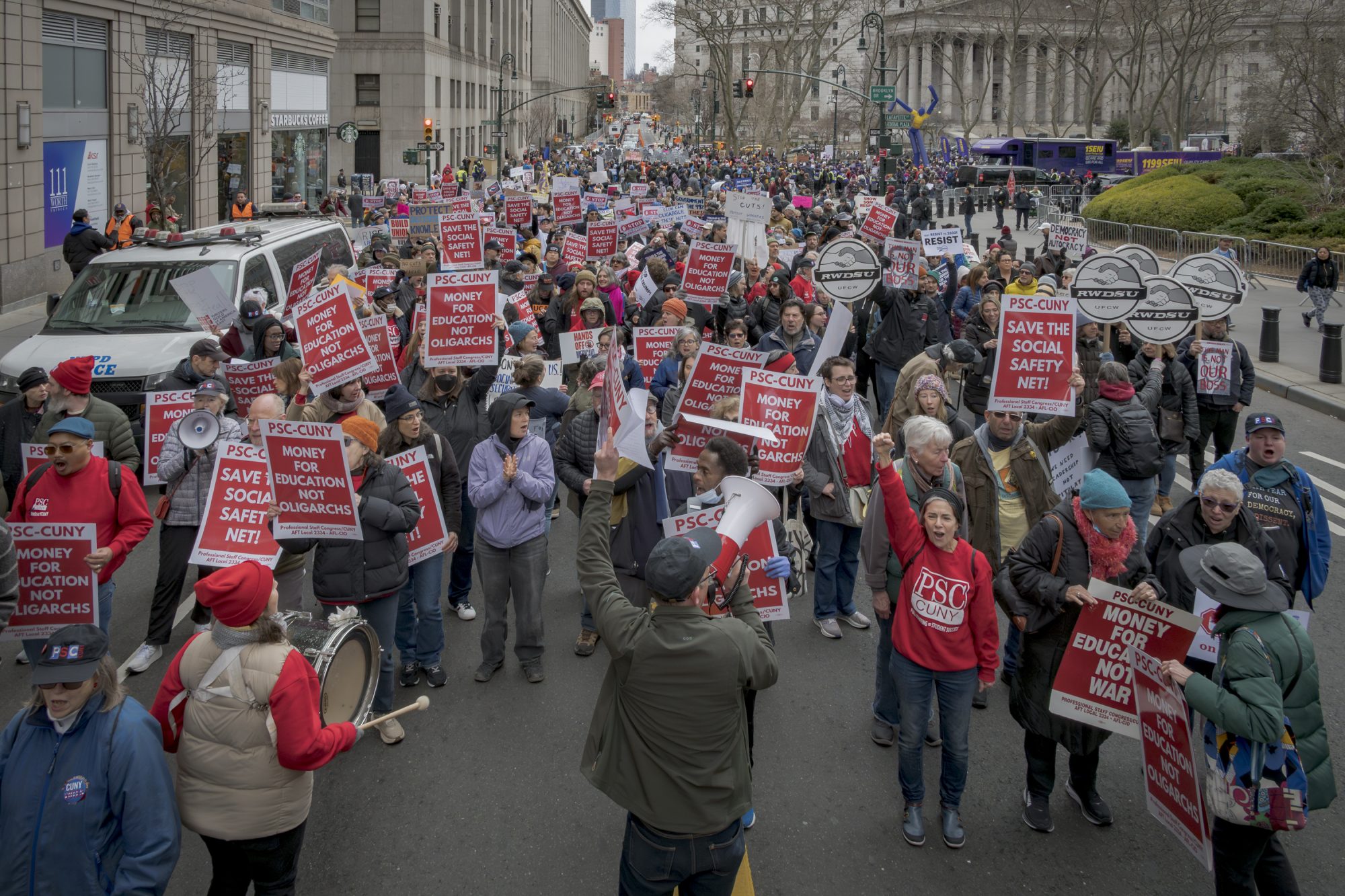
After Brooklyn College unjustly terminated employment for four adjunct instructors, the union fought back. With vigorous organizing, political outreach, grievance representation and media advocacy, the campaign for the “Fired Four” has resulted in the reinstatement of three of four–the union continues to press the case for the fourth.
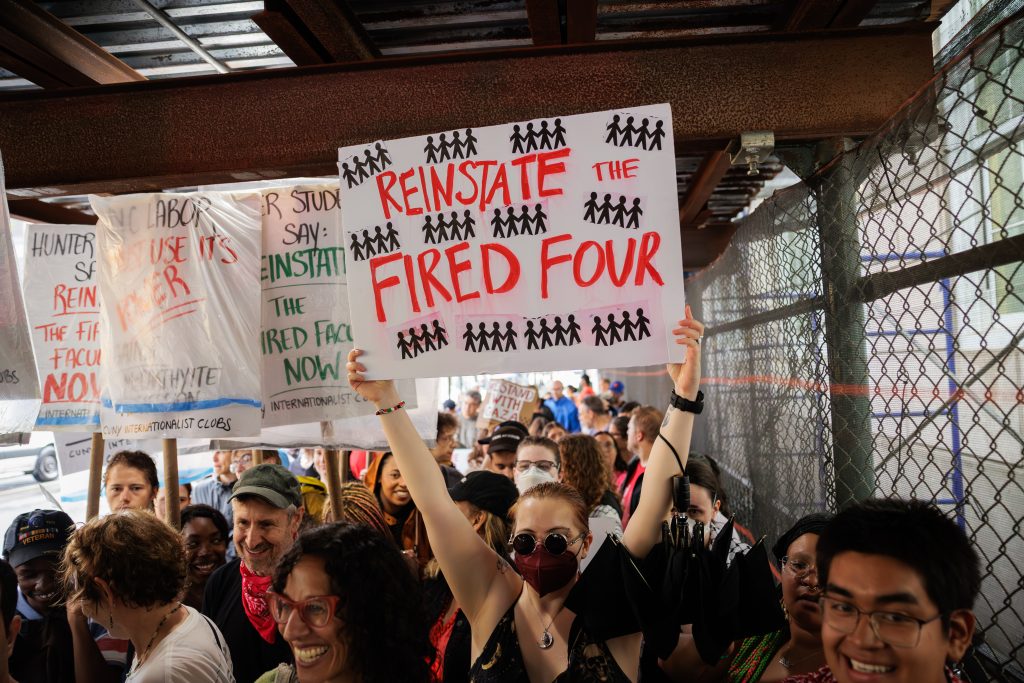
PSC members advocating for the Fired Four at Brooklyn College (Credit: Paul Frangipane).
The PSC worked not only to win their reinstatement, but to raise the alarm bell that academic freedom is under attack not just by the federal government but at CUNY campuses locally. The union’s academic freedom committee has been hard at work to organize around the issue and the Committee for Adjuncts and Part-timers has demonstrated how adjunctification contributes to the suppression of political speech on campus.
But the union has also worked with elected officials to find other ways to defend academic freedom for adjuncts and other academic workers who do not have the kinds of job protections full-time faculty have. Senator Julia Salazar and Assemblymember Diane Moreno recently introduced a bill that would enact more protections.
“Academic freedom is under attack. Four professors at Brooklyn College were fired or not reappointed due to their vocal opposition to the genocide in Palestine,” Assemblymember Moreno said in statement. “In other states, professors are being fired for teaching about gender identity or voicing support for union activity. New York needs to set a positive example, not contribute to democratic backsliding.”
She added, “We must take action to protect the right to teach and the right to learn. Without those rights, democracy does not exist.”
The idea for the bill predates the Fired Four saga, PSC President James Davis explained. The union has considered trying to win academic freedom in the law for years. Some of the conceptual work and drafting of this bill was done by Distinguished Lecturer William A. Herbert, the late executive director of the National Center for the Study of Collective Bargaining in Higher Education at Hunter College. “This is something we have been talking about,” Davis said. “It’s gratifying to see that work in print.”
The Senate bill says: “Any employee at a higher education institution in the state, covered under the definition of academic freedom…may bring an action against the employer institution in any court of competent jurisdiction for damages, including punitive damages, for declaratory and injunctive relief, and such other remedies as the court may deem appropriate.” While adjunct faculty still do not have all the job protections full-time faculty enjoy, Davis noted that this provision applies “irrespective of anyone’s job or rank,” marking “specific progress for contingent faculty.”
In addition, the bill states, “Where an employee at a public higher education institution reasonably believes dismissal or other disciplinary action would not have been taken but for a violation of such faculty member’s academic freedom…such employee may assert…a defense before the designated arbitrator. The merits of such defense shall be considered and determined as part of the arbitration award. If there is a finding that the dismissal or other disciplinary action is motivated, at least in part, by a violation by the employer of such subdivision, the arbitrator shall dismiss or recommend dismissal of the disciplinary proceeding, as appropriate, and, if appropriate, reinstate the employee with back pay.”
This would apply to union members.
Corinna Mullin, one of the “Four” who has been reinstated, said, “As one of the CUNY Fired Four, it is an incredible honor to see our collective struggle, led by the PSC-CUNY, student organizers, and the broader CUNY community, inspire the Academic Freedom Protection Act. This bill is essential to ensure that no other educator loses their job for exercising their conscience, whether in solidarity with Palestinian liberation or the liberation struggles of other oppressed peoples, speaking out against racist police violence and fascist ICE attacks on our immigrant communities, defending LGBTQIA+ rights, or organizing for union rights. Academic freedom is not a privilege; it is a right, and I urge all of my union siblings to fight for its passage.”
And Anthony Alessandrini, the chair of the PSC’s academic freedom committee, said, “By codifying the AAUP’s definition of academic freedom and insisting that these rights must be defended for all faculty, librarians, and staff, especially adjunct faculty, this bill is crucial in the fight to defend academic freedom in New York and represents a precedent that I hope will be taken up in other states as well.”
The Senate bill’s sponsor memo specifically cites the Fired Four as justification for the new proposed legislative protections. “In 2025, four adjunct professors at Brooklyn College were fired or not reappointed, despite the fact that they had received recommendations from their department heads, had positive reviews from students, and had been assigned classes to teach the following semester,” it said. “The administration offered no reason for these actions. However, the one thing in common between the four professors was their vocal support for Palestine. The firings have sparked concerns among students, professors, and activists, who worry that the school is retaliating against faculty for their protected free expression of their views.”
It goes on, “This bill is meant to codify the principles of academic freedom to afford protection to a wide range of employees at higher education institutions. By amending the education law, the civil service law, and the civil rights law, this bill will apply to all employees at higher education institutions, regardless of the nature of their appointment. The robust definition of academic freedom accounts for speech and activ- ities in and out of the classroom, so that professors may speak freely and explore controversial ideas without fear of retaliation. To enforce this definition and provide relief to employees alleging an academic freedom violation, the bill also establishes a final binding arbitration process for employees at public higher education institutions, and a private right of action for employees at all higher education institutions.”
Davis said he was glad to see the work of the union, especially for Herbert (who died in April), pay off in the form of legislation. He believed that the flashpoint of the Fired Four has rightfully made academic freedom a bread-and-butter issue for academic unionists.
“It made an abstract, esoteric idea very concrete,” Davis said. “It’s real people’s lives and jobs.”