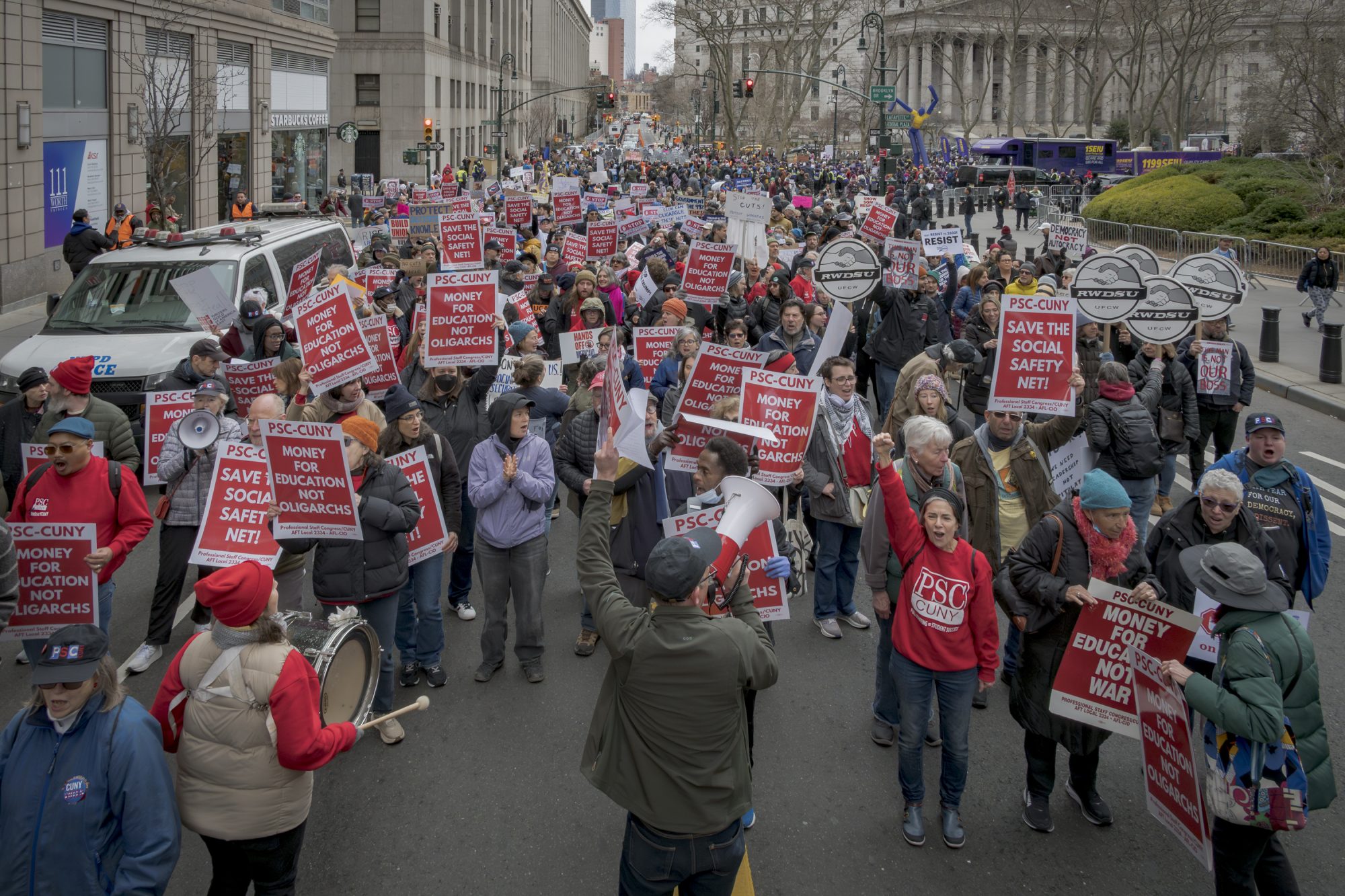
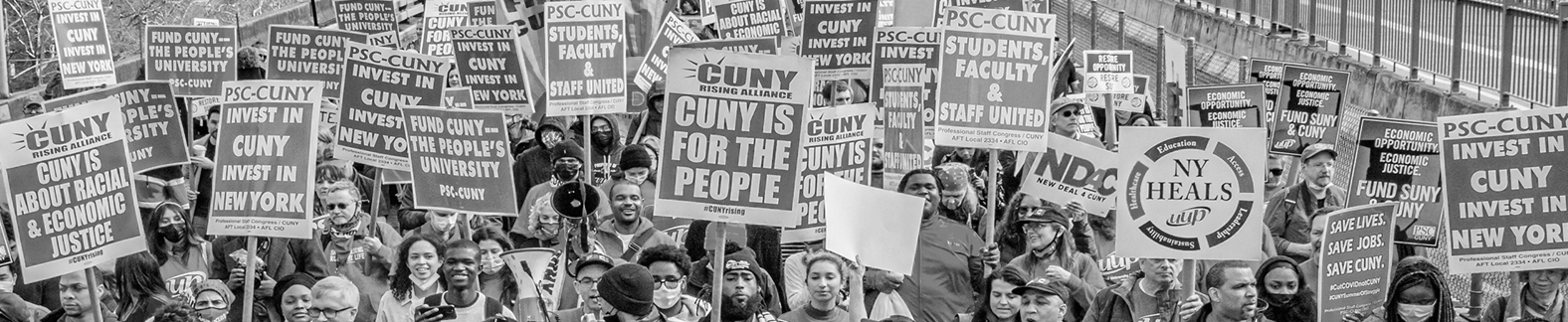
In advance of a vote at this week’s New York City Council Stated Meeting, the following Higher Education Unions released this statement opposing City Council Intro 175-B.
Professional Staff Congress/CUNY
AAUP-NYU
CFU-UAW NYU
AAUP Leadership Council – The New School
AAUP Executive Council – St. John’s University
AAUP-Columbia University
SVA Faculty United – UAW
UAW Region 9A
As unions and advocates that represent thousands of faculty and staff at New York City’s higher education institutions, we oppose City Council Intro 175-B, legislation regarding security perimeters adjacent to education facilities. Despite recent amendments, this bill remains unnecessary and unconstitutional. Multiple revisions have only further exposed the intent of the bill to compel the NYPD to erect security barriers and aggressively police speech with which they disagree.
As academic labor unions, we find the amendment granting special protections to workers who protest under the National Labor Relations Act galling. We cannot support a bill that deprives our students and community allies of their First Amendment rights in exchange for our own. Protecting some people’s freedom of speech and assembly and not others is on its face unconstitutional.
The original bill encouraged the NYPD to create security perimeters within 100 feet of educational facilities – a massive swath of our city. Thankfully, the blatantly unconstitutional 100-foot language is removed, but this bill is still so vague as to invite political weaponization.
The NYPD testified before the City Council on February 25 that they already have the tools necessary to police protests. The law currently empowers police to ensure that protests around educational facilities remain non-violent, building entries cannot be blocked, and sidewalk and street traffic are unimpeded. In fact, the police have often overstepped their existing authority, as recent history shows, targeting racial justice protesters more aggressively than others.
If the goal of Intro 175-B is to obtain additional information about the NYPD’s policies around managing protests, then oversight hearings would be more appropriate than this bill. Indeed, the NYPD repeatedly emphasized at the February hearing that their guidelines are already publicly available in the Patrol Guide. Ironically, it was the NYPD Deputy Commissioner for Legal Affairs who was left to defend the First Amendment against the Council’s willful disregard for fundamental constitutional rights. As recently as 2014, the U.S. Supreme Court made clear in a unanimous decision in McCullen v. Coakley, that overly broad buffer zones such as the security perimeters contemplated by Intro 175-B are unconstitutional.
Measures to lawfully prevent discrimination are worth funding. Instead of eroding the U.S. Constitution, the Council could expand funding for the New York City Commission on Human Rights (NYCCHR) to perform its historic legal role of mediating, educating, and litigating issues related to discrimination and harassment.