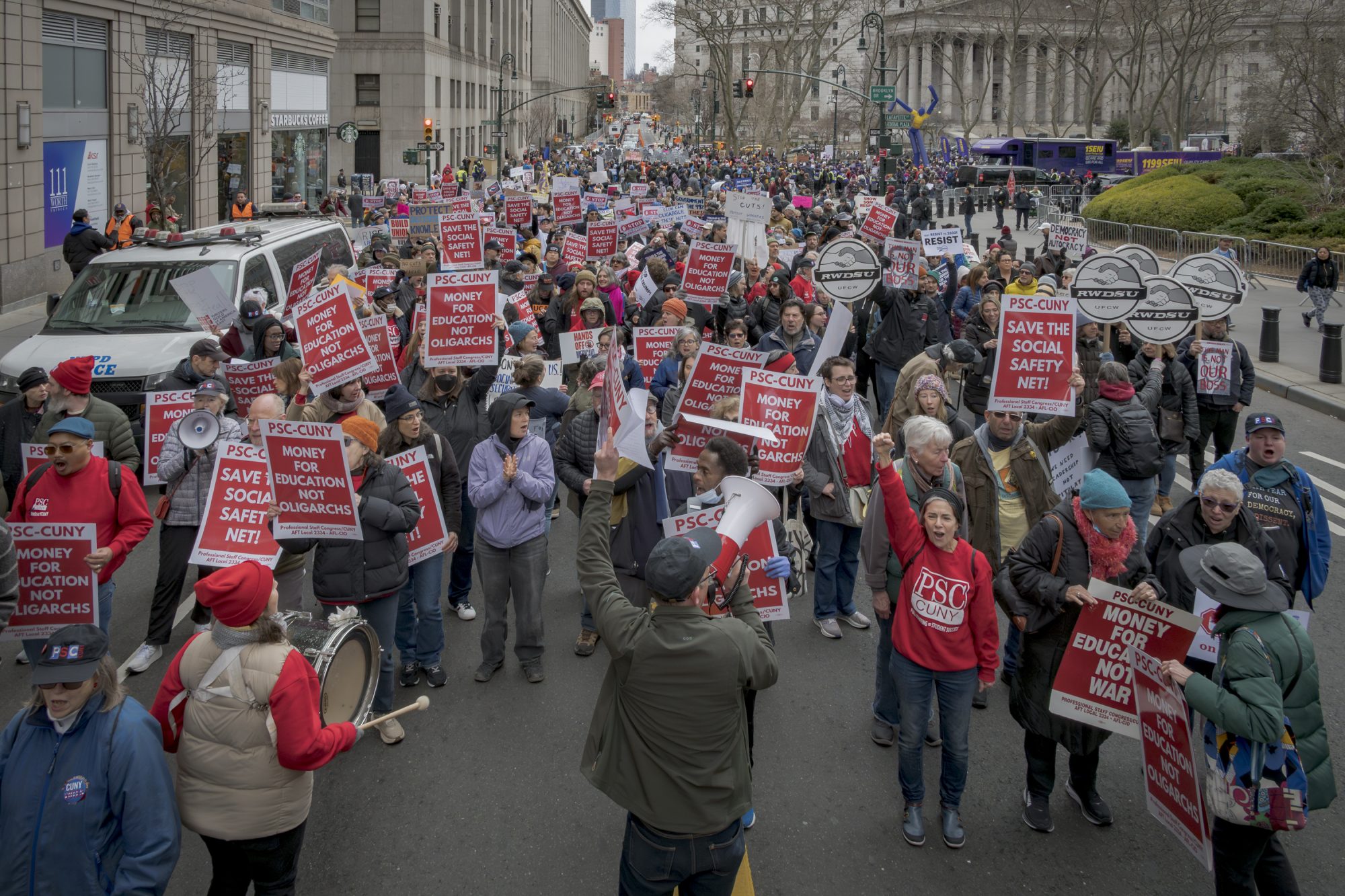
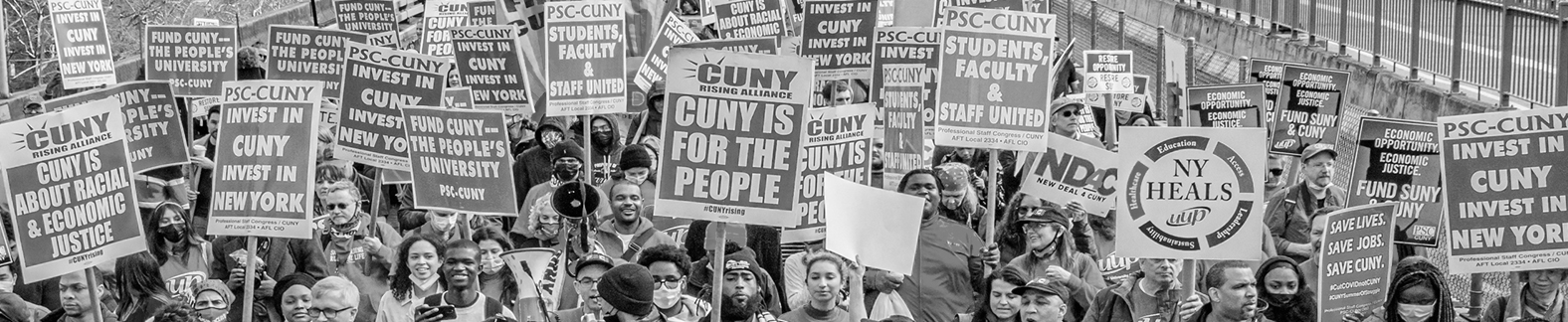
In the aftermath of a series of pro-Palestine protests in the city last year, opponents scrambled to find new ways to hamper these demonstrations. Two bills were introduced in the City Council, one that would encourage NYPD to create buffer zones between protests and houses of worship, and another that would do the same thing to educational facilities, including CUNY campuses.
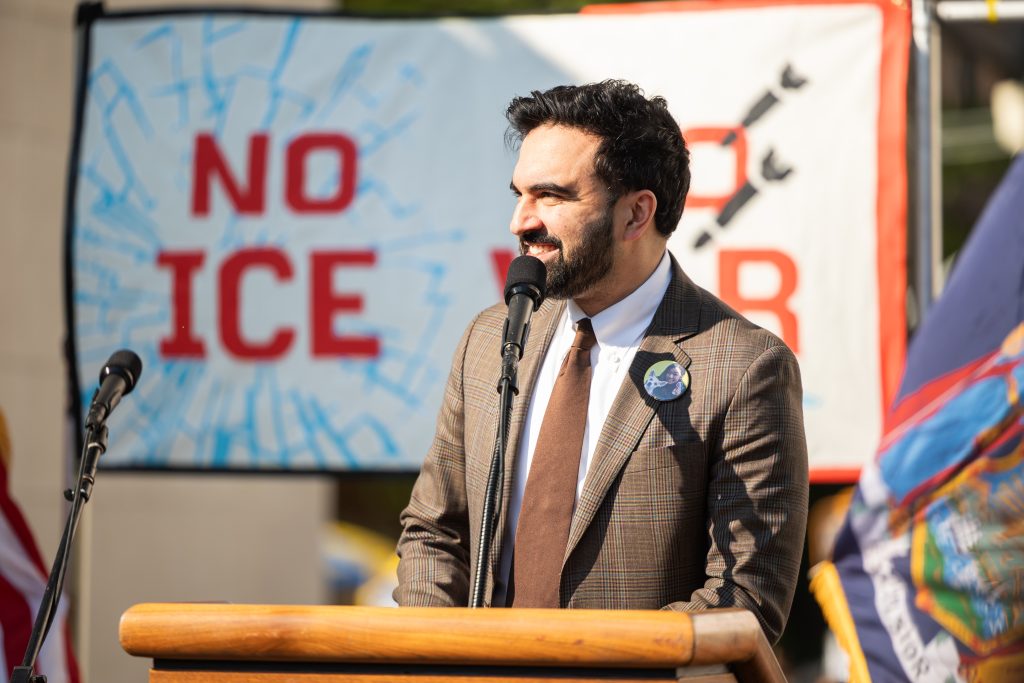
The PSC and others supported Mayor Zohran Mamdani’s veto of 175-B (Credit: Paul Frangipane).
Almost immediately, New Yorkers concerned for the First Amendment interpreted these bills as threats to the public’s right to demonstrate. With churches, synagogues, mosques, temples, schools and colleges all over the city, the impact of these bills, as originally proposed, would make large swaths of the city anti-free speech zones. If a construction union placed an inflatable rat outside a non-union job site that happened to be next to a school, were they all of a sudden an illegal demonstration? With these proposals, New York City was starting to look no longer like a free society.
For the PSC, the threat of the educational facilities bill was existential: the police should not be able to create zones around our campuses where faculty, staff and students could be enjoined from demanding funding for CUNY, a fair contract for workers or more resources for students. Free thought, the exchange of ideas and the right to vocally express dissent are sacrosanct to university life–the educational facility buffer zone bill stood against the principle of free discourse.
The union sprang into action, along with other members of the pro-free speech community. PSC leaders mobilized members to call lawmakers to voice their concerns and PSC officials spoke directly to members and testified publicly about the problems these bills posed. Pressure from the PSC and other unions led to a carve out for labor actions in a revised educational facilities bill, Int. 175-B, ensuring that union rights would not be impeded. Both bills were also watered down substantially to essentially grant police discretionary powers they more or less already had. These were steps in the right direction from the PSC perspective and proved yet again that the collective muscle of unions and supporters could defeat bad legislation, but they also underlined the broader problem: the council was pushing through a nonsensical set of bills not to enhance public safety but to appease a more conservative faction of city political players.
By the time both bills reached a full floor vote, they had been diluted, but they still alarmed the public. The educational bill, thanks to PSC mobilization and testimony, passed without a veto-proof majority, a testament to the bill’s weakness and the union community’s strength. When Mayor Zohran Mamdani vetoed the bill encouraging police to create buffer zones for protests near educational facilities, PSC President James Davis heralded the news, saying Int.175-B endangered “First Amendment rights to free expression for all New Yorkers irrespective of religion, race, or nationality, imposing new restrictions near any vaguely defined ‘educational facilities,” which, “includes CUNY campuses, which are worksites and sites of political expression.”
The New York Times said the bill, pushed by Council Speaker Julie Menin, whose well-heeled supporters have positioned her as a centrist bulwark against the progressive mayoral administration, “would have required the New York Police Department to publicize plans to deploy security perimeters around educational facilities during protests,” adding that Mayor Zohran Mamdani in his veto message “said he believed the bill could be improperly applied to ‘workers protesting ICE, or college students demanding their school divest from fossil fuels or demonstrating in support of Palestinian rights.’”
“Int. 175-B is not a narrow public safety measure; it is a piece of legislation that has alarmed much of the labor movement, reproductive rights groups, and immigration advocates, among others, across this City,” Mayor Mamdani said in his veto message.
For Menin, this was her first big defeat. These bills, which would have curbed public criticism of US-backed militarism in the Middle East, had faced enormous opposition. There was also vocal dissent within the city council against the measure, as well. Politico wrote, “Council Member Tiffany Cabán, who co-chairs the body’s Progressive Caucus, praised the mayoral veto, arguing against giving police ‘more tools to silence dissent and brutalize protestors,’” reporting that she praised the mayor for vetoing “this ill-conceived bill that would further enable efforts to criminalize protests and stifle freedom of speech.”
In her first legislative showdown with the Mamdani administration, she stood not as an all-powerful disciplinarian against protests, but a humbled public servant who like all elected officials is answerable and accountable to the people. For the PSC, the watering down of both bills and the successful defeat of the educational buffer zone bill was not just about the preservation of protest but about sending a strong message to the speaker: the city of New York City voted for progressive change, not retrograde elite hangringing about the inalienable rights of unions like the PSC.
The veto of 175-B wasn’t the end of the story. The speaker reportedly was working tirelessly to whip enough votes to override the veto while a coalition of unions and progressive groups, including the PSC, mobilized to sustain it. The PSC organized 13 unions, including UAW Region 9A, 1199SEIU and NYSNA, to join a letter pressing the city council to oppose an override. PSC members attended rallies and press events, sent over 1,000 letters to city lawmakers, and called their council members telling them to put the First Amendment above scaremongering from conservatives. The mayor’s veto was preserved in the end, thanks to pressure from PSC members and many other progressive activists.
“This is an important victory achieved through tireless organizing,” said Anthony Alessandrini, the chair of the union’s academic freedom committee. “That organizing needs to continue: whether it’s the blacklisting of our Fired Fourth colleague, CUNY management preventing students from speaking at their own commencements, or politicians looking to trample on academic freedom, the PSC needs to lead the way in pushing back and standing up for free speech and political expression.”
The speaker is planning a much blander version of the buffer zone bill. According to Chalkbeat: “Colleges, universities, museums and libraries, teaching hospitals and other educational facilities will not fall under the bill’s scope.” The new bill impacts “public and nonpublic elementary schools, middle schools and junior high schools” as well as “nonpublic high schools,” according to the bill’s language. The bill, sponsored by Councilwoman Elsie Encarnacion and has the support of the speaker and ferociously reactionary members like Vickie Paladino and Inna Vernikov, would require the NYPD commissioner to furnish the speaker and the mayor with “a proposed plan to address and contain the risk of physical obstruction, physical injury, intimidation, and interference, while preserving and protecting the rights to free speech and assembly, and protest, at educational facilities through the use of security perimeters…at entrances to, and exits from, such educational facilities, including parking lots or driveways of such educational facilities.”
Davis said in a statement, “Together with students, fellow unions and community partners, we built a coalition to defeat the misguided Intro 175-B proposal. We oppose any efforts by the City Council to further restrict New Yorkers’ rights to free expression.”
“I’m proud that our union mobilized our members to defend this veto of a cynical attack on democracy and the right to protest,” said Danny Katch, an adjunct lecturer in English at City College, the site of enormous police repression of campus protests in April of 2024. “We’re going to have to keep organizing against the conservative and bought off politicians in both parties who are going to continue to try to undermine Zohran’s election mandate to tax the rich, fund public institutions, and end over-policing.”