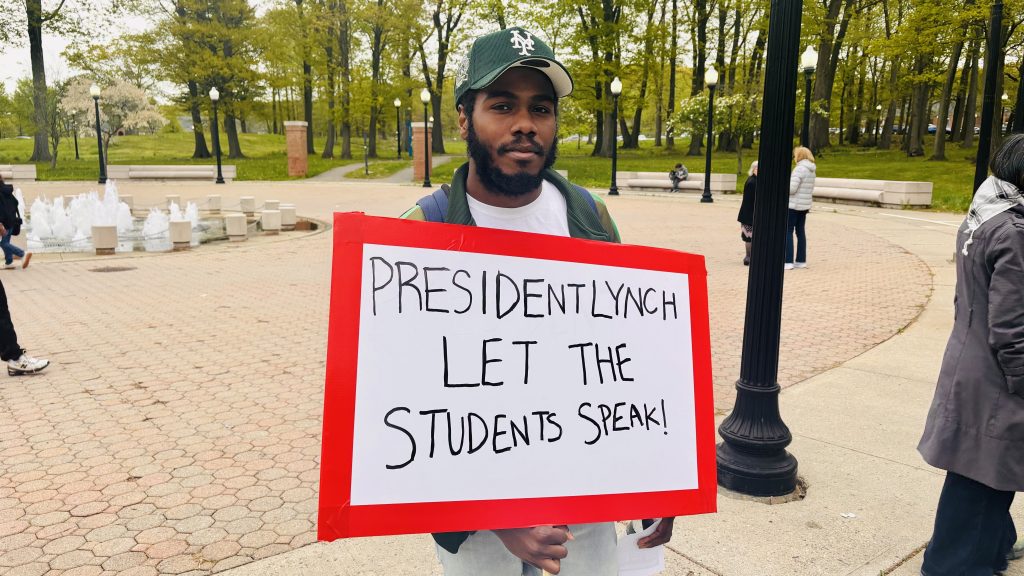
Students and PSC members want free speech at the College of Staten Island (Credit: Moses Merisier).
Graduation season at CUNY is normally a time for celebration and to honor the achievements of the graduating students. And it’s a time for the faculty and staff to admire the fruits of their labor and happily mark the finish of an academic year. But this year, CUNY management is spoiling the vibes.
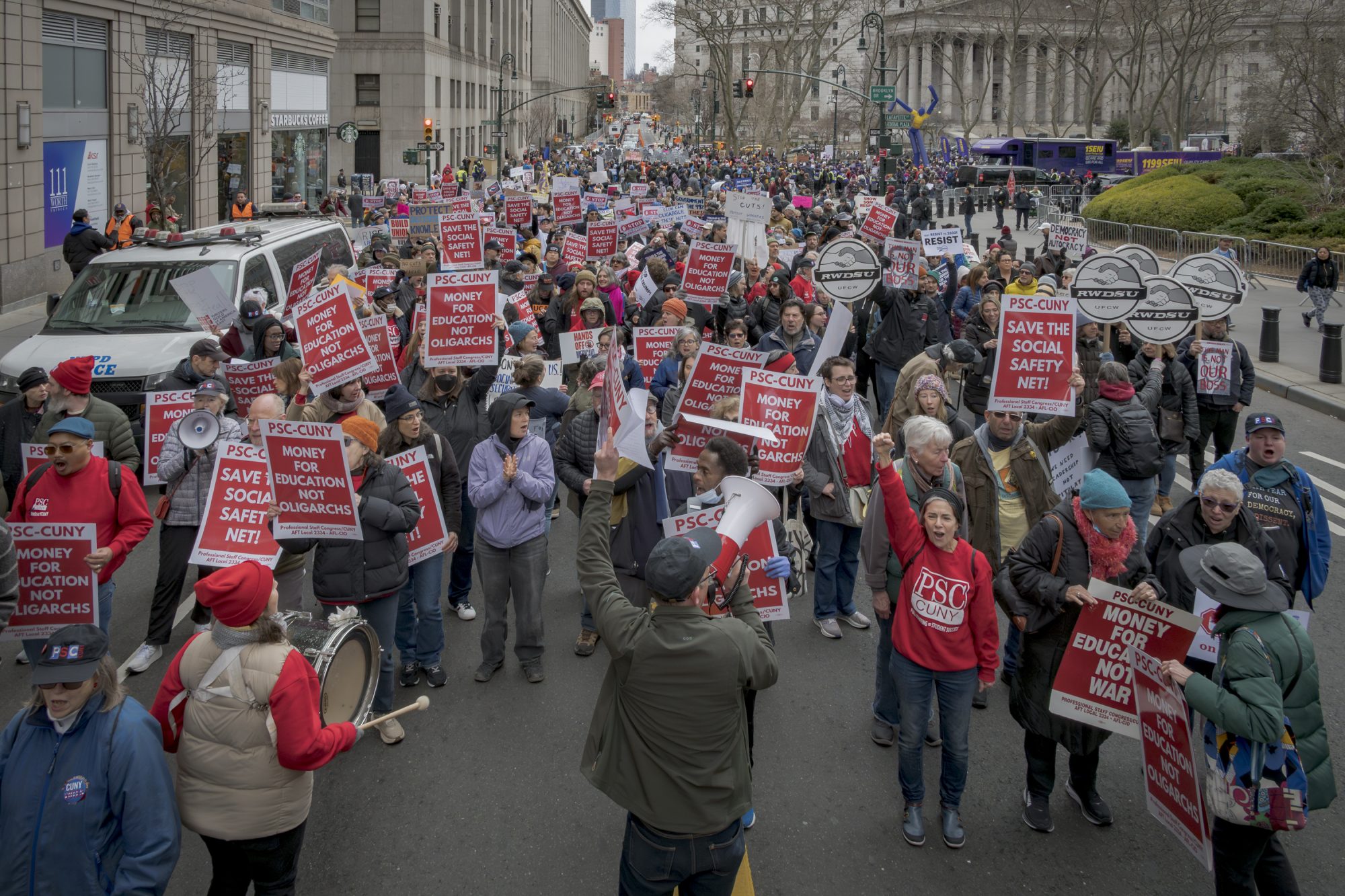
At multiple campuses, PSC members are joining with the students to protect freedom of expression and union rights. At the College of Staten Island and the School of Law, members and students are fighting a management decision not to have live student speakers at commencement. At York College, the PSC chapter opposes management’s decision to host commencement at an anti-union location.
The censorship is in keeping with a trend of repression against student speech around the country. Other area schools are having similar problems. “Graduation speakers will no longer give live remarks at school-based ceremonies and must instead record their statements for a video, in compliance with a policy NYU is rolling out this year,” reported New York University’s student paper, the Washington Square News. And the Associated Press said, “Rutgers University has canceled a planned graduation speech by business leader Rami Elghandour after some students raised concerns about his criticism of Israel on social media.”
On April 20, Anthony Alessandrini, chair of the PSC’s Academic Freedom Committee, sent a letter about the commencement issues to CUNY Chancellor Félix V. Matos Rodríguez, CSI President Timothy Lynch and School of Law Interim Dean Natalie Gomez-Velez.
“We write in support of faculty, staff, students, and alumni of the College of Staten Island, who have demanded the reinstatement of a live student valedictorian speaker at this year’s CSI Commencement,” he said. “Our committee sent a letter on March 23 in support of a similar demand for the reinstatement of a student speaker at the CUNY School of Law commencement. The fact that students are being prevented from speaking at their commencements—either via requiring speakers to pre-record their remarks, or by eliminating student speakers altogether—at multiple CUNY campuses suggests a deeply disturbing pattern. In plain terms, such policies amount to blatant censorship and are a very clear violation of our students’ right to free expression. As a committee dedicated to defending academic freedom at CUNY, we join our colleagues at CSI and the Law School in demanding the immediate reinstatement of live student speakers at commencement ceremonies at their colleges, and throughout the CUNY system.”
Students and PSC members also held a free speech demonstration at CSI on April 28. Students at the School of Law held a rally a week prior.
“We launched a public letter demanding that the interim dean reinstate a student speaker, which now has well over 600 signatures,” said Hannah Waltz, a third year law student, in a statement. “CUNY Law’s Student Government passed a resolution calling on the dean to reinstate the student commencement speaker, and the Professional Staff Congress (CUNY’s system-wide union representing over 30,000 faculty and staff) wrote a letter to the interim dean and CUNY’s Chancellor Matos directly in support of speaker reinstatement. Later in March, our faculty unanimously passed a resolution to reinstate the student speaker, without a single objection, not even from the dean herself.”
Waltz added, “Our class is deeply disturbed that neither a Student Government resolution, a unanimous vote from professors and staff members alike, nor calls from the union representing the entire university system is enough to persuade Dean Gomez-Velez to allow the students she claims to be so proud of to speak at their own graduation.”
Jonathan Cope, the CSI chapter chair, said “Free speech is a core value of academic unions. We all became educators to encourage our students to use their voices–whether we agree with them or not. We believe we should let our students speak. Moreover, overruling the recommendations of legitimate faculty governance bodies should be of concern to every PSC-CUNY member at CSI. We genuinely hope that the CSI president reconsiders this decision before the 2026 commencement ceremonies.”
Jay Arena, a professor of sociology at CSI and a member of the CSI faculty senate who participated in the rally, said, “The outrage of faculty was on display two days after the April 28 demonstration, at the college’s faculty senate and college council governance meetings. In a landslide vote, 29-2, faculty voted in favor of a resolution demanding Lynch revoke his edict and allow a live, not recorded, student address. The vote was preceded by a parade of faculty, many who have never or rarely spoken at the gathering, who passionately spoke in favor of the resolution.”
On May 5, the CUNY University Faculty Senate passed a resolution urging “college presidents and school deans at [CUNY] to allow Graduation Speakers…to share their words live and in person on graduation podia, in affirmation of CUNY’s commitment to Free Speech principles.” The resolution cited the Supreme Court case Tinker v. Des Moines Independent Community School district, which “ruled that ‘students do not shed their constitutional rights to freedom of speech or expression at the schoolhouse gate,’ and that free speech can be curtailed only when it can be shown that the speech in question would pose a ‘material and substantial disruption to the learning environment.”
In Queens, PSC members at York College are protesting their college’s decision to hold commencement at nearby St. John’s University, a Catholic institution that recently invoked “religious exemption” to end recognition of its two faculty unions—the St. John’s University Chapter of the American Association of University Professors (SJU-AAUP) and the Faculty Association (FA).
PSC members rallied with the SJU unions outside Madison Square Garden in March right before Saint John’s first game in the NCAA tournament to call out the union busting.
“As we know, St. John’s University has recently engaged in union busting,” said Freya Pritchard, the PSC chapter chair at York. “In particular, on February 19 of this year, the president of St. John’s University notified the faculty of St. John’s University that the university would no longer recognize the two unions that represent the faculty at St. John’s University. Regrettably, York College is planning to hold its graduation this year at St, John’s University. I do not know if it is the intention of the administration of York College to support union busting.”
She added, “However, regardless of their intention, supporting union busting is exactly what they are doing. This is not an issue for just York College or even for just other CUNY campuses but for all union members and supporters.”
The York chapter is organizing faculty and staff to wear stickers at the commencement that say “We stand with St. John’s faculty.”