Anthony B. Gronowicz was not simply a historian of race and class before the Civil War and U.S. foreign policy–he was a stalwart in the history of the PSC as well as the city and state. He was found dead on May 31, in his apartment.
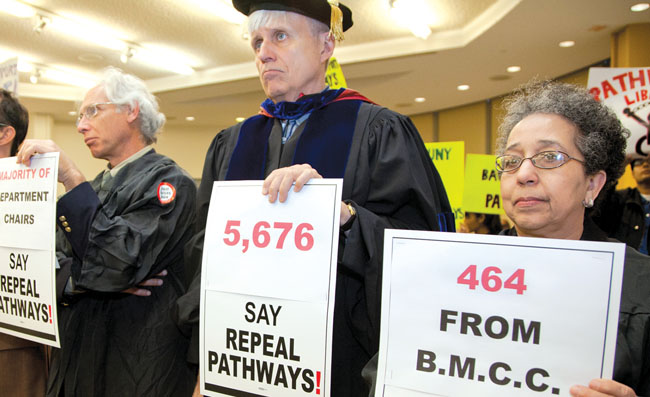
Anthony Gronowicz always stood up for public higher education (Credit: Pat Arnow).
A lifelong New Yorker, Gronowicz was an adjunct professor of history at CUNY for five decades. From the Brooklyn College obituary: “A respected historian, accomplished scholar, and dedicated educator, Gronowicz served students at Borough of Manhattan Community College and Brooklyn College. He was at Brooklyn College on three separate occasions dating back to the 1980s, including as a fellow at the Ethyle R. Wolfe Institute for the Humanities. A member of the CUNY community for more than 50 years, he remained actively engaged in teaching and scholarship throughout his life and never formally retired. Most recently, he taught at Brooklyn College during the past semester. Professor Gronowicz earned a B.A. from Columbia University and a Ph.D. from the University of Pennsylvania. A full professor and prolific scholar, his research focused on race, urbanization, and U.S. foreign policy. He authored three books and numerous scholarly articles, making significant contributions to the study of history and public affairs.”
Professor Gronowicz –Tony to his friends in the union – was deeply committed to his students and to the pursuit of historical understanding. He will be remembered for his passion for teaching, intellectual curiosity, generosity of spirit, and sense of humor, and many contributions to the PSC and to the CUNY community.
Tony’s reliability and dedication strengthened our union. He served on the PSC executive council and delegate assembly and was active in union committees working to defend adjunct faculty and protect workers around the world. The union could always count on Tony to attend a contract rally, speak out for PSC members and students at a CUNY Board of Trustees hearing, or simply attend one of the PSC’s many community-building social events. He was an outspoken supporter of adjunct rights to better pay, job security and academic freedom, especially in regards to his support for the Fired Four.
Tony was a founding member of the PSC International Committee, established in 2001 to educate members and to build international solidarity with workers overseas. Renate Bridenthal, professor emerita of women’s and gender studies at Brooklyn College, noted, “Tony was a member of the International Committee since its inception. His contributions were invaluable. More than a teacher, Tony was a mentor who also guided his students in activism.”
Gronowicz ran for mayor on the Green Party ticket in 2005 and 2013. His commitment to radical anti-racist and anti-imperialist politics included his time teaching Assata Shakur on Rikers Island in the late 1970s, which he always spoke of with such pride and honor.
He began his career at CUNY at John Jay College in 1972 and went on to teach at Brooklyn College, and other units, including the Joseph P. Murphy Center for Worker Education and Labor Studies. He was highly respected by his colleagues in history and the humanities as a rigorous and meticulous scholar. His acclaimed work, Race and Class Politics in New York City before the Civil War, published in 1997, is considered by historians as a seminal critique of the existing liberal canon, which downplays the white working class’s collaboration with the subordination of Black people in New York City and beyond. Considered by his peers as an archival masterpiece, the work diverged from the existing liberal scholarship that tended to glorify the white working class in the nineteenth century and downplay the Democratic party’s complicity with maintaining a stratified hierarchical system of white domination.
In 2021, Gronowicz published Last Western Empire: A History of U.S. Foreign Policy, a precise and highly regarded analysis of American imperialism from the Spanish-American War to the present. The book contends that the United States,founded as an extension of the British Empire, prospered through geographic isolation and two world wars even as it regularly descended into race-based political chaos due to a historical legacy of internal chattel slavery.
Remarkably, Tony was able to balance his scholarship and union activism with dedicated teaching. He gravitated toward students who had been overlooked, discarded, or underestimated by institutions. He worked closely with immigrant students struggling through precarity and nervous conditions, and with young veterans who had been sent to fight in Afghanistan and returned to school carrying the contradictions of war. Through student publishing projects, he encouraged them to write, edit, think critically, and trust their own voices. Students who had once doubted themselves became editors, writers, organizers, and intellectuals in their own right.
Tony believed deeply in the transformative capacities of those most failed by the existing order. He understood that those closest to hardship often carried the fiercest longing for change—not because suffering automatically radicalizes, but because contradiction sharpens one’s desire for a better world. He saw political possibility where others saw deficiency. More than a professor, Tony was a mentor who practiced what can be described as creative reciprocity. He committed himself to people not out of charity, but because he believed they could become makers of history themselves.
As Tony O’Brien, another founding member of the International Committee put it: “What a landmark Tony was in our political life. I’ll miss his piercing gaze, his Polish-knight-of-old bearing and his never ever giving up on rewriting the ugly script of the world our generation was given…Someone who worked with Tony quoted Shakespeare when they heard he had died: ‘There cracks a noble heart.'”
Gronowicz’s loss has saddened his colleagues in the PSC but strengthens their resolve to build a stronger union committed to principles of racial justice and international solidarity.
Immanuel Ness is a professor of political science at Brooklyn College and the chair of the PSC International Committee. Corinna Mullin is adjunct faculty at Brooklyn College and John Jay College in the political science and economics departments. She is a PSC delegate and a member of the Steering Committee of the International Committee. Sarah Raymundo serves on the National Executive Board of Bagong Alyansang Makabayan (BAYAN). The International Committee is planning a memorial service for Tony Gronowicz together with his family and comrades in the Fall.