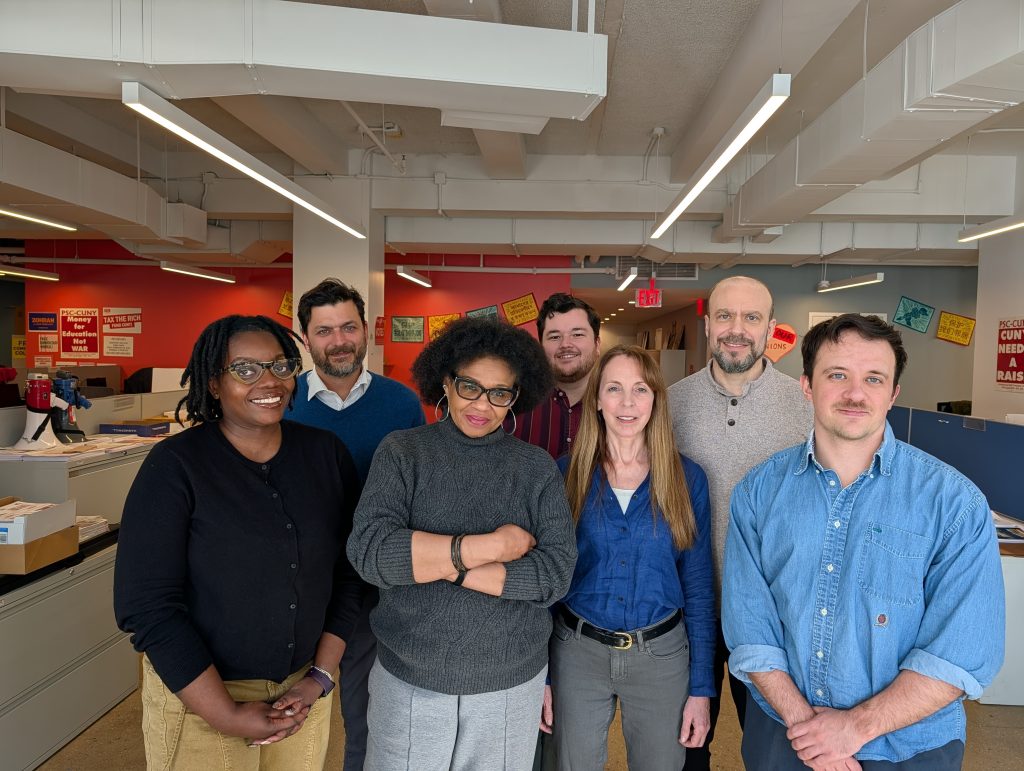
Front row, left to right: Tiffany Brown, Faye Moore, Carol Rial, Nick Sarnelli; Back row, left to right: Nicholas A. Devyatkin, Mitchell Manning, Greg Douros. Not pictured but deeply appreciated: Stephanie Crowder. Photo: Fran Clark
The PSC contract enforcement and legal teams don’t just serve members who have a grievance: these are multifaceted departments whose complex and extensive work informs all areas of the union’s efforts, including collective bargaining strategy, member organizing, legislative work, and more.
Faye Moore, who became the union’s director of contract enforcement in early 2022 after years of serving as a contract enforcement coordinator, said that her department “is usually the members’ first contact with the union,” as it is where rank-and-file members turn when they have a problem on the job. Her department must “make sure that the contract that we negotiate for our members is implemented properly.”
That doesn’t just mean winning cases for members when they need representation. It also means identifying needed improvements in the language of the contract, important work that informs the bargaining agenda. Sometimes a member runs into a problem with management that isn’t a contract violation. The contract enforcement team can help members resolve some such issues through an informal complaint process. When patterns arise in the complaints, that can often lead to an organizing campaign on a campus or within a title. Or it can end up on the agenda of a labor-management meeting or the subject of an even broader campaign. For instance, Moore’s team is working to address pension contribution problems members are experiencing throughout CUNY – now the union has a new campaign to pass legislation requiring an audit of CUNY’s pension practices.
In short, these departments are the backbone of PSC unionism: Two full-time lawyers, three full-time grievance counselors, a contract enforcement coordinator and a contract enforcement director. That’s in addition to more than 20 member grievance counselors representing PSC chapters who receive monthly training, a dozen HEO advisors, and the union’s outside lawyers. This team handles a lot, to say the least.
“I love when we win,” Moore said, noting that she also enjoys when a member works with a union representative, and as a result of their ordeal becomes more active in the union.
But the work isn’t just about individual cases. Like in the Supreme Court, grievance decisions and arbitration awards can set precedents and lock in the interpretation of contract language. The department is often looking at how a case or cases can shape university policy for the better. “A grievance for one person can change contract language,” Moore said. “I think members should know that we take it very seriously.”
“When management violates the contract, they’re spitting in the faces of tens of thousands of PSC members past and present who have worked toward this contract,” said Mitchell Manning, who has been a PSC grievance counselor since 2023. “Part of the fulfillment of my job is being in the present struggles and knowing that our current work is informed by years of organizing, grievance work and litigation. When we’re defending the contract we are building atop that history.”
Carol Rial, another grievance counselor, felt similarly.
“You cannot help but to feel close in some way to the member; you come to know the minutiae of the situation,” she said. “‘Tell me what happened to you,’ I’m immediately predisposed. Once I hear the entire tale it makes me all the more bent on winning. That focus and intentionality comes naturally to those who do this work.”
Rial works with two member grievance counselors, Ruben Rangel and Stan Wine, to represent adjuncts.
It’s “a lot of work and an enormous effort to get a win,” she added, noting that “at the end it is so thrilling.”
Tiffany Brown, who joined the PSC staff in the legislative department in 2016 and became a grievance counselor last year, said there is something empowering about informing members about their rights on the job, telling them “you don’t have to sit there and take it, and the union can provide avenues and venues for you to be heard.”
Greg Douros is the union’s contract enforcement coordinator. In addition to representing members, he works with the pension committee in the fight to fix pension problems at the university. The CUNY administration has failed to properly deduct and submit pension contributions for hundreds of PSC members to the City pension systems. Douros helps individuals push CUNY to fix their pension contributions, but also conducts presentations at CUNY campuses and works with the union’s legal, communications and legislative teams to address management’s pattern of pension failures. “We enforce CUNY policy and labor law,” Douros said. “This is something that is so integral to people’s lives.”
He also works closely with the union’s College Laboratory Technician (CLT) chapter. Douros recently won a case where a CLT at LaGuardia Community College received backpay and a step increase that had been denied. But he represents other members, too: He recently helped a CLIP instructor at Borough of Manhattan Community College win $17,000 in backpay after she was not paid her full salary.
Douros also works with Brown and Manning to represent Higher Education Officer (HEO) series employees at various campuses. Manning is the point person for workers at the CUNY Research Foundation, and the whole staff team works with the in-office member grievance counselors Victoria Chevalier and Carla Cappetti and the chapter grievance counselors to cover full-time faculty and other titles.
Click here to find your chapter grievance counselor and here for the PSC’s in-house grievance counselors and HEO advisors.
A key part of the contract enforcement team is Stephanie Crowder, who joined the union’s staff in 2012 as the assistant to the director of contract enforcement and currently serves as the administrative coordinator for the department. She provides vital back end coordination regarding deadlines and filings for grievances and arbitration. Handling different kinds of cases is a fascinating experience for Crowder. “I like being in the back end of it, seeing all the moving parts,” she said.
Technically speaking, the legal department is separate from contract enforcement. The legal director is the union’s chief litigator and union lawyers advise on bargaining, organization, legislation, and communications. They also ensure compliance with lobbying reports and US Department of Labor regulations.
But the lawyers also play a huge role in day-to-day contract enforcement. While grievances are handled by the counselors, the lawyers advise on individual and class-action grievances, and Weingarten cases representing members in disciplinary hearings as well.
“We advise on particularly more complicated, high-stakes, CUNY-wide grievances,” said Nicholas Devyatkin, the union’s legal director.
The lawyers also handle arbitrations, about one or two per month. Arbitrations are incredibly time consuming and expensive (filing fees, arbitrator fees, occasional outside attorneys). But this is where union dues pay off: a healthy budget gives the union the ability to defend members and the contract, even in lengthy arbitration battles.
“The importance of dues, it’s a collective,” Devyatkin said, adding that the “the union can amass a huge amount of resources” to defend and represent members.
“It’s what gives us the power to fight the government, fight corporations, and win against institutions that have far more resources than the union and far more resources than the individual,” Devyatkin said.
Nick Sarnelli became a PSC staff attorney in April of 2025 after two and half years as a lawyer at NYCERS, a major public-sector retirement system. He loves the work of the department because it reviews “really interesting questions of federal and state labor law,” especially when it comes to Weingarten rights, leave rights and other major contractual rights for members. “It really impacts how CUNY can relate to individual employees.”
Like the rest of the staff in these two departments, he likes when the union wins because it shows how the power of the union can help members. “We don’t have the resources that CUNY has, we have to work on our toes,” Sarnelli said. “It makes you feel like you’re a part of a collective effort.”
For the PSC contract enforcement and legal team staffers, this isn’t just a job, this representational work is deep in their trade union bones. Manning fell in love with grievance work when he was co-chair of resident advisors at the University of Massachusetts at Amherst in UAW Local 2322. For Manning, doing this work for PSC is highly rewarding. “It’s the collaborative nature of the work,” he said. “A lot of it is done behind the scenes. There are a lot of opportunities for us to get together and talk about the issues, but it also means we’re winning and losing together.”
Rial, a former adjunct lecturer in English at Baruch and Hunter Colleges, started as a member grievance counselor at a time when a new multiyear appointment contract provision created the need for more attention to adjunct grievances. Rial eventually joined the PSC staff in 2022. Moore served a term as president of Social Services Employees Union Local 371, a storied and feisty District Council 37 affiliate, and from 1994 to 2007 served as its vice president in charge of grievances. As a law student at American University, Devyatkin knew he wanted to defend the right of due process, something that is central to trade union representation work.
Douros was inspired to begin a career in trade unionism after joining a graduate assistants’ union at the University of Kansas. “This is a way to transform people’s lives,” he said.
Brown’s inspiration to move into contract enforcement was related to her pursuing a law degree at CUNY School of Law. “For me, being in a law school that’s known as a public-interest law school and in service of human needs, being a grievance counselor makes sense and is aligned with how I see my future,” she said.
For the whole team, the work of enforcing the contract gives meaning to all the strenuous organization the union does to win a good contract. “Without contract enforcement the contract is just a piece of paper,” Douros said. “We make it living.”
Published: April 10, 2026