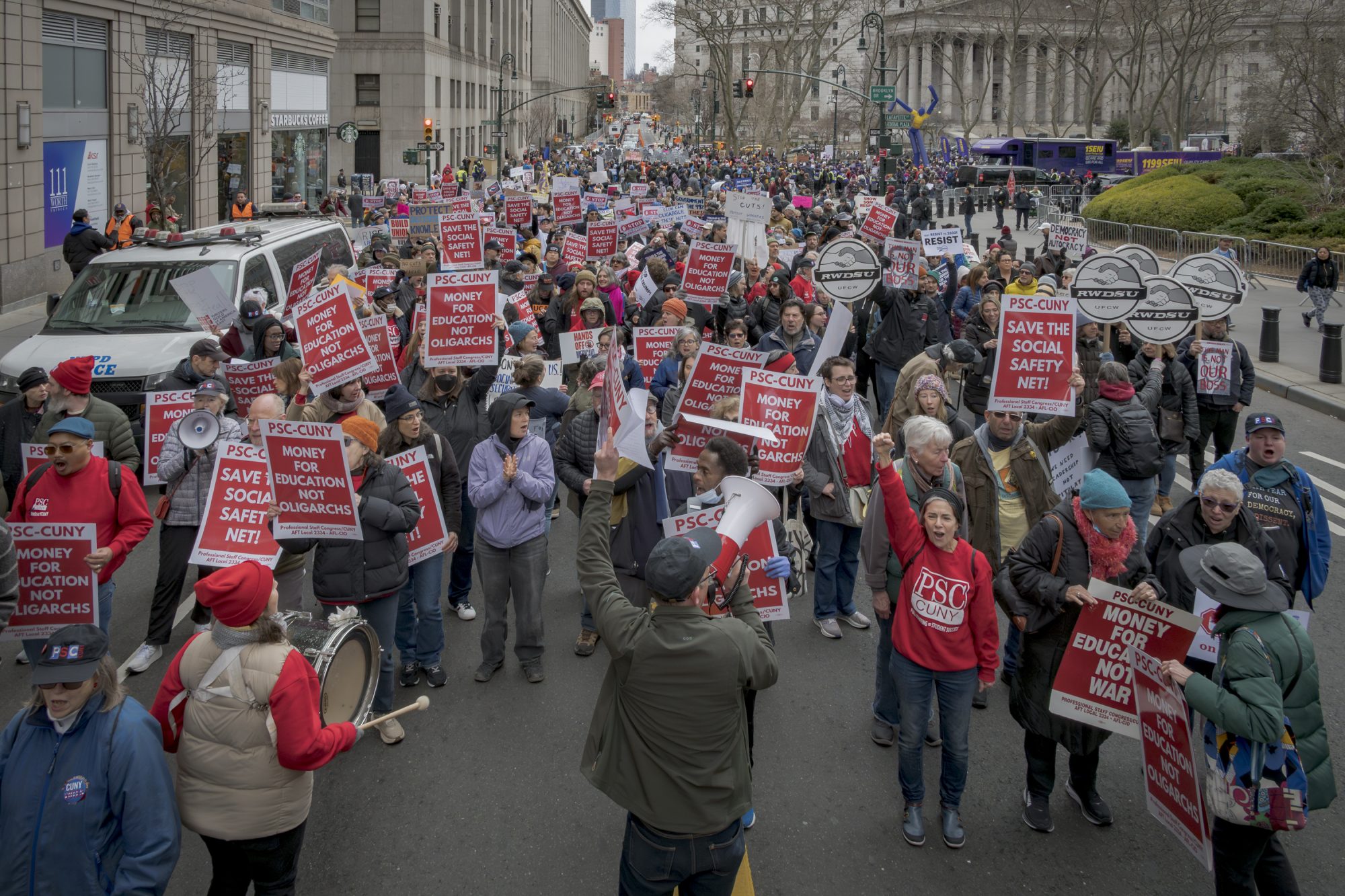
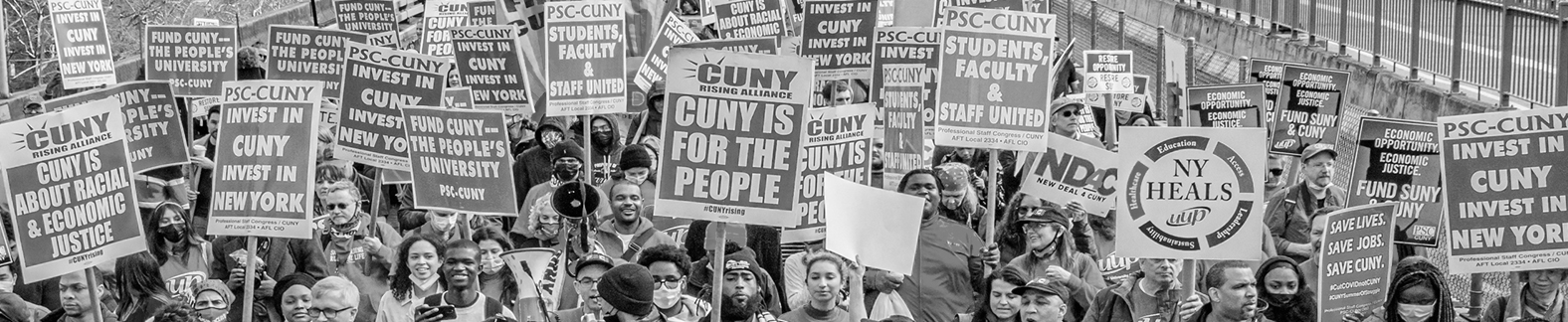
The PSC supported Zohran Mamdani’s successful run for mayor for a variety of reasons, and one of them was his commitment to freeze the rents for 2.4 million New Yorkers living in rent stabilized apartments. Now he’s in office and the Rent Guidelines Board is assembling for its annual ritual of setting rent increases.
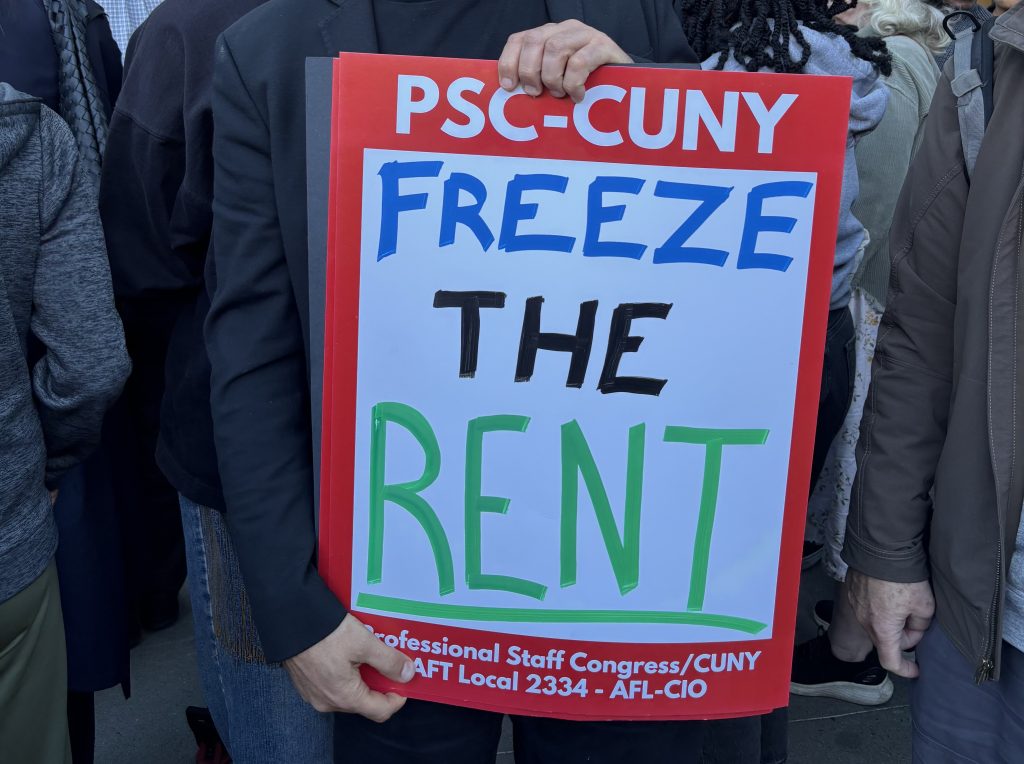
The message is loud and clear (Credit: Ava Farkas).
Activists are mobilizing and demanding the board freeze the rates and approve a 0% increase, a precedent the board set under the de Blasio administration. That precedent was betrayed by the pro-landlord Adams administration for four years resulting in ballooning increases for tenants. But the coalition for a rent freeze is fighting back under a more pro-tenant administration.
PSC is part of that coalition, and not just because it’s the right thing to do. This year, several of the RGB’s public meetings and hearings on the subject are happening at CUNY campuses. The first meeting occurred at LaGuardia Community College on May 7. In a preliminary vote held that night the board “approved increasing rents on stabilized apartments by up to 2% for one-year leases, but set a rent freeze as the floor,” according to Crain’s New York Business.
PSC members joined activists outside LaGuardia to demand a rent freeze.
“People should be able to live where they work. That is what this rent freeze is about,“ said Jen Gaboury, the PSC first vice president, at the rally, noting that hundreds of thousands of city and state workers, including CUNY faculty and staff, live in the city. “ sometimes our students can’t even afford to live with their families. Whole families have to move away. Our retirees not only want to stay in their homes, they want their families to be able to stay near them.”
This is a subject that has been close to the PSC’s heart. Earlier this year, Nicholas Bloom, a professor of urban policy and planning at Hunter College who served on the mayor’s transition team advising on housing policy, said more affordable housing would benefit CUNY in a Clarion op-ed.
In the piece, Bloom argued, “CUNY salaries, despite upgrades in the last contract and affordable health insurance, haven’t kept up with regional housing prices. Top candidates are often discouraged by how little their salary delivers.”
He went on to write, “Part-time adjunct instructors at CUNY, who conduct the bulk of institutional teaching at an even lower salary level, and often without health or pension benefits, are in an even more difficult situation.”
“We need to be able to speak up as labor, as workers, to say we need a rent freeze,” Gaboury said. “You will be hearing voices from CUNY over the next few weeks about why we need a rent freeze.”
The public will be able to testify before the RGB at four public hearings to be held in June. Two of the hearings will be at CUNY locations: Monday, June 8 at Hostos Community College from 5-8 PM in the Main Theatre and Thursday, June 11 at City Tech from 7-10 PM in the theater. Gaboury said that these would be opportune times for PSC members to testify about the positive impact a rent freeze would have for the CUNY community.
She was joined by John Krinsky, a professor of political science at City College.
“Every year 1 out of 10 students loses their housing and becomes homeless,” he said, noting that “these are often students who are also living with their families as well. Imagine what that means at a campus like City College.”
The situation is dire, he said, because that statistic “doesn’t even include the 45 percent who experience some kind of housing insecurity.”
That statistic is down from the height of the COVID pandemic, but still a startling number.
“This is no way to study, it’s no way to try to improve your chances in life,” Krinsky said.
Krinsky acknowledged that CUNY often is an engine for social mobility, where working-class students can earn an affordable education to rise up in the workforce. But that can’t work, he said, if students can’t afford to live.
“It is hard as hell and it shouldn’t be so hard because landlords are taking the money our students could otherwise have if they didn’t have to work too much, if they didn’t have to try to cobble together anything to make rent,” he said. “They don’t study as much as they need to, right? They can’t. That’s no way to study, that’s no way to have to teach.”