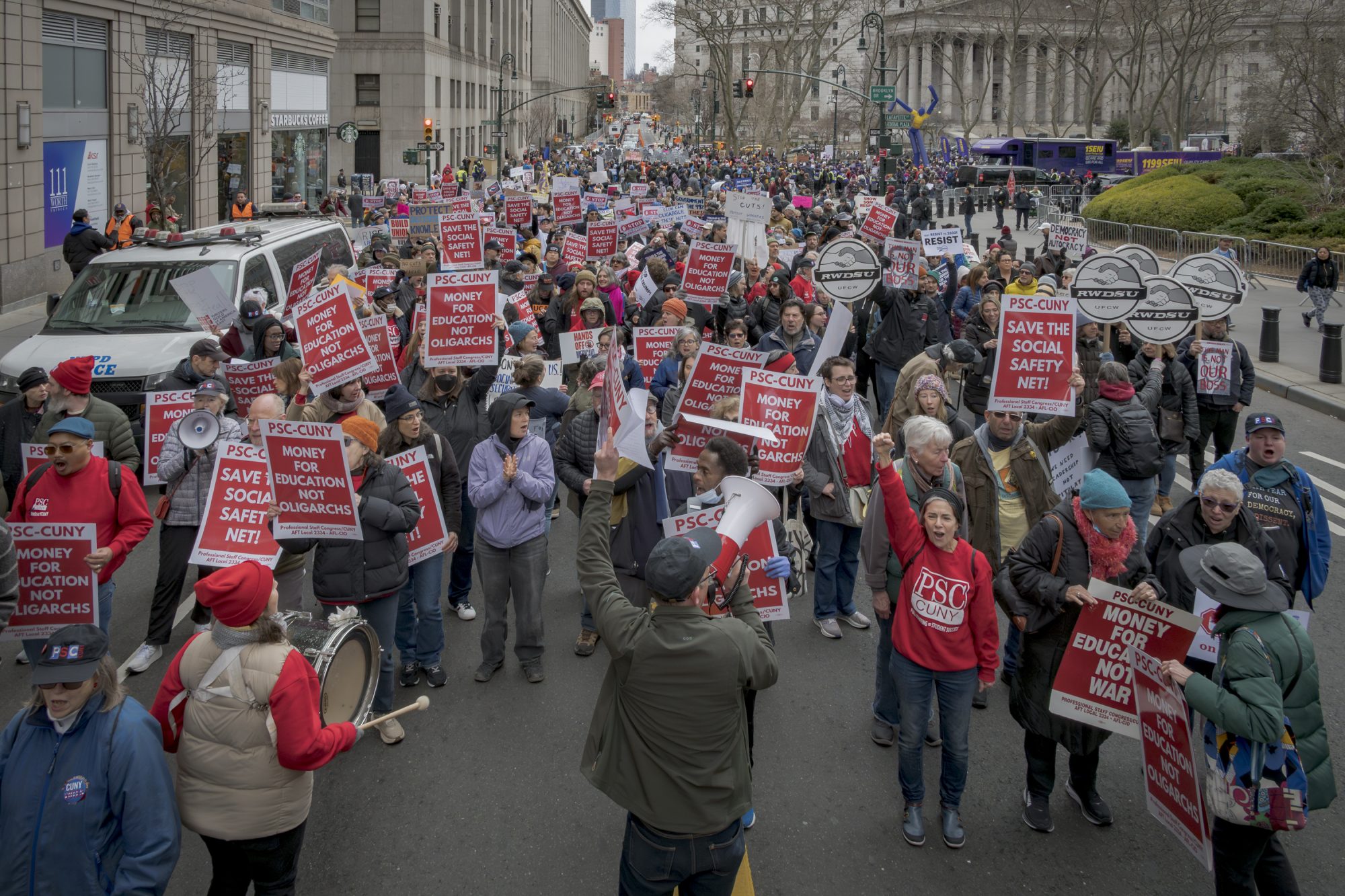
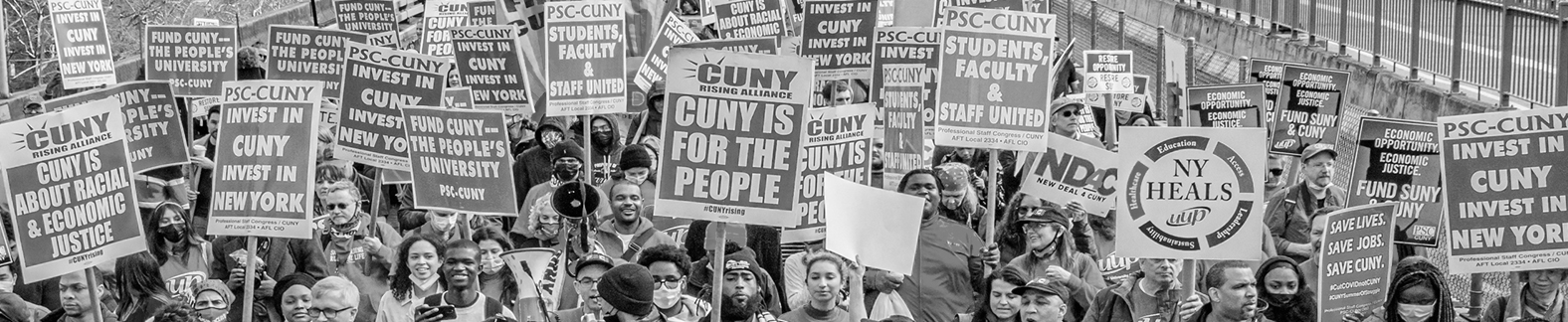
After years of being a part of the Queens College PSC Chapter, the faculty at the CUNY School of Law established their own chapter last year. And this semester, they started putting their energies into action. “Establishing our own PSC chapter allows us to now address Law School-specific issues more directly and effectively,” said Kara Wallis, the chapter chair.
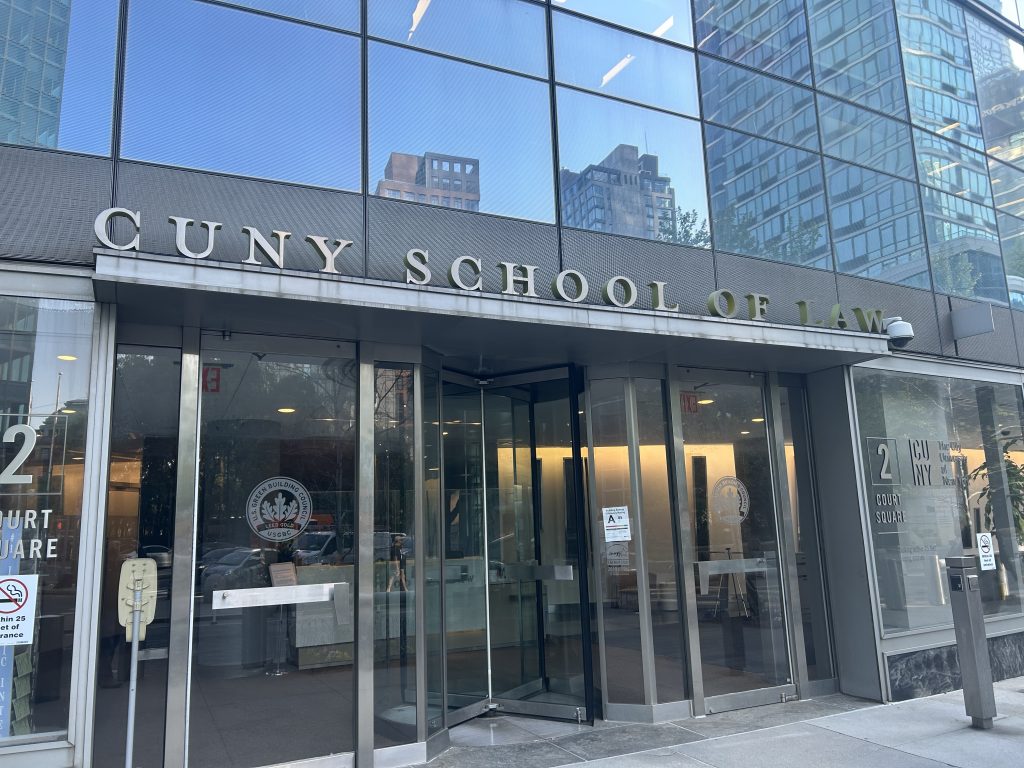
The CUNY School of Law in Long Island City, Queens (Credit: Ari Paul).
While Higher Education Officers belong to a cross-campus HEO chapter, the school’s administration’s indifference to staffing problems and the attrition crisis that emerged after the pandemic have negatively impacted faculty.
“As New York City’s only public law school, we are dedicated to diversifying the profession and producing practice-ready, public interest lawyers who can meet this moment, but that mission cannot be achieved without adequate staffing and resources,” Wallis said.
Faculty at the school are also facing the threats to academic freedom that have been increasing nationwide in recent years, and Wallis hopes that the newly formed chapter will be an avenue for confronting those threats. “Student organizing and legal clinic work has also been met with suppression and threats to academic freedom with little guidance or basic protective leadership from our administration,” she said. “As an American Bar Association accredited law school, the ability to engage in our work free from political interference is essential.”
Indeed, students at the school are circulating a petition calling on the administration to reinstate a student speaker at commencement. In April, students held a press conference denouncing the decision. The previous month Anthony Alessandrini, chair of the union’s academic freedom committee, sent a letter to CUNY Chancellor Félix V. Matos Rodríguez and School of Law Dean Interim Dean Natalie Gomez-Velez in support of the student demand, saying, “we are also concerned that CUNY Law’s revocation of the student speaker may become part of a larger attempt to prevent students from speaking at commencement at other CUNY colleges,” adding that “Attempting to prevent students from speaking at their own graduation goes against every principle upon which CUNY was founded and in the name of which it continues.”
While the new chapter is busily defending faculty and students’ rights, they are also speaking up in solidarity with professional staff colleagues, “fostering a workplace where employees are respected, adequately resourced, and supported in advancing the Law School’s mission,” as Wallis said.
“Many staff members are working out of title, beyond their regular hours, or without sufficient support to meet departmental needs. In response, our chapter is advocating for working conditions that reflect the value of CUNY’s behind-the-scenes public servants. For example, we have called on the administration to proactively reclassify staff and provide business rationales for changes in titles when hiring for vacancies. We have also secured agreement from the administration on clearer processes for future office moves, following a series of destabilizing workspace changes.”
Wallis, an associate professor of law, has a storied career in public-service law like the rest of the faculty at the School of Law, considered a powerhouse for this kind of legal scholarship. According to her official biography, she “was a staff attorney at Bronx Defenders,” and working with the “Southern Poverty Law Center and Florida Legal Services as co-counsel” she “primarily litigated class action challenges to Florida’s draconian use of solitary confinement in its state prisons.”
She is joined by other titans of the legal world in the chapter. The vice chair of the chapter is Frank Deale, the former legal director of the Center for Constitutional Rights. The chapter’s grievance counselors are Babe Howell, a scholar of excessive policing, and Marbré Stahly-Butts, the co-founder and former executive director of Law for Black Lives.
CUNY Law has “such a rich history of using the school as a tool of social justice,” Stahly-Butts said, noting that for a growing number of faculty having their own dedicated union chapter that “we could all be part of at the law school would be a meaningful contribution to worker power and against fascism and authoritarianism.”
Howell added, “Since about 2021, however, the sense of common mission and faculty governance has been replaced by a top down administrative approach with little to no transparency or consultation. Simultaneously, the Law School has become unwilling to speak out to defend justice or condemn injustice. It has even worked to silence its students and deemphasize the achievements of its clinics, faculty, and alumni. It was this loss of both voice and consultation that inspired us to come together and form our own PSC chapter. The chapter gives us a voice for the law faculty to proclaim this institution’s continued role in fighting oppression and injustice and a form to demand the return to joint governance.”
Wallis sees union organizing at the new law school chapter linked to the legal work and scholarship she and her colleagues are known for.
“My teaching and legal scholarship focuses on civil procedure, rule of law, and ethics,” Wallis said. “In this unprecedented time in our nation’s history with extreme attacks on higher education and the public servants generally, I see union engagement as not only essential to my scholarship, but necessary for my survival as a queer, Jewish American woman – only with solidarity among workers and among neighbors will we see our way through this constitutional and civic crisis.”
Stahly-Butts concurred.
“I came out of the Black Lives Matter movement and this idea of movement lawyering. We have to be using and wielding legal tools in a way that is building the power of progressive social movements and enabling us to withstand and fight back against oppressive political power,” she said. “Labor has always been a bulwark of that.”
And Howell said, “If there’s one thing that a life dedicated to attempting to achieve justice through the law teaches, it is that the law may be a tool that can help to avoid atrocious outcomes but to achieve real justice organizing and collective action are needed. As a former defender, my work as an attorney often ameliorated an individual’s or family’s hardships, but my work did not fix the system. Having worked in organizing spaces around over policing and prosecution of communities of color, only collective action holds any promise of real change. We teach our students both the skills to represent individual clients and the patience and humility required to serve as movement lawyers. These skills and commitment to movements are attributes that all the officers of our Law School PSC chapter bring to this work. “
Editor’s note: This article has been updated since it was first published.