As a faculty member in the English department at City Tech, I would love nothing more than to focus on planning classes, developing my own scholarship and contributing to the vibrant creative communities that flourish on campus. Unfortunately, I spend too much of my time and energy as a scholar, educator and community member thinking about how to get CUNY to take seriously concerns on our campus about mold, leaks, rat feces and asbestos.
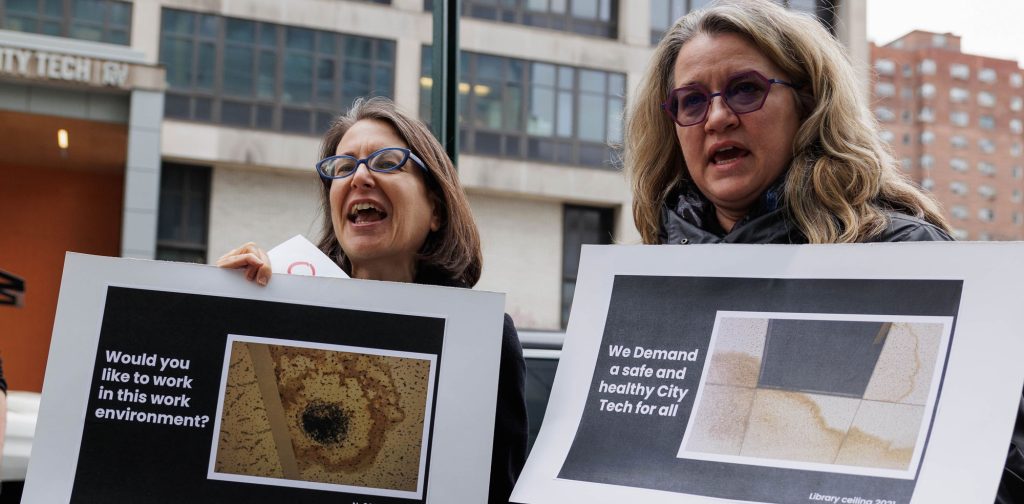
Members protest health problems at City Tech (Credit: Paul Frangipane).
Since at least 2019, City Tech has experienced multiple crises related to health and safety on our campus due to near constant problems of water intrusion throughout our buildings leading to frequent leaks, floods, falling ceiling tiles, and pervasive mold. More disturbing has been the history of denial and intransigence from CUNY administrators in response to our concerns. The refusal to acknowledge and address the gravity of problems related to water intrusion in the building and the failure to investigate and assess the hazards using accepted protocols has only compounded harm and impeded our collective ability to provide a safe, healthy, and welcoming space for CUNY students.
Despite ample evidence of water damage and mold, we have been consistently told by our administration that “there is no mold” and that “mold is not a health hazard.” This despite all available research about the health risks posed by mold and dampness, particularly in a city with one of the highest rates of childhood asthma in the country. In fact, both the World Health Organization and National Institute for Occupational Safety and Health consistently underscore the health dangers of damp or moldy buildings, indicating that persistent dampness and water damage in buildings in and of itself causes health problems. Despite this, faculty, staff, and students at City Tech who have reported negative health effects from mold and construction related debris have been ignored and dismissed.
After half a decade of raising these concerns, it is galling to find out that the administration is in possession of an environmental assessment that shows over 40 classrooms–thousands of square feet of space–in our buildings to be mold infested. This same report discovered rat feces above thousands of square feet of ceiling tiles over the college’s day care. Not only is this disgusting, but it poses serious health risks. The report recommended immediate mold abatement and remediation of these areas by licensed professionals. When this report was brought to our attention, we asked the administration how they planned to address the issues identified. As of our last labor management meeting, there were no plans to address these issues. All the areas identified in the report, including classrooms and the day care center, are still occupied and in active use despite the lack of remediation. No one who works or learns in these areas has been notified of the potential risks.
We are grateful for CUNY’s pursuit of capital projects that may address the long-term structural failings of our campuses that lead to these problems. In the meantime, faculty, staff and students continue to work and learn in unsafe spaces where ceiling tiles regularly fall in and leaks are frequent. Our institutional archives have also seen the destructive impact, including a unique science fiction collection that has seen repeated water damage. Meanwhile, management’s failure to adhere to safety standards to protect employees during construction only compounds the problem.
At City Tech, where active construction is under way in parts of the NAMM and Library buildings, we have faced repeated health risks from construction. In the fall of 2025, a town hall was disrupted by a cloud of thick dust presumed to be caused by nearby construction. The dust lingered in the area for a good twenty minutes. Several members in the audience whipped on masks. Many attendees reported symptoms after the incident, including asthma and congestion. When the incident was brought to the administration’s attention, we were told that no harm had been done and the college declined to do any testing to find out what City Tech community members had been exposed to. According to our chapter’s research into the experiences of City Tech members, this same area of the building was flooded at least five times in the Fall 2025 semester and despite frequent requests, no one has been evacuated from offices or lounges in this area, even as there continue to be construction-related hazards.
While I have only witnessed the issues at City Tech, in talking to CUNY faculty from other campuses, I have learned of similar issues across Brooklyn CUNY campuses. At Brooklyn College, there are also ongoing rodent/wildlife issues in various buildings, frequent leaks, lack of drinking water, persistent elevator and therefore accessibility issues and a tendency to patch up problems on a surface level rather than address the root causes. At Kingsborough, I hear of significant malfunctions in the HVAC system. At Medgar Evers, I hear of extreme water intrusion, flooding, and mold, particularly in the library, destroying archives and degrading learning and working conditions. All of these situations are familiar to me and they speak to the endemic health and safety problems on our campuses.
CUNY students deserve a safe and healthy environment to learn in without mold, rat feces, and persistent flooding. This should not be a radical argument, but an essential function of CUNY’s mission. This requires funds to improve the infrastructure of our learning environments, a commitment to transparency about the state of our campuses, and a willingness to listen to student, faculty and staff concerns and address them rather than deny and delay. We all have an interest in a CUNY that provides a safe and healthy learning and working environment. We can only bring that CUNY into being with a more honest, serious, collaborative approach to facing the health and safety conditions that exist now and transforming them.
Megan Behrent is an associate professor of English at City Tech. This article is an edited version of testimony she delivered to the CUNY Board of Trustees in April. The PSC invites all to a speak out on the health and safety crisis at Brooklyn campuses on April 22, details here.