The White House Office of Management and Budget has proposed a sweeping overhaul of the rules governing billions of dollars of annual federal financial assistance for scientific and social research, healthcare, infrastructure, and more. The proposal would transfer the oversight now conducted by individuals capable of evaluating in an evidence-based manner to political appointees without the expertise or training to make these evaluations. If implemented, the result will be the decimation of the American system that has led the world in the field of research, increasing our health, safety, innovation, and economic well-being, and the dominance of other countries, such as China, willing to invest deeply in research infrastructure. I recently submitted comments to the OMB urging them to withdraw or substantially revise the rule. You should, too, before July 13. Here’s how.
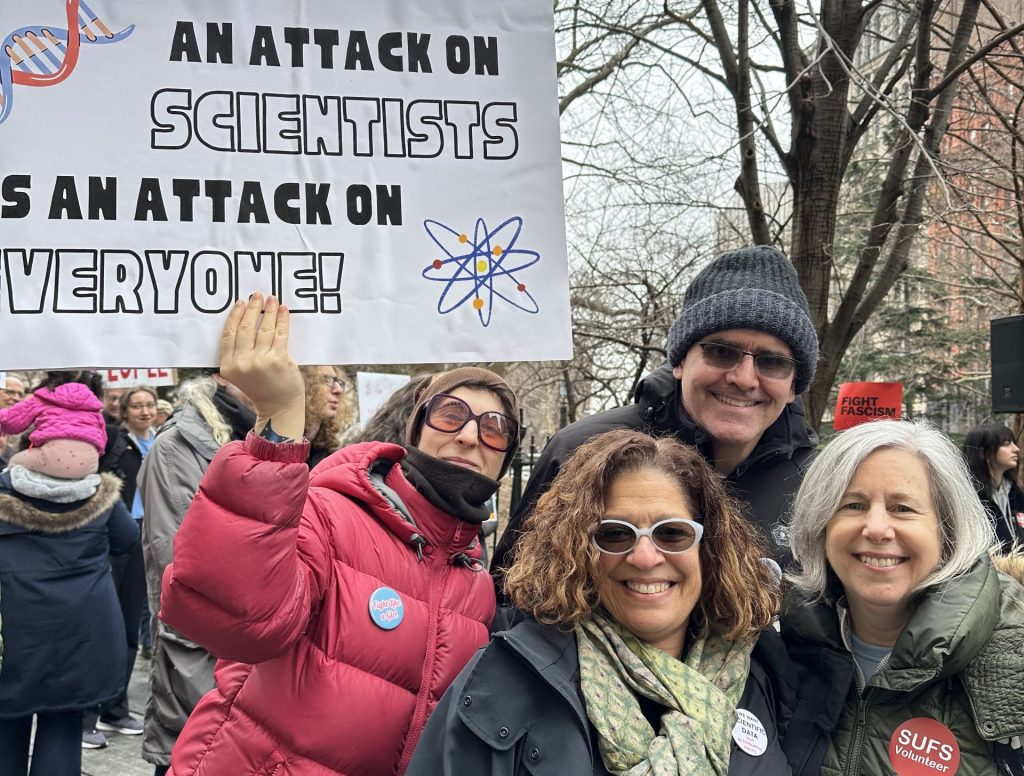
Cathy Savage-Dunn, right, rallying for research (Photo courtesy of Cathy Savage-Dunn).
I am professor and chair of the biology department at Queens College and a member of the PhD Programs in Biology and Biochemistry.. I have been a faculty member for 29 years. My lab is currently supported by a five-year $1.9M research grant from the National Institutes of Health (NIH), and I have served as the Principal Investigator on several federally funded NIH and National Science Foundation (NSF) awards across my career. In addition, I have served as a reviewer on numerous NIH and NSF grant review panels.
The rule change is being driven by OMB Director and Project 2025 co-author Russell Vought through a process that establishes binding government regulations. It calls for pre-issuance review of awards by political appointees, deeming that awards must “…demonstrably advance the President’s policy priorities”. This provision suggests that one person’s opinion should supersede the collective creativity and knowledge of a broad network of experts submitting proposals and expert peers reviewing them. This rule risks ceding to extreme ideologies rather than maintaining rigor and transparency in granting awards.
Diversity, equity and inclusion, global climate change, questions of gender, and many other topics the Trump administration deems “woke” would be ineligible for federal research funding. Research on such unfavored topics has already been dramatically stifled and disrupted.
The draft regulation states that peer review should not be “routinely deferred to”. Peer review is the foundation upon which our success in scientific research has been built since World War II. Peer reviewers work diligently to evaluate all aspects of a scientific proposal, including its impact, its feasibility, its innovation, and how the team and institutional environment will advance its objectives. Competition is fierce: no more than one or two of each 10 proposals will be funded. This system works remarkably well to identify the best science, and should absolutely not be undermined. Turning these decisions over to political appointees is unnecessary and harmful.
Another provision of the draft would allow active grants to be terminated at any time. It has always been true that a grant could be terminated after being funded, though this is typically only done in the event of fraud or a major delinquency of effort. To terminate without a finding of fraud or noncompliance deeply destabilizes the scientific enterprise. Running a research lab is akin to running a small business. I need to recruit and train students and other personnel, purchase equipment and supplies, pay bills and meet payroll, and then produce publications and other deliverables. All of these activities require long-term planning and investment and a stable funding stream. Researchers hired by a lab cannot be subjected to arbitrary and capricious firing. The jobs of more than 150 CUNY employees and fellows were put at risk in the spring of 2025 when the Trump administration began its attempted ideological purge of research funding through a series of executive orders. This provision will have terrible impacts on the training pipeline needed for our ability to address future problems.
My PhD mentor, Nobel Laureate Martin Chalfie, taught me that grants are different from contracts. Research grants are deliberately designed to allow researchers to follow new information and new technologies to perform the most cutting-edge and impactful studies. Research is a fast-moving field at its best, and ideas from 3-5 years ago may well become outdated as the project progresses. It is imperative that researchers not be afraid of following new directions or exploring questions that ideologues would rather not have answered for fear of losing their funding.
Other sections would stifle the exchange of ideas that is fundamental to scientific progress. One provision would disallow payment of publication and article processing costs by federal awards, contradicting the scientific community’s movement towards increasing open access and transparency in disseminating the results of publicly funded research awards. Another would limit collaboration with colleagues in other countries, and another would require researchers to request preapproval of conference attendance at the time of their grant application. I have been an active participant in 1-3 scientific conferences every year of my scientific training and career and have co-organized multiple conferences.A major goal of every conference is to promote communication and exchange of ideas by individuals who weren’t otherwise aware of one another. This exchange occurs prior to publication, at a stage where feedback can dramatically change the course of a project to make discoveries on new ground. To pre-plan conference attendance 3-5 years in advance completely undermines the goal of these conferences.
After much chaos and lost scientific progress, many of the initial attacks on research funding have been reversed by the courts. But Trump, Vought, and their allies have not given up. Court rulings haven’t stopped them from ignoring Congress’ intent to fund research, firing staff, and slowing the current NIH and NSF grantmaking and approval processes to a near standstill. The rate of grant funding this year is lower than it has been in a generation. If the allocated funds are not spent by the end of the fiscal year (Sept 30) they will be returned to the treasury. Now, this latest regulatory tactic is once again threatening to undermine the scientific enterprise and other fields of research from performing and communicating the most impactful and timely projects. The current system of peer review should not be dismantled.
Cathy Savage-Dunn is the chair of the biology department at Queens College and professor at the Graduate Center. An earlier version of this article was submitted as commentary to the Office of Management and Budget.