FOR IMMEDIATE RELEASE: Wednesday, February 25, 2026
Students, Faculty and Staff Rally with Legislators for Increased Funding for SUNY, CUNY, Financial Aid
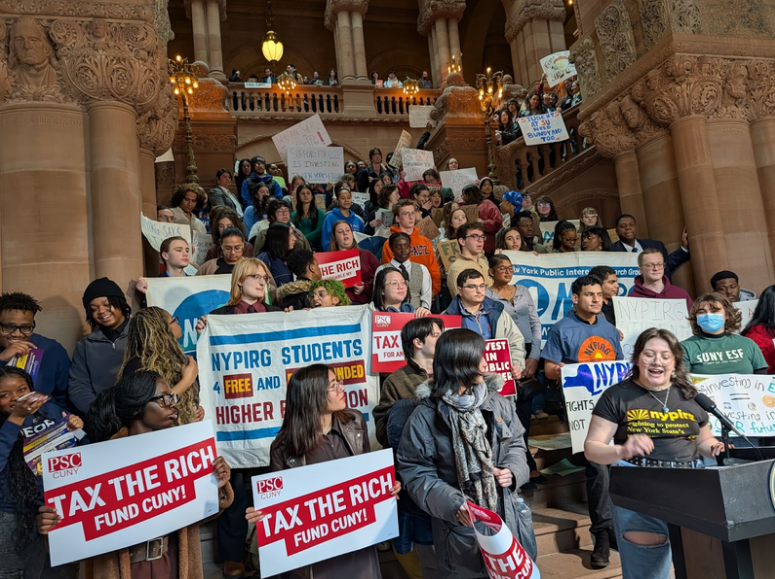
(Albany, NY) – More than 300 students, faculty, and staff from City University of New York, State University of New York, and independent colleges rallied with legislators today inside the state Capitol to support a platform of increased funding for New York’s public university systems, broader access to free tuition, more financial aid, and higher taxes on corporations and the rich to help sustain those investments.
A coalition of student organizations, academic unions, and community groups held the rally to kick off their Higher Education Action Day before meeting with 100 legislators. Participants bused and carpooled from as far as Buffalo, Plattsburgh, New York City and Stony Brook to join the action.
While Gov. Kathy Hochul has proposed modest increases in funding for CUNY and SUNY, her Executive Budget falls short of the reinvestment needed to make up for years of disinvestment and mounting federal cuts. New funding is also needed to support program enhancements and to cover the costs of enrollment growth.
The groups are calling for increases over the Executive Budget of more than $250 million for CUNY and SUNY senior colleges and community colleges: $108 million for CUNY to hire full-time faculty, advisors and mental health counselors, $100 million across the SUNY system to support program enhancements and cover the costs of recent enrollment growth, plus $41.8 million to close budget deficits at SUNY colleges.
Most state-operated colleges in the sprawling SUNY system are still facing budget shortfalls due to SUNY’s inequitable allocation of state funds and four campuses are in full-on crisis: SUNY College of Environmental Science and Forestry ($8.3M deficit), Buffalo State University ($16M deficit), SUNY Fredonia ($11M deficit), and SUNY Potsdam ($6.5M deficit). At CUNY’s 25 colleges and schools, the staffing gains from prior budget cycles have been eroded by faculty attrition, leaving the system vastly understaffed.
Gov. Hochul is also seeking to expand SUNY and CUNY Reconnect, the rebranded program of free community college for students ages 25-55 in high-demand fields that was called the Opportunity Promise Scholarship in last year’s budget. The coalition supports Reconnect as a step toward universally free higher education, but is urging the state to fund thousands of new full-time faculty and staff to accommodate the new students–more than 5,600 at the SUNY community colleges and almost 5,900 at the CUNY community colleges.
“I’m so proud to be in the Capitol today for Higher Education Action Day, with hundreds of students from every corner of New York,” said Daniel Bayer, Chairperson for NYPIRG and College of Staten Island student. “The leaders of tomorrow are the college students of today – we know an educated public is the key to a bright future for New York State. Increasing state investment to fully fund CUNY and SUNY and to expand financial aid and opportunity programs means everyone gets the resources necessary to succeed. We are looking to Governor Hochul and the legislature to be a champion for students, faculty, staff, and the higher education system as a whole.”
State Senators John Liu and Lea Webb joined Assemblymembers Demond Meeks, Karines Reyes, Jessica Gonzalez-Rojas, Linda Rosenthal and NYC Council Higher Education Chair Rita Joseph at the rally. They spoke passionately about the need to support public higher education.
“There is no better investment the state of New York can make than in funding for our public universities. Governor Hochul made a good start in her Executive Budget, but we need more!” said Senator John Liu.
“We know that our communities can not thrive if our higher education institutions are not fully funded. But we also know our higher education institutions are major leveragers of investment, economic development, community engagement, and so much more,” said Senator Lea Webb.
“We want New York students to be able to be prepared and compete in a global marketplace. The way we do that is to ensure that we fully fund our City University of New York,” said Assemblymember Karines Reyes, sponsor of the New Deal for CUNY legislation to make CUNY free and fully funded.
“Tax the rich fund CUNY! Tax the Rich fund SUNY!Tax the rich. Fund needed social programs throughout New York State!” said Assemblymember Demond Meeks.
“As a proud champion of public education, I stand in solidarity with the faculty, staff, students, and advocates calling for meaningful investment in the City University of New York and the State University of New York. These institutions are engines of opportunity for working families, but opportunity requires sustained funding. We must address the more than $250 million needed to hire full-time faculty, advisors, mental health counselors, support enrollment growth, and close dangerous budget deficits. Expanding SUNY and CUNY Reconnect is an important step toward free higher education, but access must be matched with adequate staffing and resources to ensure student success. New York should invest boldly in its public universities and ask the wealthiest corporations and individuals to pay their fair share, so every student has a real pathway to opportunity,” said Council Member Rita Joseph, Chair, NYC Council Committee on Higher Education.
New York’s public higher education systems provide hundreds of thousands of New Yorkers with a high-quality, accessible and affordable education. The community colleges are the first entryway to higher education for many New Yorkers and a crucial part of the state’s workforce development system. The SUNY teaching hospitals educate the next generation of health care workers and provide critical care regardless of patients’ ability to pay. Yet CUNY and SUNY are woefully underfunded, even after recent state investments.
PSC/CUNY members are proud to educate the students of the City University of New York. But after significant faculty and staff attrition and a three-year surge in enrollment, we need increased funding in this state budget to hire full-time faculty, advisors, and mental health counselors that will help provide students the support they need to succeed and thrive. A streak of good state budgets thanks to the Governor and the Legislature has helped, as have CUNY Reconnect and TAP enhancements, but CUNY remains underfunded. That’s why we’re urging Albany to invest $108 million more in CUNY and to enact revenue raising policies to support future investments,”said James Davis, President of the Professional Staff Congress/CUNY.
“We thank the Governor and the Legislature for their ongoing commitment to public higher education. Over the last three years, they have provided significant increases to SUNY and CUNY. Unfortunately, public higher education has been under attack from the federal government. We need to push back on these attacks and protect the incredible work that happens every day at our colleges, our universities and our public teaching hospitals. Now more than ever, we need to continue the progress we have made to ensure that campuses have the resources they need to provide the highest quality of academic programs and services that students need and deserve,” said Frederick E. Kowal, president of United University Professions.
“Access to a college degree is only half the battle; the other half is ensuring students have the support they need to actually cross the finish line. We know what works. Programs like the Educational Opportunity Program have a decades-long track record of taking students from under-resourced backgrounds and turning them into New York’s next generation of doctors, teachers, and leaders. But right now, the demand for these life-changing programs far outstrips the funding. We are calling on the State to not only protect but significantly expand investment in opportunity programs and campus infrastructure. True affordability isn’t just about a lower tuition bill, it’s about ensuring that every SUNY student has a safe campus to learn on, a reliable way to get there, and a support system that doesn’t let them fall through the cracks.
From expanding the SUNY Reconnect initiative to achieving a tuition-free future, our goal is clear: New York must lead in making higher education a public good, not a private luxury. When we invest in our students, the entire state benefits from it,” said Maria Fernanda Armas Galin Senior Director of Government Relations, SUNY Student Assembly.
The groups are advocating for financial aid reforms and movement toward a tuition-free future. As a first step toward achieving universal free tuition, they are urging the Legislature to expand the Governor’s SUNY and CUNY Reconnect program to offer free associates degrees for students starting at age 18 at any SUNY or CUNY college offering programs in the designated high-demand fields. The second step would be to make the first 60 credits free at all SUNY and CUNY colleges.
They are also calling for infrastructure investments, restorations and increases for the state’s opportunity programs and for free OMNY Cards for CUNY students and other investments that promote student retention and success.
“CUNY represents more than 240,000 students across New York City, and for too many of them, the biggest barrier to success is simply getting to class. Transportation access is not a luxury; it is a necessity. Free OMNY cards for CUNY students would remove one of the most immediate financial burdens our students face, increase retention and graduation rates, and directly strengthen New York’s workforce. Through the CUNY University Student Senate Student Commuter Grant Pilot Program, we are calling for a $1.4 million investment, with $700,000 from the state and $700,000 from the city, to launch a targeted pilot that prioritizes student parents, students with disabilities, and other high need populations. When we eliminate transportation barriers, we make it possible for students to show up, stay enrolled, and succeed. At the same time, we must continue strengthening CUNY CARES and other basic needs initiatives that address food insecurity, mental health support, and student homelessness. Transportation access and student support services must move together, but they are distinct investments that require bold and intentional funding. If we are serious about equity, we must fund both. Investing in our students means removing barriers and reinforcing the systems that help them thrive,” said Akkeem Polack, CUNY Trustee, University Student Senate Chairperson.
“Students across New York are doing everything right: enrolling in college, working, and pursuing degrees that strengthen their families, their communities, and our workforce. Yet too many of our students are forced to navigate impossible financial tradeoffs just to stay enrolled. Sustained investment in SUNY and CUNY, alongside modernized financial aid, is critical to ensuring students can complete their degrees and fully participate in New York’s economic future,” said Melissa Clarke, NY Policy Director at uAspire.
“We are proud to be part of a Statewide coalition that champions access to higher education for students with disabilities among its priorities. It’s time that New York stopped excluding students with Intellectual Disabilities from applying for the State’s basic student financial aid grant,” said Luis “Junior” Alvarez, chair of the CUNY Coalition for Students with Disabilities (CCSD), an advocacy group representing CUNY’s 14,000 self-identified students with disabilities.
CCSD is urging the state legislature and the governor to support CUNY’s request for a $5.2 million investment in services for students with disabilities, particularly in the area of Assistive Technology services. The group is also calling for a budget restoration and increase for the State Education Department’s program to enhance services for postsecondary students and for passage of legislation to allow students with Intellectual Disabilities in certain transition programs to be eligible to apply for TAP.
“At a time when higher education is under attack, New York must double down on our investments in our students, our schools, our financial aid, our counselors and staff, our basic needs supports (food, housing, and mental health), and yes – our diversity, equity, and inclusion policies too. Every student should have belonging and support on the road to a degree and a good job. Our students, advocates, and alumni are grateful for this opportunity to meet with their legislators, share their experiences, and ignite more passion for progress.” said Sean Miller, Northeast Regional Director at Young Invincibles, a leading national young adult policy and advocacy organization.
###
The Professional Staff Congress (NYSUT, AFT Local 2334), represents 30,000 faculty and professional staff at the City University of New York.
United University Professions UUP is the nation’s largest higher education union, with more than 42,000 academic and professional faculty and retirees.
NYSUT is a federation of more than 1,200 local unions, each representing its own members. NYSUT represents more than 600,000 members who work in, or are retired from, New York’s schools, colleges, and health care facilities.
The New York Public Interest Research Group’s (NYPIRG) mission is to give students an array of extracurricular activities and opportunities to participate in important public policy discussions, through which they can learn a wide range of valuable skills, contributing to a well-rounded educational experience.
The SUNY Student Assembly is the official representative organization for SUNY students. Comprised of community colleges, Agricultural and Technology Institutes, Statutory Colleges, University Colleges, and Doctoral Granting Institutions, SUNY is the largest public university system in the United States, serving over 1.3 million students each year.
The University Student Senate’s mission is to preserve accessibility, affordability, and excellence of higher education at CUNY. The USS delegates are responsible for the representative governance of the 500,000 students at CUNY’s 25 institutions.
uAspire believes that every student should have equitable access to postsecondary access to live the life they envision. Its mission is to improve the economic mobility of underrepresented students by creating financial solutions to diverse postsecondary pathways. uAspire started 40 years ago and impacts 1.5 million students nationwide.
Young Invincibles empowers the next generation by amplifying young voices in the fight for affordable education, accessible health care, and meaningful career opportunities. Through research, advocacy, storytelling, and youth-led action, we break down barriers to ensure every young person — regardless of background — has a fair shot at success.
The CUNY Coalition for Students with Disabilities (CCSD) is a coalition of student clubs/organizations aimed at protecting students’ rights, in particular students with disabilities. CCSD strives to increase awareness, opportunity and foster community amongst CUNY’s more than 11,000 students with disabilities.
The CUNY Rising Alliance is a coalition of student, labor, and community organizations fighting for a free and quality CUNY and to ensure that CUNY provides communities and students with access to quality higher education.
Published: February 25, 2026 | Last Modified: February 27, 2026