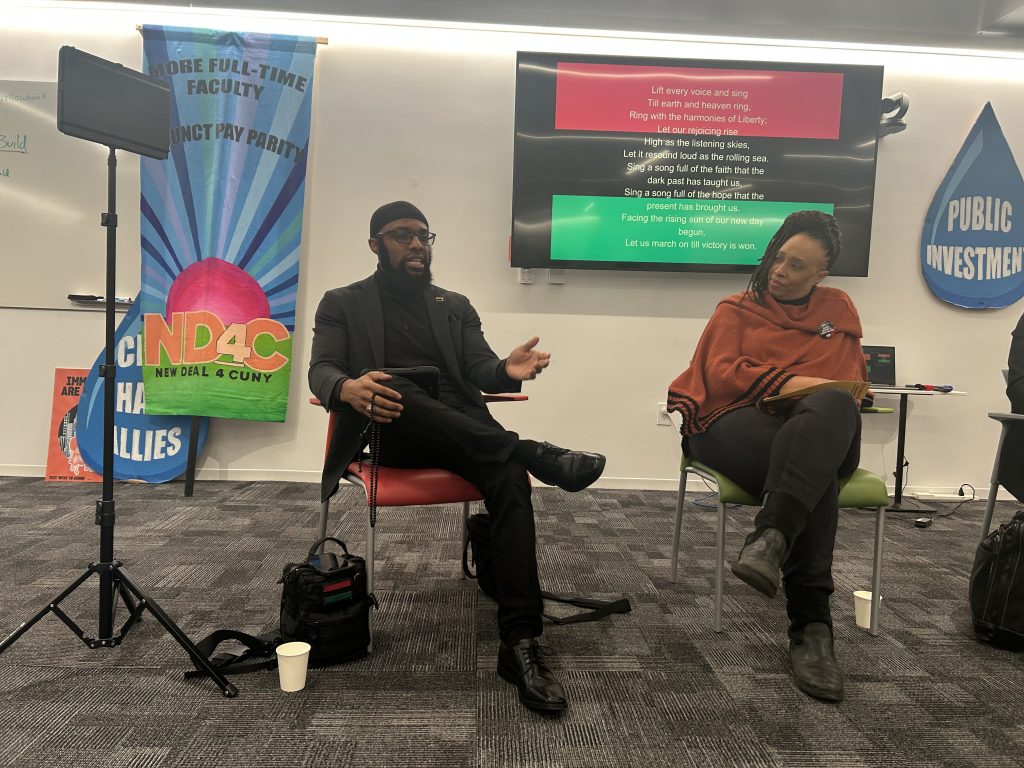
Jamel Coy Hudson (left) with Alethia Jones.
To mark the 100th anniversary of Black History Month, the union’s BIPOC Working Group examined the role of Black labor leadership in the current moment before a packed audience at a panel event at the union’s headquarters on February 4.
Jamel Coy Hudson, a lecturer in communications at Baruch College, moderated the event with Alethia Jones, distinguished lecturer at the School of Labor and Urban Studies; Cameron Black, assistant professor at SLU, Janella Hinds, vice president at the United Federation of Teachers and secretary-treasurer of the NYC Central Labor Council; and J. Philippe Abraham, secretary-treasurer at the union’s state affiliate, NYSUT.
Hudson said the event was meant to explore how Black labor leaders “navigate in our skin,” asking the panelists what brought them to labor leadership and union activism.
Abraham said that growing up in Haiti taught him the need “to be a voice,” and when the United University Professions helped him with workplace issues when he was a staffer at SUNY-Albany, the union recognized his talents and he moved up through the leadership ranks. “I had an instinct of wanting to help, so I kept going,” he said.
Hinds said that she was inspired by her father, a Panamanian immigrant and airplane mechanic who took on a second career as a New York City school teacher. When she was having money troubles as a young adult, he encouraged her to get a job in the education system, knowing that teaching offered a steady income and a pension. That’s when she started as a substitute teacher, but with the mindset of a trade unionist–her father was also a union rep. “When I started teaching, I was very clear that I had a collective bargaining agreement and that I had rights,” Hinds said.
Black grew up in Florida, and didn’t know much about unions growing up, other than that he was taught that they were only for white people. When he attended college at Stetson University, he successfully organized a group of Black students to advocate for the removal of a public portrait of one of the school’s founders, who was a member of the Ku Klux Klan. When the administration finally acquiesced to the pressure, he became inspired by the power of organizing.
Jones grew up in Jamaica and saw firsthand how the United States Cold War interventionism in her country tore it apart politically. When she came to the United States, she didn’t see herself embracing the so-called American Dream, but instead, as someone running from imperial bellicosity. “We were pushed out by US foreign policy,” Jones said.
The panelists discussed what it means to be a Black trade unionist in America in a political climate that is fueled with extreme racism and billionaire-backed anti-worker sentiment. Jones made the point that Black union leadership is truly about lifting all workers, saying Black leaders are fighting “for a better society for everyone.”
Abraham cited the example of Claude Cummings, the president of the Communications Workers of America. Abraham noted that it is important for Black workers to see that their unions do, in fact, have Black people at the face of the organization. “Folks are able to see us as true leaders,” he said. “It’s important for people of color to be elevated to union leadership.”
All of the panelists agreed that Black union leadership isn’t just about union presidents and vice presidents, but about rank-and-file unionists coming together and building power. “Leadership is not about a title,” Jones said. “It’s about an attitude, something we all possess.”
The BIPOC Working Group will continue their celebration of Black history with a social media campaign posting Member Mondays and Historical Fridays content throughout the month. PSC members can also RSVP to participate in an art build sponsored by the working group on Thursday, February 26th at 6 PM in the union hall.
Published: February 5, 2026 | Last Modified: February 11, 2026