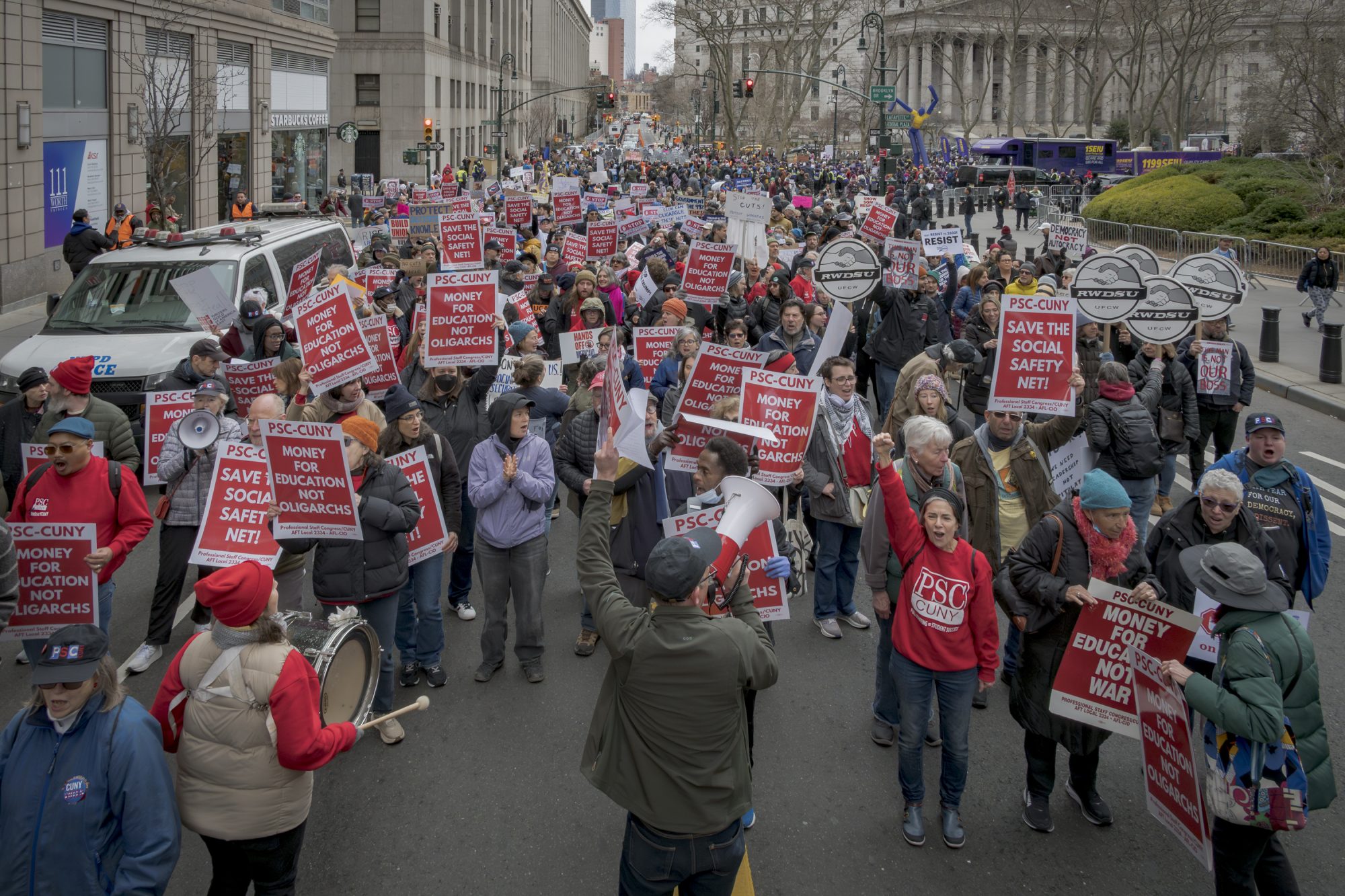
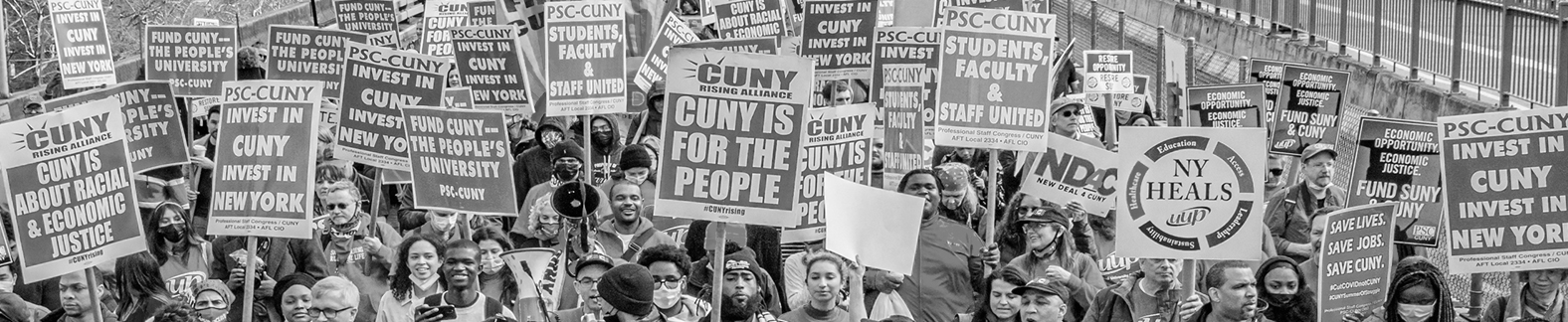
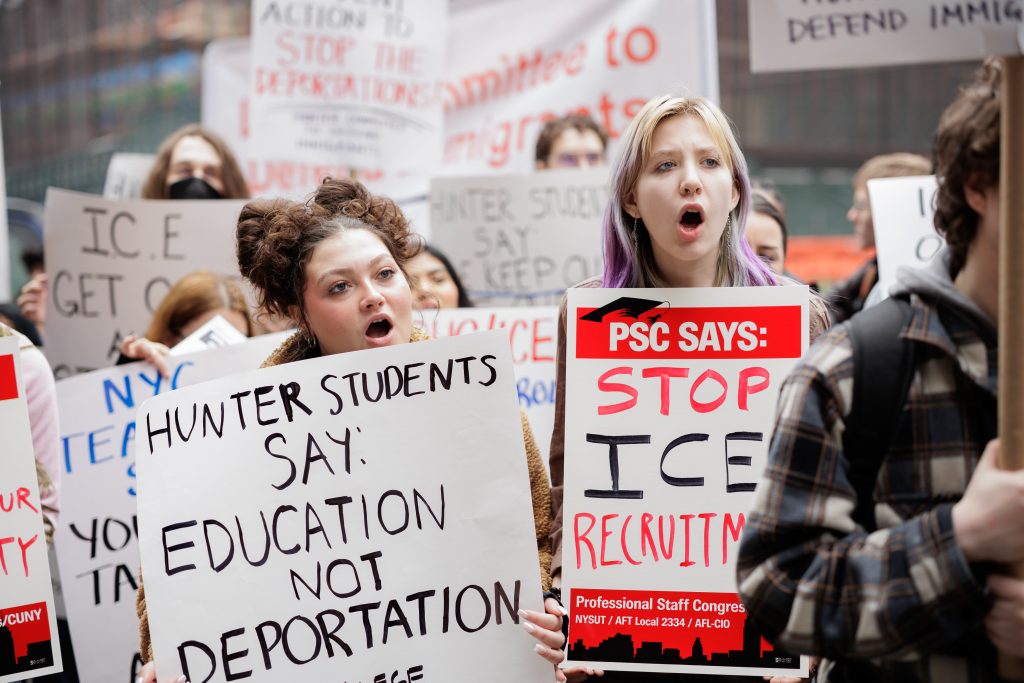
An anti-ICE and anti-DHS protest at John Jay College, during a recruitment event, last year. (Credit: Paul Frangipane)
Events in Minneapolis are on the minds of labor activists everywhere. For us in the PSC, these events redouble our determination to fight for immigrant rights, which are inseparable from the rights of all working people. And they highlight the importance of building still further the activities and membership of our union’s Immigrant Solidarity Working Group (ISWG). A key part of this is building ISWG teams on every CUNY campus and strengthening their connections with immigrant communities.
Philadelphia has been mentioned as a likely target; will NYC be next? As part of building labor’s power and bringing it into the struggle to stop the raids and deportations, every union and workplace should build its own committee for the defense of immigrant rights.
In late January I traveled to Minneapolis, where I met up with some friends who are unionists in Los Angeles and Portland, Oregon, as well as in the NYC Labor Committee to Defend Immigrants, which is made up of activists in a range of unions. We wanted to show solidarity with the courageous fight by Twin Cities workers, students and community members, and to see for ourselves the huge “ICE Out” mobilization scheduled for January 23.
On that Friday morning, the temperature in Minneapolis was –21 degrees. This did not deter the hundreds of Twin Cities unionists who came out for the day’s first protest, at the Minneapolis airport – nor the estimated 50,000 Minnesotans who came to that afternoon’s rally and march against ICE terror. Showing that the murder of Renee Good would not intimidate or silence them or stop their intensive organizing and resistance, they have inspired millions across the U.S. At the rally, I found the contingent from our sister union at Winona State University – whose president Jenna Chernega recently addressed the PSC Delegate Assembly – and gave them some PSC-ISWG buttons reading “Education Not Deportation.”
But what did the federal occupation forces do the very next day? At about 9 a.m. on the morning of Saturday, January 24, word spread that on Nicollet Avenue in the Whittier neighborhood, home to many immigrant families, DHS agents had shot and killed another person. (Only hours later did we learn his identity: Alex Pretti, a Veteran Affairs Hospital nurse and member of American Federation of Government Employees Local 3669.) Protesters were gathering at the site of the murder, and we decided to join them.
The smell and taste of tear gas hung in the air, but the feds had taken off. A small memorial to their latest victim was being built by some young people on the spot where, as all of us have surely seen by now on video, he was quite literally executed. Half a block away, protesters were leading chants and a crowd had gathered in the street. I wanted to tell them that we at CUNY are with them. From the top of a large dumpster, I told the crowd that in New York the previous day, many thousands, including members of a lot of the city’s unions, had marched in solidarity with Minneapolis, demanding “ICE Out” of Minnesota, New York and everywhere.
As the crowd chanted “Say his name,” I learned for the first time the name of Alex Pretti, and said that his name and that of Renee Good, together with the name of George Floyd – whose murder by Minneapolis police sparked the millions-strong anti-racist protests of 2020 – join those of at least 32 immigrants who died in ICE detention last year. Yet the names of these immigrants – such as that of Geraldo Lunas Campos, asphyxiated on January 3 in a West Texas detention camp, or Silverio Villegas González, shot to death by an ICE agent in a Chicago suburb last September – are rarely mentioned, and that needs to change.
It’s important to remember the 1934 general strike in Minneapolis, one of three that year that paved the way for the mass union organizing drives of the 1930s. Noting that I was expressing my own views and not speaking on behalf of the union, I said that while the previous day’s massive protest showed the population’s inspiring determination and refusal to be silenced, it was still not a real general strike bringing out labor’s power – and some unions that joined in calling the action told their members to stay on the job if they had no-strike clauses in their contracts (which most do). The job of organizing one remains. Workers’ mass collective power needs to be brought into the fight, and this means facing and overcoming the obstacles to doing that.
From NYC, Philly and Memphis to Chicago and Minneapolis to the West Coast, labor strikes and mass worker/student mobilizations must be built and carried out, if we are to defeat ICE terror and the accelerating drive for a police state. A real general strike by Minnesota’s working class, like the one in ’34 that shut down the city’s transport, industry and commerce, would be an enormous step forward. What is the central reason why one has not occurred so far? The unions’ power is chained, not only by no-strike clauses and the punitive anti-strike statutes in many states their leaders cite to justify not striking, but by the political chains binding labor.
Democratic presidents Obama and Biden expanded ICE and built up the deportation machinery wielded by Trump’s administration today. It’s true that feds killed Alex Pretti, but Minnesota state police arrested protesters the previous day, while Democrats are the bosses of the police (including those who killed George Floyd) in cities across the U.S. Today in Minneapolis, Chicago, Los Angeles, D.C. and elsewhere, police under the command of Democratic mayors have shielded the ICE and Border Patrol Gestapo, arresting scores of protesters in the name of “public safety.” To unchain workers’ huge potential power, to stop the raids and deportations, labor must free itself from capitalist parties and politicians. What’s needed is a workers party dedicated to carrying through to the end such struggles as the one we need today for a Twin Cities general strike to force ICE out.
A couple of days later, on another stunningly cold morning, my friends and I ate at Al’s Breakfast in the Dinkytown neighborhood, which has been famous since before most of us were born. On the door was a sign reading “Everyone Welcome, Except ICE.” Signs like that were everywhere in the city. The spirit of Minneapolis today is one of solidarity and courage. What we saw there will stay with us for a long time.
What I saw in Minneapolis deepened not only my desire to help build that solidarity but my conviction that to win the fight that faces us, we must wage it as a class struggle pitting the full power of the workers and oppressed against the drive to crush the rights of us all. Minneapolis shows once again that this is no easy task, and we must claim no easy victories. But it also shows the validity of a motto long popularized by teacher unionists in Mexico, who are no stranger to capitalist state repression: la lucha educa – struggle educates. The struggle of our fellow workers and students in Minneapolis, whose courage is contagious, is helping to educate millions and inspire our side with the determination to win.
Sándor John, an adjunct at Hunter College who teaches Latin American and U.S. history, is a member of the PSC’s Immigrant Solidarity Working Group.
Published: February 5, 2026 | Last Modified: February 6, 2026