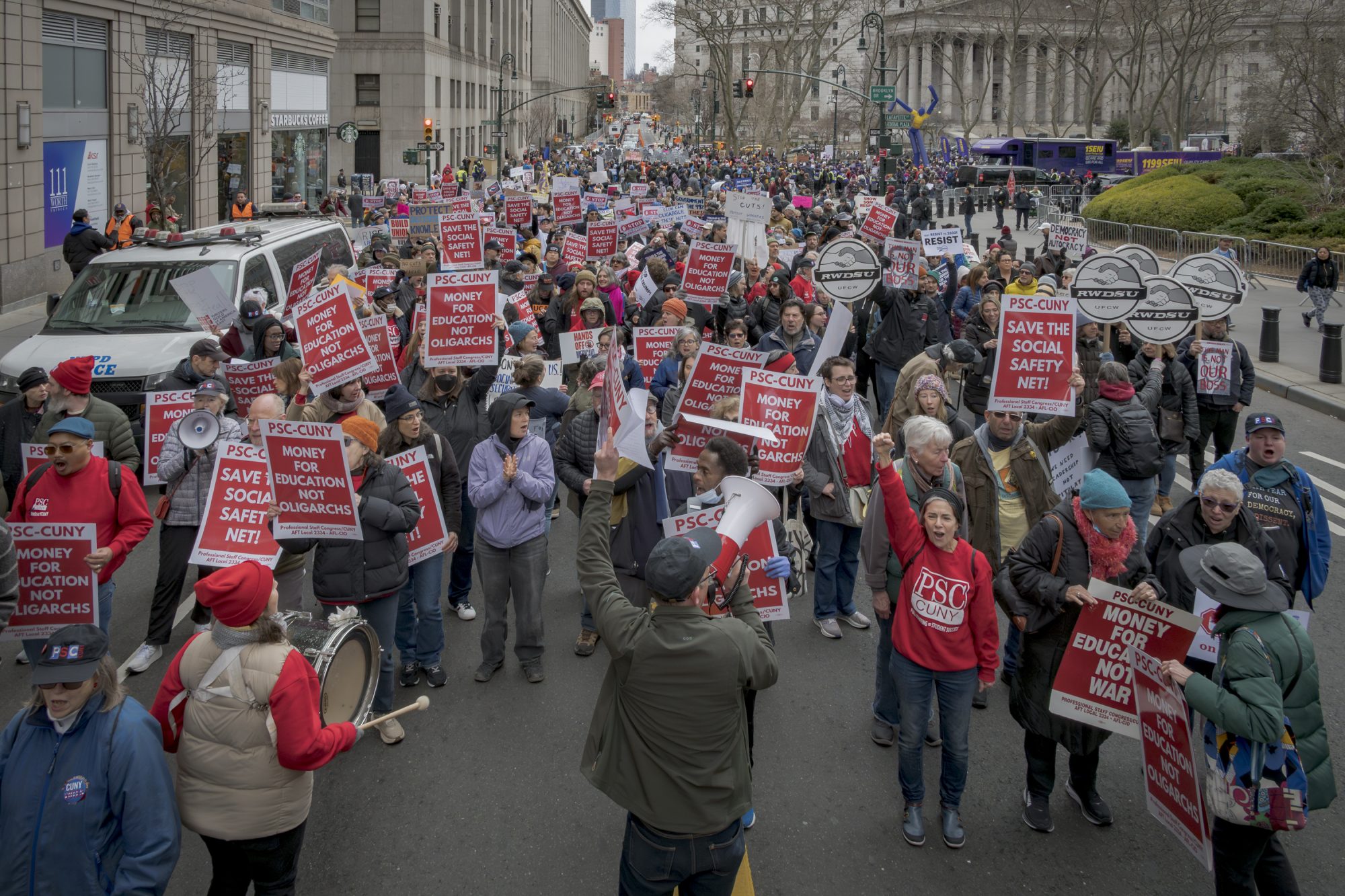
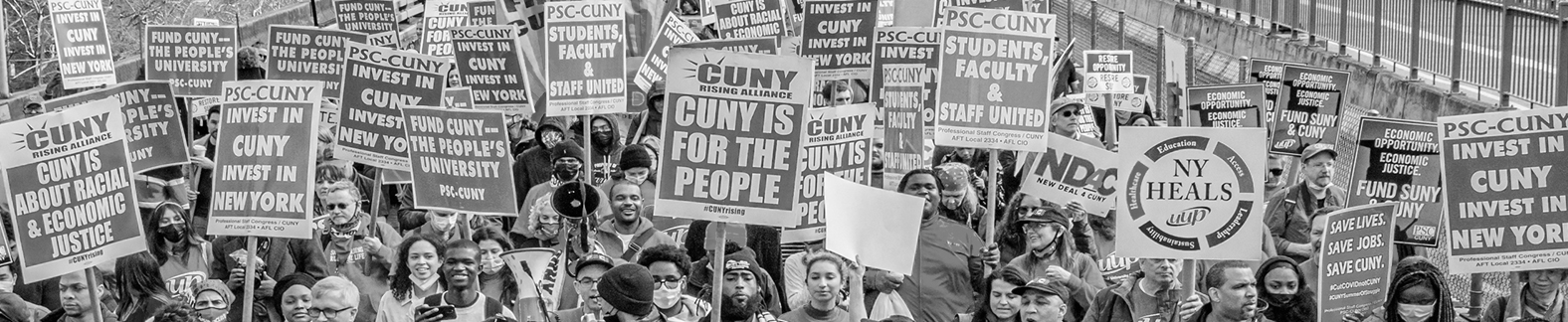
The PSC and other unions have been fighting for more than a decade to reverse cuts to New York’s public-sector pensions. Lately, the labor movement has been winning.
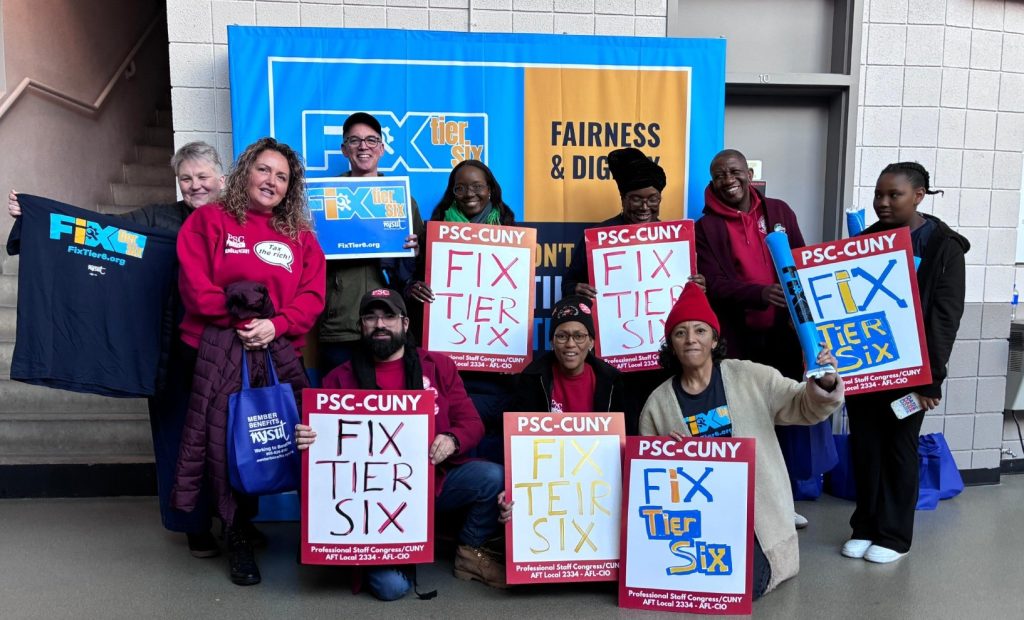
Members fight for pension reform in Albany.
During his first term in office, Governor Andrew Cuomo strong-armed the state legislature into adopting a new pension tier that cut pensions for state employees hired after April 1, 2012. Tier 6, which now covers two-thirds of state workers including CUNY faculty and staff, requires workers to pay more out of pocket than workers in lower tiers. It also sets a later retirement age and has worse early retirement terms than the pensions available to earlier hires. The changes were particularly hard on CUNY adjuncts.
The PSC has been opposed to Tier 6 from the beginning. President Barbara Bowen, the PSC president at the time, was quoted in Clarion saying, Cuomo’s imposition of new pension tiers “was pure political opportunism,” in which he joined with Republicans who blamed the state’s budget woes on compensation for state workers. She added, “A lower pension tier is a bogus solution to the state budget deficit.”
PSC members joined 15,000 other union activists in Albany at a “Fix Tier Six” rally organized by our statewide affiliate NYSUT on March 8. Jeff Ballerini, an academic adviser at Queensborough Community College, was among the members who signed up.
“I think those who assume public service, whether that’s in higher education or K-12 or the unformed services, the state has made a compact with us: in return for years of dedication, hard work and support they would acknowledge that by investing in public funds ensuring that we’re adequately compensated for those efforts,” he said.
For Ballerini, Tier 6 undermined that promise by degrading pension benefits. He believed that fighting to fix Tier 6 was linked with the union’s current demands of Governor Kathy Hochul and state lawmakers to tax the rich to fund CUNY and other vital services.
“Fixing Tier 6 really dovetails into the revenue demands,” he said. “We want to make sure New York is supporting its citizens, including its public-sector workers.”
“Tier 6 has created a second-class retirement status for public employees, including faculty and staff in CUNY,” said Kevin Adams, director of community standards and student conduct officer at Medgar Evers College. “While previous tiers offered a more predictable and secure path to retirement, Tier 6 requires members to work longer, contribute more, and receive less.”
Adams, who attended the rally, added, “This tier creates a ‘pension penalty’ for younger and newer employees. It makes it harder for CUNY to recruit top talent and retain experienced staff when they see that their total compensation and retirement security are significantly lower than the colleagues sitting right next to them.”
“I have friends and relatives who will personally benefit from the restoring of benefits,” said Diane Menna, co-chair of the PSC Pension Committee. “I am very much involved with details about contributions and benefits of active members and know in concrete numbers the significant differences between benefits for Tier 4 members versus Tier 6 members.” She added, “If we want to continue to attract top rate professionals to our schools and universities, a vital element is decent retirement benefits.”
Governor Hochul attended the rally and vowed reform. “The governor says she’s in support of a more equitable plan after making previous changes to Tier 6 in 2022,” Spectrum News reported, quoting her saying at the rally, “We’re taking a shorter vesting period from 10 years down to five. And also, I’m fighting for a fairer pension plan because it’s essential that we continue recruiting people.”
City and state unions have long recognized the inequalities created by Tier 6. According to NYSUT, the PSC’s state affiliate, “Tier 6 members pay 3 to 6 percent of their salaries into the pension system their entire career — and their contributions grow with pay raises, Tier 4 member contributions are capped at 3 percent and end after 10 years, Tier 6 members must work to age 63, up to 40 years of service, or face heavy penalties” while “Tier 4 members can retire at 55 with 30 years of service.”
Progress has been made, however, thanks to union advocacy. In 2022, the 10-year vesting period enacted with Tiers 5 and 6 was reduced to 5 years. Halving the vesting period to match Tier 4 guaranteed a pension benefit for 85,000 Tier 6 members, according to the UFT. In 2024, the Final Average Salary calculation was reformed to allow for more generous payouts.
NYSUT, UFT, PSC and other unions are now pushing to lower the Tier 6 retirement age and reduce members’ out-of-pocket contributions.
These last points were major demands at the Albany rally. The Public Employees Federation, which also participated in the rally, explained the demand to lower the pension contribution for all employees: “A higher percentage for newer workers is a disincentive for them to make a career in public employment and penalizes those who receive promotions or negotiated raises.”
Like other unions, PEF also called for the state to “Eliminate arbitrary retirement penalties for career employees: Workers who commit their careers to a public employer should not be penalized when it is time to retire. Make retirement eligibility for members in Tiers 5 and 6 the same as for members in Tier 4 by allowing full retirement benefit for any member who is age 55 or older and has worked for 30 or more years.”
Published: March 9, 2026 | Last Modified: March 15, 2026