For Howard Prince, the grievance process isn’t just a part of trade unionism but a centerpiece of trade unionism. “Grievances are the guts of the union,” he said. “It really matters the most in respect to members.”
Prince, a grievance counselor for nearly 50 years, added, “It is emotionally satisfying when you know you can help someone who’s in trouble. You feel good about yourself knowing that you were able to help someone Who do they turn to? The union.”
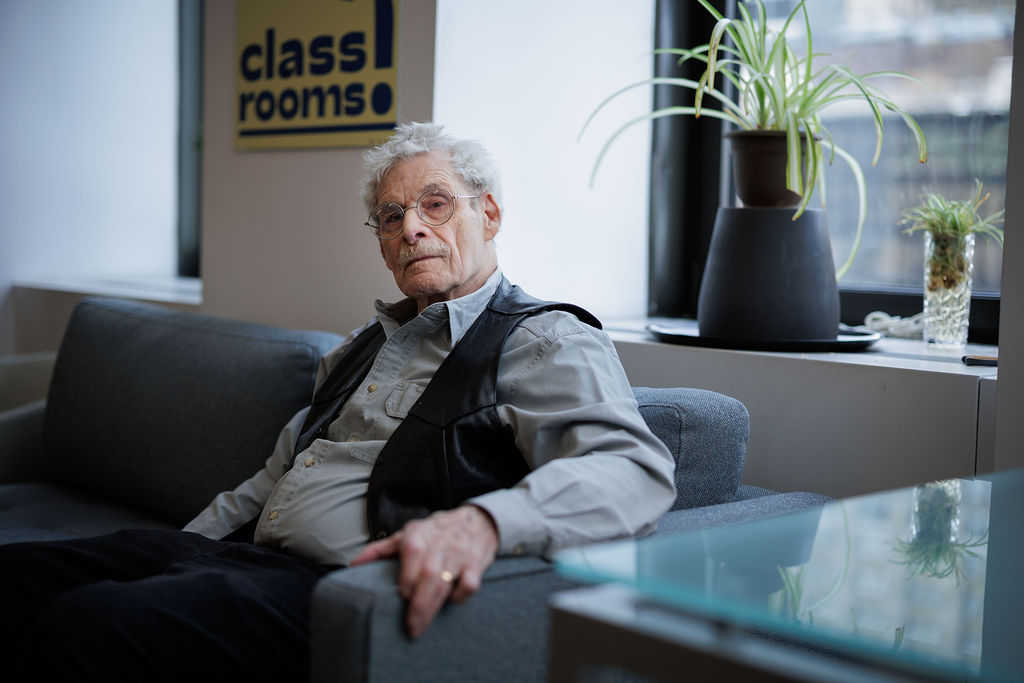
Howard Prince (credit: Paul Frangipane)
Prince, who had retired from the Borough of Manhattan Community College as a full professor of history in 2005, retired as a PSC member grievance counselor this past December. He stepped into the role in 1975, representing hundreds of members over the years as they faced contract issues, tenure disputes, and disciplinary proceedings.
Prince became a grievance counselor during one of the most tumultuous times in CUNY history: the 1975 fiscal crisis had threatened the university’s finances. He spent 10 years as a hard-fighting grievance representative, working hard to resolve cases often through settlements but going to arbitration when necessary. But early on he saw that grievance work wasn’t just about protecting individual members–if the union won cases, more members would see the union’s strength and want to get more involved.
“Debra Bergen liked to use the grievance world as a way of building membership involvement,” he said, citing the union’s long-serving director of contract enforcement, who retired in 2017. “If the membership knows that the union is there trying to fix this and make this better, it helps morale.”
After 10 years as a faculty member, Prince was promoted to management as associate dean of academic affairs at BMCC, a position he held for 11 years, including nine of which he spent as the College’s labor designee. “I got a different perspective from management’s side,” he said. “I used the experience to help me down the road, because I know more or less what the CUNY Central office was looking for in terms of decision-making and how you can work around to convince labor designees to settle cases.”
Eventually, Prince wanted to be back in the classroom. When he returned to teaching, however, he was barred from resuming his union role by a rule requiring that he work two years as a faculty member before returning to grievance counseling. “I called it penance at the time, because I had sold out,” he said with a laugh.
Over the years, Prince served as a mentor to generations of PSC member grievance counselors and contract enforcement staff. Like case law, there is a vast body of arbitration decisions, arguments, and settlements that guide the union on how to interpret the PSC-CUNY contract and administration policies. For many in the PSC, Prince is a living database of the union’s contract enforcement department.
James Davis, president of the PSC, said, “There is a reason so many of us have consulted Howard Prince over the years. He has encyclopedic knowledge of our arbitration history and exceptional dexterity with the issues that affect PSC members. He has for decades been a deeply committed unionist with a fierce sense of fairness and a creative approach to resolving matters related to our collective bargaining agreement and university policies favorably for our members.”
Members have expressed gratitude about Prince’s dedication to the union.
Robin Isserles, a grievance counselor and professor of social sciences and human services at BMCC, said, “Howard Prince embodies the Yiddish word ‘mensch.’ He’s a patient, supportive mentor, whose guidance helped us in our capacity as grievance counselors,” she said, adding, “Through his actions and words, he taught me what true unionism means, lessons that will carry me for as long as I carry my union card. And perhaps beyond.”
Lana Zinger, a professor of health, physical education, and dance at Queensborough Community College who is also a PSC grievance counselor, said, “Howie Prince’s retirement marks the end of an extraordinary chapter for our union and for all of us who had the privilege of working alongside him.”
She added, “His guidance was instrumental in helping me successfully navigate and win my promotion case against QCC, a moment that changed the course of my career and one I will always credit to his depth of knowledge, and refusal to back down.”
This experience with Prince inspired Zinger in her own advocacy. “His work on my promotion case inspired me to step into this role with the goal of advocating for others the way he did for me. Over the past decade, it has been a privilege to work alongside Howie and to continue learning from his example. He was a mentor in the truest sense, generous with his knowledge, strategic in his thinking, and deeply committed to justice for our members.”
Faye Moore, the PSC director of contract enforcement, said, “Howie is one of a kind. Not only is he the institutional memory for contract enforcement, but he is selfless when it comes to guiding, mentoring and really listening to our membership.”
Moore added, “He’s a living example of when we fight we win.”
Anthony Creaco, a professor of science at BMCC, credited Prince’s hard-nosed advocacy for saving his career.
“When I was applying for the rank of full professor at BMCC nine years ago, I had all the credentials necessary to receive the promotion. However, my chairperson had a personal grudge against me,” he said. “He created new guidelines that others didn’t have to follow in order to get the rank of full professor in order to prevent me from receiving it. One of these new guidelines disqualified all of my research publications. I filed a grievance against the college, and it was Howard who represented me.”
Creaco explained that at the Step One and Two grievance hearings Prince tore down all of the administration’s arguments buttressing their denial of his promotion.
“He guided me every step of the way,” Creaco said. “When we were approaching the date to attend the arbitration, the CUNY attorney found Howard’s arguments so compelling, they declined to fight over the matter in arbitration and allowed the issue to go to the select committee. Even though I was denied the promotion from the select committee, Howard’s arguments compelled CUNY to reinstate my research publications. I then reapplied for the promotion. The new BMCC administration supported it, and I received the promotion to full professor. I truly believe until this day that they did not fight it because they did not want to go through the arbitration process again in fear of how Howard fought for me. I owe Howard so much for this, including my career.”
Creaco added, “If I ever had to go through this again, and I could choose anyone to represent me, I would choose Howard Prince any day of the week and twice on Sunday.”
Published: January 30, 2026