The PSC is leading the campaign against the Trump administration’s attack on scientific research in New York City. Cuts to vital projects don’t just impact a few researchers; they can rob the city of medical advances and support for many vulnerable and in-need people.

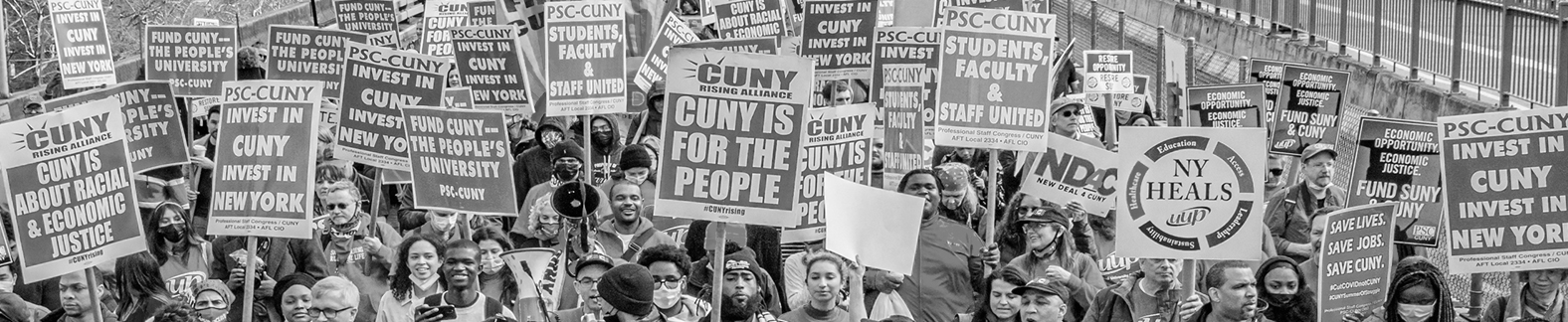
Support for research (Credit: Paul Frangipane)
PSC members and supporters gathered in front of the Trump Building at 40 Wall Street on June 30 to call out the Republican members of New York’s congressional delegation for budget bills that would cut billions from U.S. research agencies such as the National Institutes of Health (NIH), the National Science Foundation (NSF), the National Endowment for the Humanities (NEH) and other research-funding agencies. The Trump administration has already terminated thousands of grants that address diversity, equity and inclusion, or study vaccines, climate change, gender or other areas of inquiry that the Trump administration is working to suppress.
Letter for research
More than 2,000 CUNY and SUNY researchers and allies have signed a letter calling on New York’s congressional delegation to defend federal research funding for CUNY and SUNY. The letter to the delegation argues that every dollar invested in NIH-funded scientific research generates $2.56 in economic activity. In New York State alone, this amounts to $8.27 billion in economic activity and 30,522 jobs. A new study by economists has estimated that a 25% cut to science funding would lead to a 3.8% decline in GDP, similar to that seen in the Great Recession.
Members from around the University have sounded off on why these cuts are so devastating for the city.
Sexual health
For Marie, a 24-year-old barista from Queens, the local Title X clinic was a lifeline. It was where she got affordable birth control, allowing her to finish her degree at Queensborough Community College. It was where a routine wellness exam and a free cervical cancer screening caught precancerous cells early. For thousands of New Yorkers like Maria, these clinics aren’t political talking points; they are the foundation of a healthy life. But now that foundation is cracking.
Imagine a New York where a simple STI test becomes a luxury, and where family planning is out of reach for those who need it most. Consider the people living with HIV who will no longer have access to care and treatment: Their viral load will increase and impact their own health, but it can also lead to increased rates of spreading the virus. Consider the increased maternal deaths in our communities that are already disproportionately impacted. Consider the queer and gender-diverse youth that will have nowhere to turn for support.
Funding cuts are pushing us closer and closer to this grim reality. New Yorkers are losing access to cancer screenings, HIV prevention services, basic reproductive health services and sexuality education. Reduced access is only part of the story: Increased costs for services and a greater public health burden are also consequences on the horizon. This is the very real cost of federal funding cuts on New Yorkers’ sexual health.
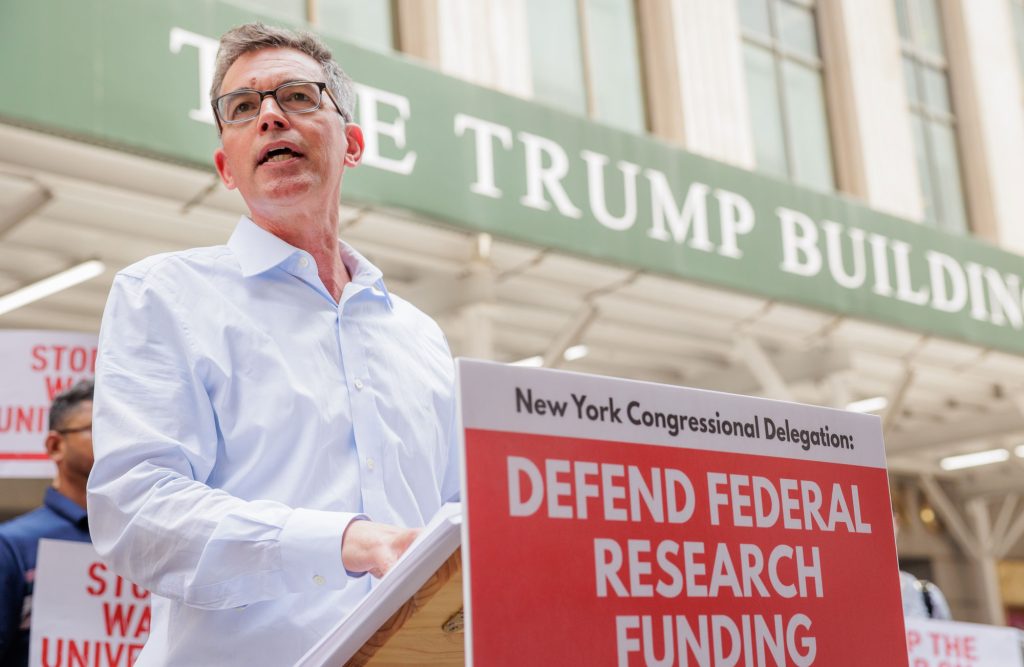
PSC President James Davis leads a rally defending research outside a Trump property near the New York Stock Exchange (Credit: Paul Frangipane)
These cuts impact all of us, but they leave our most vulnerable at the greatest risk: Lower-income individuals, communities of color and LGBTQ+ people will be hit the hardest, especially with Title X funding cuts. Title X was created to ensure equity in reproductive health: It allows people of all economic levels access to high-quality family planning services. Currently, Title X is under attack. There has been a funding freeze over the last several months, so many Title X funded programs and clinics have had to close. The last time Trump assailed Title X funding, many states were able to make up the difference. Now, however, state budgets are stretched thin. That means Title X cuts will be felt more severely.
While many of the arguments around sexual health funding cuts are related to abortion, the cuts impact many services that are not abortion-related. Title X health centers offer a variety of services such as birth control, screenings for breast and cervical cancer, family planning counseling, initial infertility assessments, STI diagnosis and care, and general wellness examinations. These funding cuts will result in increased unintended pregnancies and unsafe abortions, rising STI rates, reduced access to preventative care and even clinic closures. These cuts directly impact the health of our neighbors in every borough.
Beyond the public health crisis, cutting sexual health funding is also a poor economic decision. A study examining data from 2010 found that for every public dollar invested in family planning, an estimated $7 of taxpayer money was saved in averted Medicaid and other public assistance expenditures. Cutting funds to Title X therefore merely delays and multiplies the cost to the public, which will then be paid by the New York taxpayer.
Related headlines
There are related headlines that are also concerning: Trump has fired the team that works on contraceptive guidelines, which has been the group that has traditionally ensured that people can make informed decisions about which contraception methods are best for them. And Trump has slashed funding related to LGBTQ+ health: Over $800 million has been cut for research related to the health of queer people. We should all be concerned about the domino impact these actions will cause.
The chipping away at New York’s sexual health funding is about to become a public health crisis if we don’t act now. Each of us can 1) call our congressional representative to let them know how vital preventative sexual health care is to our future, and urge them to oppose any cuts to Title X programs; 2) donate to Planned Parenthood of Greater New York; and/or 3) share this op-ed with our friends and neighbors to help spread the word about why sexual health services are essential to New York’s future.
Spring Cooper
Associate Professor, Public Health
School of Public Health
Risking lives
Defunding science, far from saving money, will cost Americans their lives. Not metaphorically, but in a very real sense. Iowa Senator Joni Ernst’s cynical dismissal, at a town hall in Iowa, of how cutting Medicaid will inevitably shorten life, shows her, and the administration’s, indifference toward robbing Medicaid participants of years of healthy life.
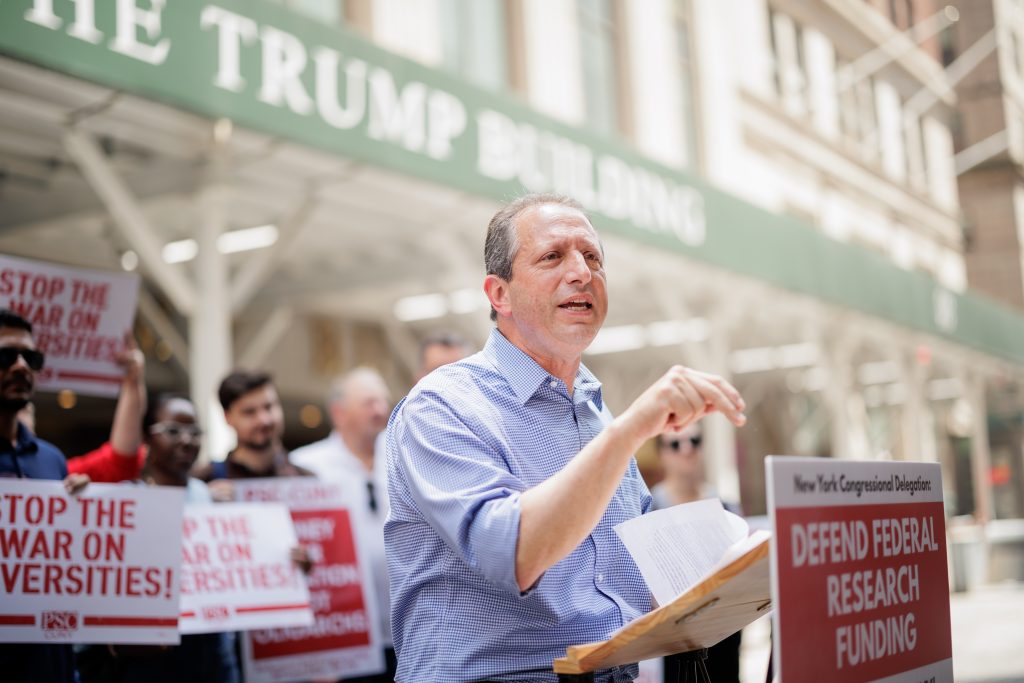
City Comptroller Brad Lander supporting PSC members. (Credit: Paul Frangipane)
The destruction of science is reflected in the new budget and the wholesale firing of government scientists and shuttering of regulatory agencies. The loss of regulation of food, air and water will subject everyone to polluted air, fecal matter in meat, toxic metals and plastics in our food, and bacteria and viruses in our water. We will live shorter and sicker lives.
With these cuts to science, there’s no limit to, or even any way to measure, how consequential the loss will be. A modern pandemic may have seemed like fiction before COVID; the next one will be worse, and this time there won’t be vaccines to slow its progression. Agencies meant to respond to such a crisis have been decimated. To avoid making our lives sickly and short, making our children sick and plaguing our old age, funding needs to not be cut, but to be increased.
Scientists’ work cures chronic diseases, cancer, Alzheimer’s and so many others that steal time with family and friends, steadily improving and extending our lives. These advances require funding. Scientific funding is not just about creating a few jobs at a research institution; it is about building the infrastructure that literally cures diseases and responds to crises.
Lots of damage
Even if funding cuts are reversed in the next budget, the damage will have been done. It takes years to build a scientific infrastructure, and only then can major advances be made. Science is not easy, and it is slow. The work requires a team composed of graduate students, postdoctoral fellows and technicians. Science takes hard work, and it doesn’t pay well. However, this hard work returns $2.46 to $10 for every dollar invested by the government. The administration is proposing a budget that will destroy labs full of dedicated professionals that have been built up over years. The labs would have to be rebuilt from scratch, wasting the taxpayer’s investment in the careers of the scientists who have dedicated their lives to making yours better.
Many scientists have already made plans to leave the country in pursuit of the freedom to conduct research, leading to the type of brain drain that once afflicted Eastern Europe. One of America’s leading rocket scientists was deported about 75 years ago to China, giving China a modern space and rocket program decades before they would have developed one without the gift from the American taxpayer. This time, too, the atmosphere of uncertainty continues to work to the benefit of other countries, especially China and India. Recovery will take generations. We are giving up what truly made America great.
Michael Green
Professor Emeritus, Biochemistry
City College
International affairs
For the last 13 years, I have served as the academic adviser at Queensborough Community College for international students on an F-1 visa, which is a status that enables foreign nationals to pursue an education in the United States. During my tenure, I’ve worked with intelligent, driven and talented individuals who have made significant contributions to their adopted communities, despite the daunting challenges they face. Not only must my advisees contend with the academic rigors that all college students experience, but they must also surmount difficulties with which their native-born peers need not be concerned. Before they even begin their degree, they must prove their financial self-sufficiency and study plans to a U.S. consular officer to obtain a visa, arrange travel, find a place to live and orient themselves to their new surroundings, often without any local support.
In spite of these hurdles, several students have engaged in research with faculty members on topics ranging from development of new materials for solar cells to integrated electronics for satellite circuitry. Others have taken on leadership roles in student government or participated in prestigious training seminars to become global citizens and agents of change. One particularly outstanding student came to our college from the People’s Republic of China in 2016. After completing a course of study at Port of Entry, our intensive English language program, in only seven months, she pursued her associate of science in chemistry, graduating with a 3.78 GPA. In addition to her impressive classroom performance, she engaged in chemistry research focusing on the synthesis of organic compounds used in the development of more affordable medicines. She presented her work at multiple events, including CUNY’s Undergraduate Research Symposium and Research Scholars Program Symposium, and was published in a scientific journal.
Overhaul needed
To be sure, the need to overhaul our immigration system is undeniable. The Executive Office of Immigration Review (EOIR), the sub-agency tasked with conducting removal proceedings and assessing appeals related to these proceedings, reported a backlog of 3.6 million cases as of November 2024, with only 700 judges to adjudicate petitions. Such egregious under-resourcing not only places an unbearable burden on the hard-working public servants dedicating themselves to ensuring the safe, orderly and fair processing of cases for new arrivals, but also puts millions in legal limbo, making it exceedingly difficult for them to know whether they will be able to remain and integrate into their host communities.
Since at least the end of the Second World War, our universities have become some of the best on Earth, not only because of the trillions we have invested in building the facilities needed to educate students, but also because of the global talent we have cultivated and recruited to conduct bleeding-edge research that advances humanity. In implementing massive spending cuts to scientific programs, Trump has prompted countless scientists to take their work to other countries, which will result in the loss of our competitive advantage in research and development that has been a foundation to our long-term prosperity. By slamming the golden door shut on prospective students, we exacerbate this brain drain by encouraging promising minds to look elsewhere for a chance to become the next generation of scientists and intellectuals that will continue to enhance the well-being and interests not only of our country but the entire planet.
All who recognize the value of research and the humanity of immigrants have a part to play in combating the degradations the Trump administration has wrought upon the scientific infrastructure that has been painstakingly constructed over the past seven decades. Take the Citizens for Science Pledge; contact your elected national representatives to express your support of federal funding for scientific research; and become engaged with local science initiatives and organizations. By adding your voice to the chorus proclaiming the critical importance of funding for scientific research and the embrace of immigrants, we can protect and promote the prosperity we have long enjoyed.
Jeff Ballerini
International Student Academic Advisor
Queensborough Community College
Bronx burning
We in the Bronx should all be scared to death of the cuts to federal support for medical and scientific research. This will hurt our health, our universities, our children and our economy. We can do something about this: We can all call our members of Congress and U.S. senators, and tell them to protect funding for research and training by agencies like the National Institutes of Health and National Science Foundation.
Roots
I live in the Bronx, grew up in the Bronx and went to NYC public schools. My mom was a public school teacher at PS 32 in the Bronx, and both of my kids went to NYC public schools. I have been a professor of biology at City College for 27 years, and have taught the children of native New Yorkers and of immigrants. My students become the next generation of doctors, scientists, physician assistants, physical therapists and teachers. For over 20 years, I directed a program funded by the National Institutes of Health that has supported dozens of undergraduates who want to get a PhD in biomedical science and work toward future knowledge and cures. This program pays students to do research as a job – they earn money for doing research – so they don’t have to work extra part-time jobs.
Immigrants
One of my trainees grew up in the Bronx in a family of immigrants from Jamaica, attended local schools, then came to City College, where he did research on genes we need to understand to find cures for some forms of blindness. Thanks to the support of this program, he is now a doctoral student in molecular biology at the UCLA Medical Center. Another trainee came to this country from the Dominican Republic after high school. He started at Queensborough Community College while learning English, then transferred to City College, where he did research on the structure of proteins, won multiple awards and is now doing PhD research that could lead to new drugs. Federal research support makes it possible for these students to pursue their scientific dreams. But that program was suddenly terminated.
Without medical and scientific research funded by the U.S., by our tax dollars, there will be no new doctors, no new scientists, no new drugs, no new cures. Funding from the federal government contributed to over 99% of all new drugs introduced in the period from 2010 to 2019. In the past five years, U.S. universities (which rely on federal funds) had patents on over half of the new drugs approved by the Food and Drug Administration. My brother nearly died as a child due to a blood disorder; without the medical research to understand and treat his condition, I would not still have my beloved younger brother to scream about the Knicks with. Yet funding for research to find cures for diseases like cancer or Alzheimer’s disease is now being canceled.
Forbes reported that research and training grants drive $95 billion in economic activity. Think of all the people who work in hospitals and universities and labs, who deliver supplies and equipment, or who do all the other jobs at places like Montefiore Hospital, or Albert Einstein Medical Center, or Fordham University, or Lehman College. In New York State alone, funding from the National Institutes of Health and National Science Foundation supports over 30,000 jobs and provides over $8 billion in economic activity. Basic science not only saves lives, but also drives the U.S. economy.
Pressing questions
Do you care about having excellent universities in the Bronx, so your kids and grandkids can pursue their professional dreams? Of course you do.
Do you care about having universities to train enough doctors and health-care professionals to look after you and your family? Of course you do.
Do you care about having universities to train enough scientists and engineers to find cures for diseases like cancer or sickle-cell anemia, and to invent the next technological breakthroughs like smartphones, so you can have a video call with your abuela who lives far away? Of course you do.
Do you care about good jobs in the Bronx? Of course you do.
To ensure a future in which we have all these things, we have to tell the people who decide how to spend our tax dollars – politicians – what we want. It’s so easy. Call or email your member of Congress or U.S. senator, and tell them to protect the funding for research and training by agencies like the National Institutes of Health and National Science Foundation. Let’s keep the Bronx educated, working and healthy.
Jonathan Levitt
Professor, Biology
City College
Published: September 12, 2025