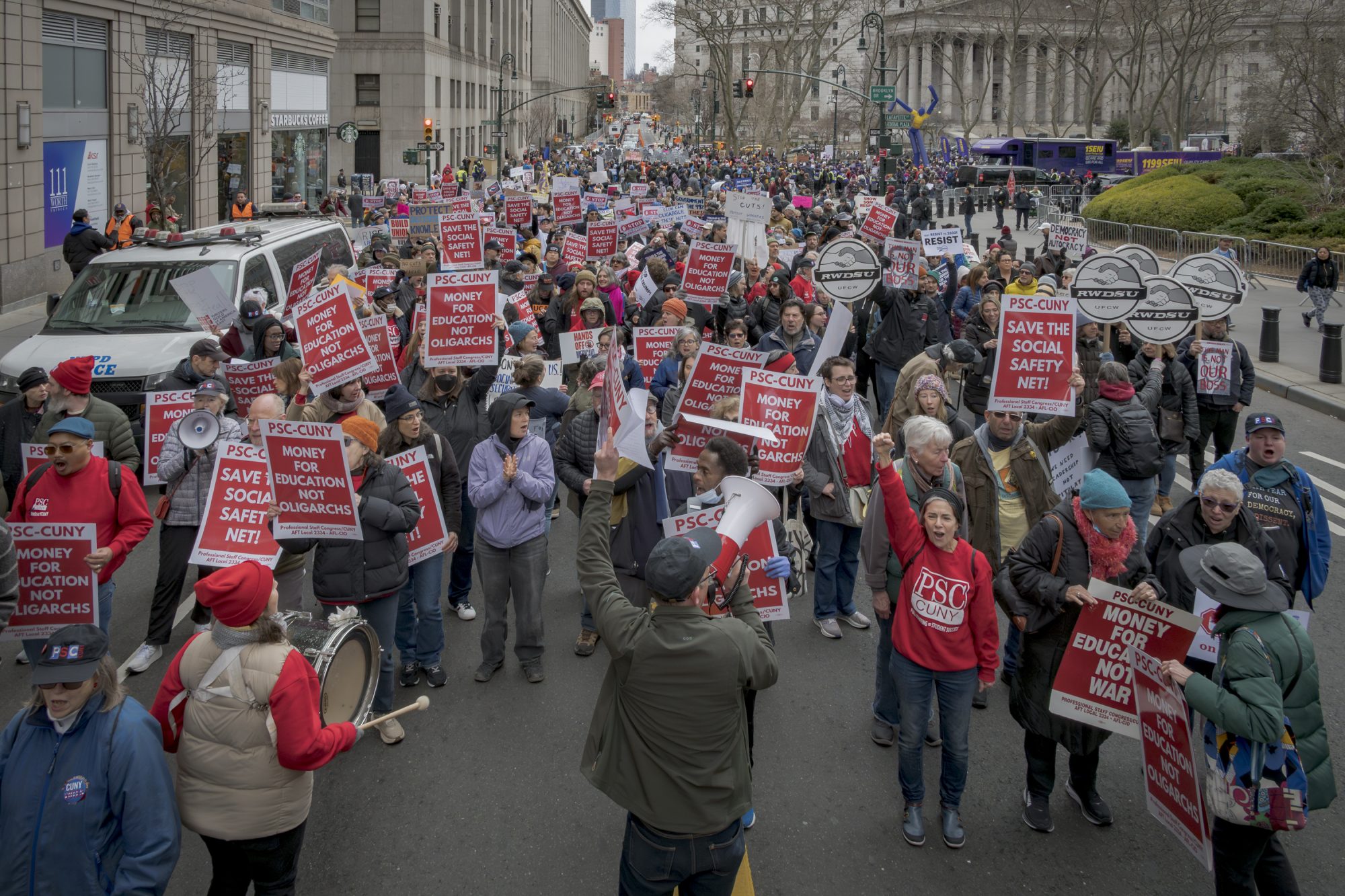
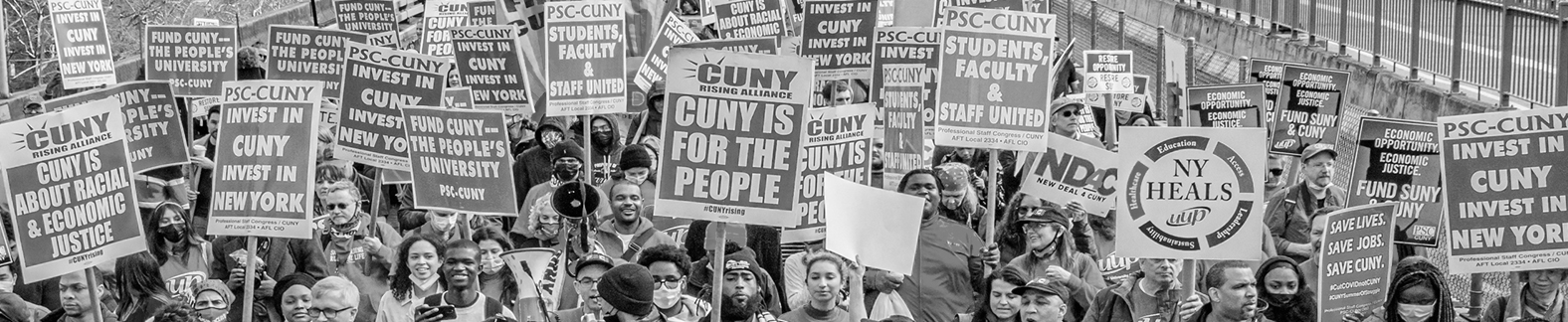
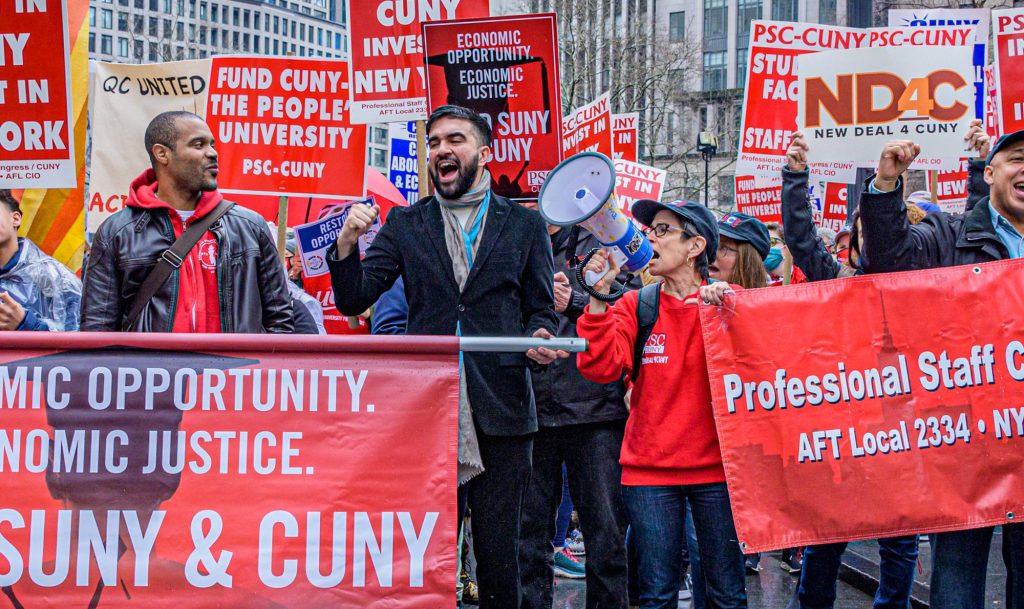
Zohran Mamdani marches with PSC members demanding full funding for CUNY on March 6, 2022. (Credit: Erik McGregor)
In the last issue of Clarion, we reported on how PSC members played a key role in getting out the vote for Zohran Mamdani in the Democratic primary for mayor. The PSC was one of the first unions to come out in support of Mamdani, in large part because he vocally fought for CUNY funding and against austerity at the state level.
The union’s work paid off, but members didn’t rest on their laurels. As disgraced ex-governor Andrew Cuomo attempted a right-wing independent bid after losing the primary, and launched a campaign that was laced with fearmongering, PSC members once again fought for Mamdani’s candidacy.
Once again, he won in electrifying fashion.
PSC members knocked on doors in the days leading up to the election, and on Election Day itself. They phone-banked. They attended rallies with other unions. The union’s signs were prominent at Mamdani demonstrations. PSC Secretary Andrea Vásquez was front and center as Mamdani marched across the Brooklyn Bridge with supporters before the historic election. PSC First Vice President Jen Gaboury spoke at several rallies with Mamdani.
JUST THE BEGINNING
“The election is only the beginning. The coalition that supported Zohran Mamdani for mayor now has to throw down to enact the affordability agenda on which he campaigned,” PSC President James Davis said in a message to members, announcing the launch of the People’s Majority. “We’ll be organizing our neighborhoods and campuses, rallying in the streets and pushing Albany to make the rich pay their fair share of taxes.”
In the past, the PSC has vocally called on Albany to increase revenue to the state by aggressively taxing the rich. In a political system largely influenced by rich donors, that’s a tall order. But with a mayor who has a progressive tax plan to fund city services, including and especially CUNY, such a demand is now viable. “Mamdani’s revenue proposal recommends an additional 2 percent tax on personal income that exceeds $1 million. New York City’s top personal income tax rate is roughly 3.9 percent,” according to Tax Notes. “This measure is estimated to generate $4 billion in annual revenue.”
There are already signs of movement in the right direction in Albany. “Governor Kathy Hochul is considering raising corporate taxes as part of broader efforts to close a potential budget shortfall and help fund some of Zohran Mamdani’s agenda as New York City mayor,” Bloomberg reported.
And City & State New York reported, as the mayor’s race came to a close, “a new poll found that raising taxes on the wealthy remains a broadly popular policy position not just in New York City, but around the state where key congressional battleground contests will take place next year.”
Other ideas are being thrown around, like reviving the push for the pied-a-terre tax on expensive second homes in the city. Earlier this year, state lawmakers offered a bill that would eliminate tax exemptions for precious metals and deductions for gambling losses, in addition to bringing back taxes related to private jets.
But as trade unionists know, nothing is certain or won without a fight. Davis said that it is important that PSC members take the energy they used during the campaign and put it toward a “tax the rich” agenda that will fund CUNY, so it can hire more faculty and staff and end tuition.
RALLY
The PSC participated in a rally in Union Square backing demands to “tax the rich,” in an “event…co-sponsored by the New York City chapter of the Democratic Socialist of America, Housing Justice for All and NYS Tenant Bloc, Jewish Voice for Peace NYC, UAWRegion 9A, the Invest in Our New Coalition, and others,” reported Common Dreams, which added, “The groups are backing Mamdani’s call for universal childcare, free public buses, a rent freeze and city-operated grocery stores in the city, all of which will be made more possible with revenue raised by increased taxes on the city’s wealthiest individuals and for-profit companies.”
“A mayor doesn’t just win things on his own, it has to be a movement,” said Susan Kang, a PSC executive council member and an associate professor of political science at John Jay College, adding that there will be “canvassing to do, lobbying meetings, asking people to call their legislators, because a lot of these things have to go through the state.”
(While Mamdani has advocated for new taxes, the city can’t implement them on its own, it must go through the state.)
Kang, who campaigned vigorously for Mamdani and will continue to push for affordability policies with the newly formed Our Time organization, is confident that the momentum from Mamdani’s election campaign will continue into this advocacy because “he built a grassroots campaign,” and she encouraged PSC members in particular to be part of this new movement, “because this is like an earthquake, he was already a champion for CUNY.”
AT THE TABLE
So far, PSC members have a few seats at the table. In November, Mamdani’s transition team announced 400 appointments to various policy committees, and PSC members were well represented.
For community organizing, the transition team tapped Celina Su, professor of political science at Brooklyn College. BC professor of sociology Alex Vitale and Lehman College assistant professor of social work Maurice Vann are working on the community safety team, while Michael Jacobson, director of the CUNY Institute for State & Local Governance, will work on the criminal justice team. Stephanie Luce, professor of labor studies at the School of Labor and Urban Studies, is advising on workforce policy, and Nicholas Bloom, the acting department chair of urban policy and planning at Hunter College, is advising on housing.
Nancy Romer, a retiree representative on the PSC executive council, will advise on climate and transportation, along with Marc Kagan, an adjunct assistant professor of history at Brooklyn College. Chaumtoli Huq, professor of law at the School of Law, was appointed to the worker justice team. Barbara Caress, an adjunct assistant professor of public affairs at Baruch College, is working on health policy, and Ramzi Kassem, professor of law at the School of Law and the founding director of CUNY Clear, is on the legal affairs committee.
Two of the union’s principal officers have transition team roles, too: Gaboury is advising on health and Davis works on youth and education policy.
Davis made clear that the PSC would be a part of the continuing movement, and that while Mamdani advocated for CUNY in his campaign and as a state lawmaker, nothing was guaranteed without a struggle; the union needed to work to keep the CUNY agenda at the forefront.
“Zohran Mamdani’s campaign put 100,000 volunteers in the field, knocking on doors, phone-banking, text-banking and mobilizing their neighbors to vote,” Davis said. “Imagine if all that grassroots people power went to work demanding that Albany meet the needs of ordinary New Yorkers. Imagine if the unions that coalesced around Mayor-elect Mamdani put their might into the fight as well. The PSC and our 700,000-member statewide affiliate, NYSUT, can be central to that campaign for change.”
BOOSTING EFFORTS
Liz Stevenson, one of the union’s COPE coordinators, said, “We want to make sure that we boost contributions to our action fund to hold our elected officials accountable, including our city council members.” The COPE fund is made up of voluntary contributions from PSC members for political action.
She added that it was important to keep advocating for new revenue for the state through taxing the rich, saying, “Pushing Hochul on that will be important to Mamdani’s success.”
The People’s Majority is already mobilizing. PSC members should be ready to pressure state lawmakers and the governor to reach a budget this year that not only funds CUNY, but increases revenue by forcing the rich to pay their fair share.
Members should check the website about upcoming rallies, trips to Albany and planning meetings about the “tax the rich” agenda. Members are also encouraged to become active with the legislative committee.
CONFIDENT
Inside Higher Ed reported that the PSC was confident Mamdani would also resist federal efforts to attack immigrants: “Davis agreed that Mamdani is likely to put up a fight on behalf of immigrant students in particular, who make up at least 30 percent of CUNY’s student population.”
Davis told the outlet, “We’re hopeful that – based on [his] more pluralistic vision and the very explicit embrace of New York as a town built by immigrants over many, many generations – the Mamdani administration will be supportive of the communities that CUNY serves.”
Published: December 11, 2025