This past spring, numerous federal grants held by principal investigators throughout CUNY were canceled. Prompted by a past UFS senator, I reached out to Associate Vice Chancellor and University Vice Provost for Research Rosemarie Wesson, who kindly shared a mid-summer accounting of grants at CUNY that were canceled or frozen by the federal research funding agencies following executive orders by President Donald Trump. This was compiled prior to the restoration of some grants in mid-July. Out of privacy concerns, the summaries presented are in funded categories rather than specific grants. I’ll not be too specific here. Other data is available online, such as at Grant Witness, which estimates New York State’s current loss of NSF grants at $25.65 million and NIH grants at $1,247.88 million.
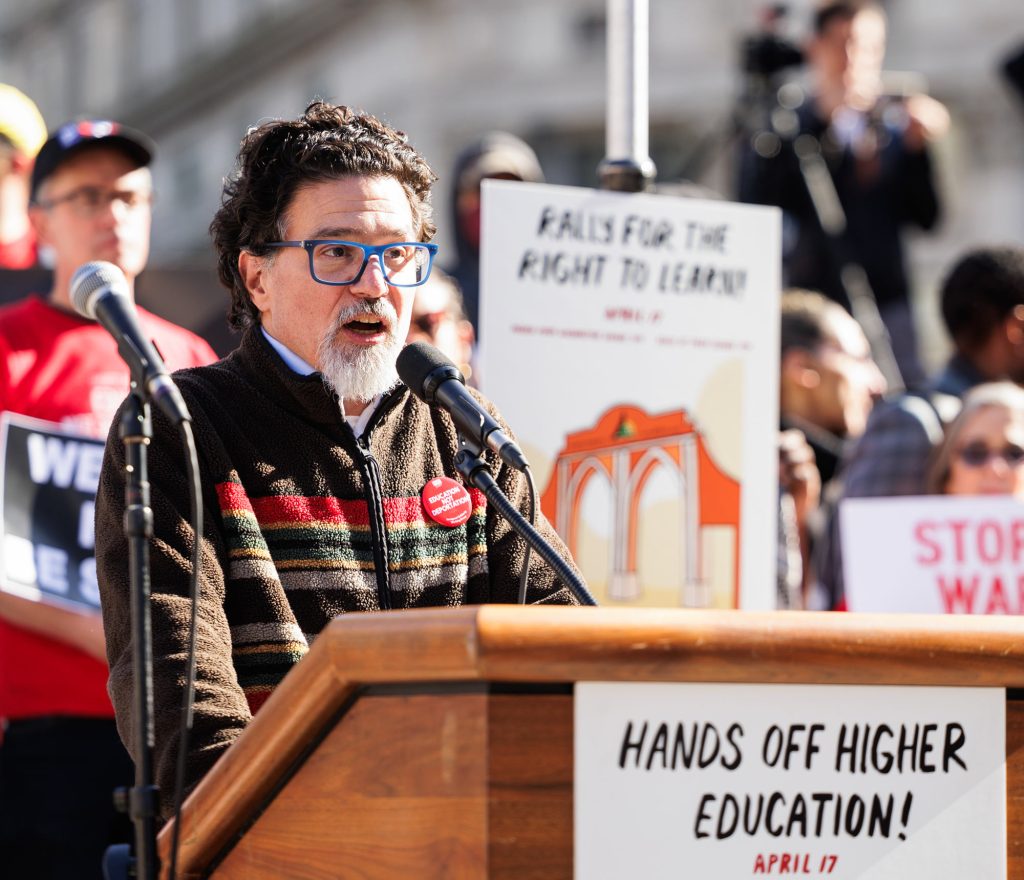
Denis Nash, an epidemiologist at the School of Public Health, denounces federal cuts (Credit: Paul Frangipane)
LOSS
In this article, I’ve made some summaries of the loss at CUNY. I’ll also bring some focus to the specific loss at City College and other units of CUNY due to a wide array of canceled training grants.
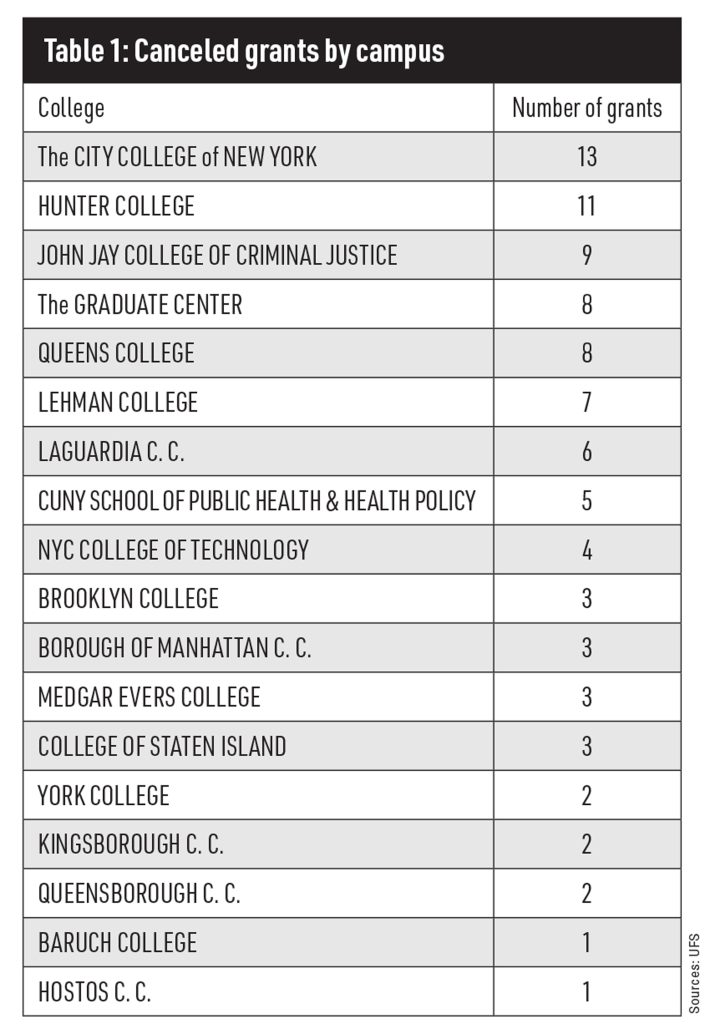
There are 91 grants listed in the dataset. The distribution by campus is given in Table 1.
There are different ways to measure grant awards: The total grant size is always of interest. Another means to monitor the effectiveness of the grant dollars is to account for grant expenditures. For this purpose, the appropriate measure is the lost dollar amount computed by the difference between the grant amount and the expenses incurred against the grant.
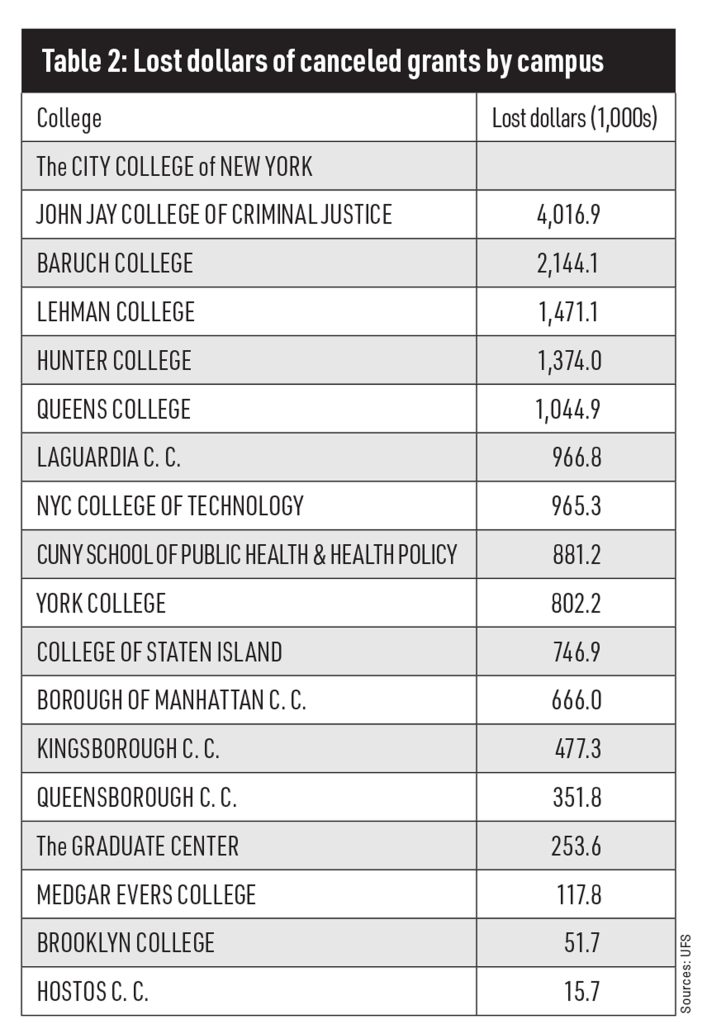
Overall, nearly $25 million was lost in the cancellations. Table 2 shows the lost dollars per campus in descending order.
The dataset also has information on the 153 people impacted, employees and fellows (not students). We detail the number of people impacted by college in descending order in Table 3.
This count may not be complete. It is unclear, for example, if the dataset includes lost support staff whose salaries were paid for through some cross-campus cost-sharing arrangement.
About 40% of the impacted grants are from the NIH (National Institute of Health) and the NSF (National Science Foundation); there are also 13 defunded NEH (National Endowment for the Humanities) sponsored grants. While the following focuses on the losses of training grants in STEM areas, we emphasize that this is not the only devastated area.
FOREFRONT
City College has been at the forefront of CUNY’s $600-plus million per year research and innovation efforts. The Advanced Science Research Center (ASRC) is on the City College campus, but maybe less well known is the infrastructure supporting future scientists at City College and throughout CUNY that stems from faculty research activities.
In the broad sweep of canceled and frozen funds, there are a number of training grants and STEM-related grants at City College.
These include:
- A bridge grant for racial and ethnic minorities at BMCC and CCNY
- An environmental science grant between the professoriat in community colleges and associate degree programs
- A grant to advance inclusion, diversity and equity in STEM
- A grant to advance undergraduate STEM education at CUNY
- A grant to inquire about the intersections of race, class, gender and ethnicity for student success in STEM
- A grant to study the dynamics and mechanisms of information spread via social media
- Grants for undergraduate students in the biological sciences, U-Rise (Research Initiative for Scientific Enhancement, NIH)
- Grants for graduate students in the biological sciences, G-Rise.
IMPACT

Many of these programs straddled several CUNY units, which also had impacted grant-funded programs. There were STEM and pre-med grants at BCC, BMCC, CCNY, Hostos CC, Hunter College, KBCC and LGCC – canceled; Bridges to the Baccalaureate grants at LGCC, QBCC and MEC – canceled; U-Rise grants at Brooklyn, Queens, Lehman and Medgar Evers College also canceled; and a related MARC (Maximizing Access to Research Careers) program at Hunter College was canceled.
This sweep of congressionally approved federal grant funds took $1.2 million from students and faculty at City College and over $4 million from CUNY collectively.
A detailed article in The City from May highlights the loss of the U-Rise grants throughout CUNY, which supported student research opportunities with a faculty mentor, stipends and tuition assistance.
On May 27, 2025, Brian Lehrer interviewed Professor Denis Nash from the CUNY School of Public Health in a “Health and Climate Tuesday” segment called CUNY Funding, Interrupted. Professor Nash discussed how he discovered his grant from the NIH was “canceled.” A City College biology professor, Jonathan Levitt, who has been involved for two decades in these efforts, called in and aptly explained:
“To become a doctor or a scientist is basically an extended apprenticeship. Federal support for the tuition or stipends of trainees is essential to the whole endeavor. To support the whole pipeline from community college to postdoc. These sorts of programs are and have been at many CUNY campuses, including my own, for decades. … The people who will be doing this work, like on Dr. Nash’s team, do we want them all to come only from middle-class-or-above households? I don’t think we do. These cuts really cut right to the heart of that.”
UPDATES
In a follow-up conversation with Professor Levitt, who is the PI on the U-Rise grant at City College, he provided updates on what has happened since the spring. He informed me of several interesting points. The U-Rise program at City College supported eight undergraduate students per year. At the other involved campuses, the number of supported students was an additional six to 10 people per campus. The support staff were one to two people, and multiple programs shared the funding of their salaries. The U-Rise grant at City was not technically “terminated,” but rather at the end of the second year of the five-year grant, the remaining funds were zeroed out. This was done at the end of March 2025. Subsequently, after two big lawsuits wound their way through the court system, funds were restored on July 18. However, on August 21, the Supreme Court potentially cleared the way for $783 million in NIH grants to be cut, which presumably includes the U-Rise program dollars. Adam Liptak wrote in The New York Times: “The upshot of the scrambled ruling, subject to ongoing litigation, appears to be that grants already canceled will not be immediately reinstated, but that recipients may be able to sue in a specialized court. Further
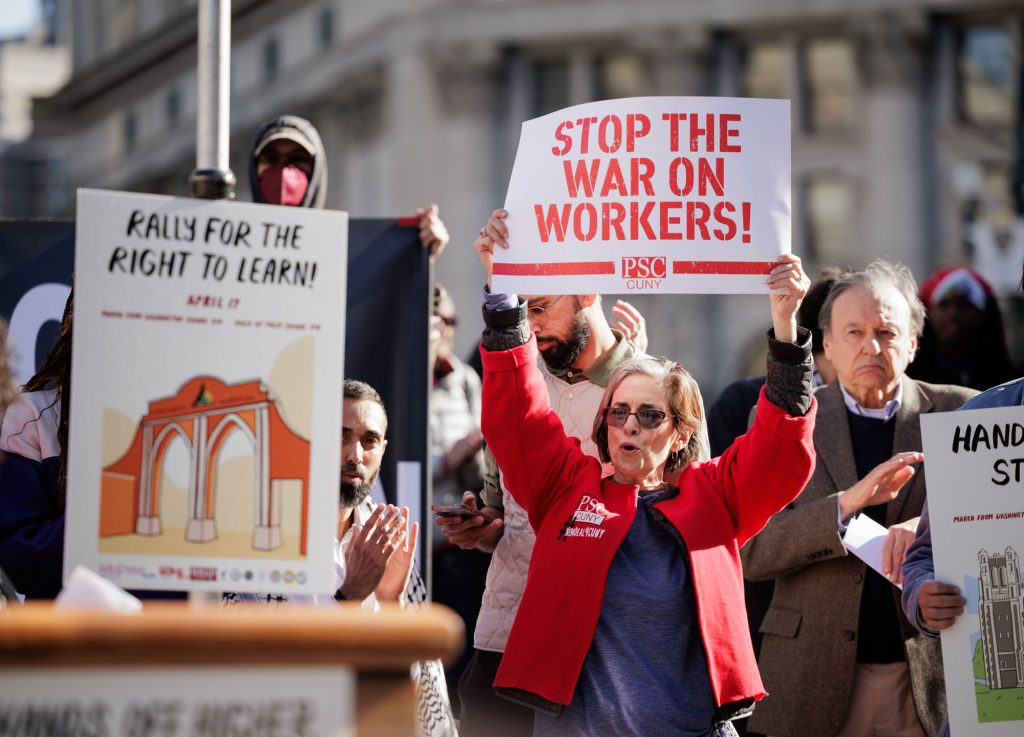
The PSC has been at the forefront of the defense of academic research. (Credit: Paul Frangipane)
cancellations may be barred.”
LOOKING ELSEWHERE
Regardless of the final ruling on the funds, the impact has been felt. Professor Levitt noted that by the time the funds were restored in the summer, students had been encouraged to look elsewhere, and many already had, leaving the pool of eligible and interested students diminished. The bridge funding by CUNY, though helpful, was mainly available only to satisfy previous commitments.
In summary, while CUNY’s dollar amounts for canceled grants may not rival the numbers reported in the national press – Trump Has Cut Science Funding to Its Lowest Level in Decades, from The New York Times, for example, has interactive graphics to illustrate the drastic decrease in national grant funding – CUNY’s lost research funds are substantial and were used to support a wide range of activities. This uncertainty about funding has a palpable impact on faculty, students and support staff.
The STEM steal does not directly harm all CUNY faculty. But these losses will be observed in all our classrooms and scholarly activities, and felt in the harm they have dealt our students.
CLOSING THOUGHT
A closing thought for consideration from “Mapping Federal Funding Cuts to US Colleges and Universities,” by the Center for American Progress: “To understand the gravity of these funding terminations, it is critical for the public to recognize that federal funding cuts to research…at universities and colleges cannot be compensated by contributions from wealthy individuals, philanthropies, or foundations. Currently, about half of Americans believe that “corporations, foundations, and wealthy individuals would fund scientific research to fill the gap created by federal spending cuts.” Public universities…have had tens of millions of dollars in federal funding targeted for termination…[some] more than $100 million…Over the past few years, there have only been about a dozen donations of $100 million or more to higher education institutions on an annual basis. Philanthropic giving…is most concentrated at elite schools; in 2020, the 20 institutions that received the most donations received 28 percent of these funds, despite only serving 1.6 percent of the country’s undergraduate students. But just over the last few months, approximately 90 institutions have each lost more than $10 million in federal funding, according to federal data.”
John Verzani is the chair of the CUNY University Faculty Senate and a professor of mathematics at the College of Staten Island. A version of this article originally ran at the UFS blog.
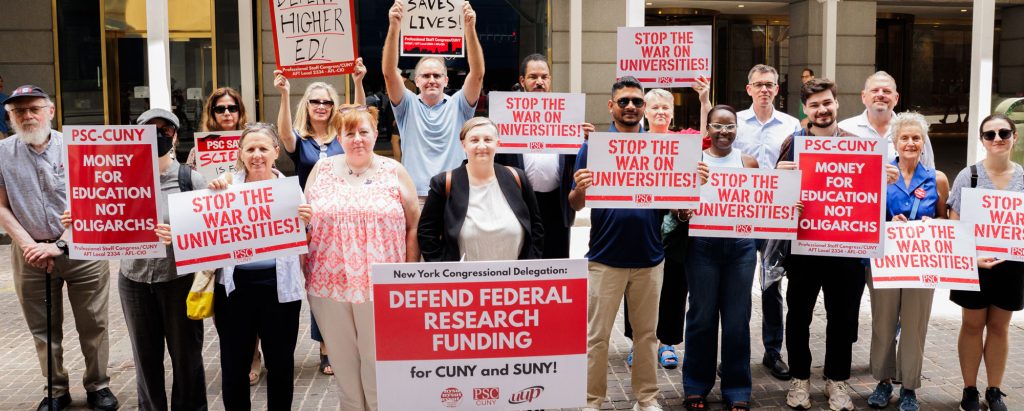
The PSC holds a press conference and rally defending funding for academic research. (Credit: Paul Frangipane)
Published: December 11, 2025