Since last June, Queens College PSC members, many working in SEEK and other important programs, have raised the alarm about asbestos work in Delany Hall, demanding information about the health risks. PSC members say the administration has done little, and they have been organizing for months to pressure both Queens College and CUNY Central to address their concerns.
Over the summer, QC SEEK Director Norka Blackman-Richards and others raised concerns about hazardous conditions, as did the PSC’s Health and Safety Watchdogs. According to a report by the chapter, the situation has been dire. Dust from the asbestos work triggered a fire alarm in October. The report said that among the problems are “No safety protocols provided despite requests” and “Inadequate dust containment during active construction with fully occupied building.” There has also been “No air quality testing or environmental assessments shared with occupants” and a “Refusal to provide air purifiers despite documented illness,” the report said.
RACISM
“It’s environmental racism,” Blackman-Richards said, noting that the programs in the building historically serve communities of color. The lack of action from the administration, as well as the conditions, were an “abomination,” said Erica Doran, the Queens College PSC chapter chair. Blackman-Richards noted that the administration was in denial about the problems. She said a student told her, “They are making us out to be crazy people.”
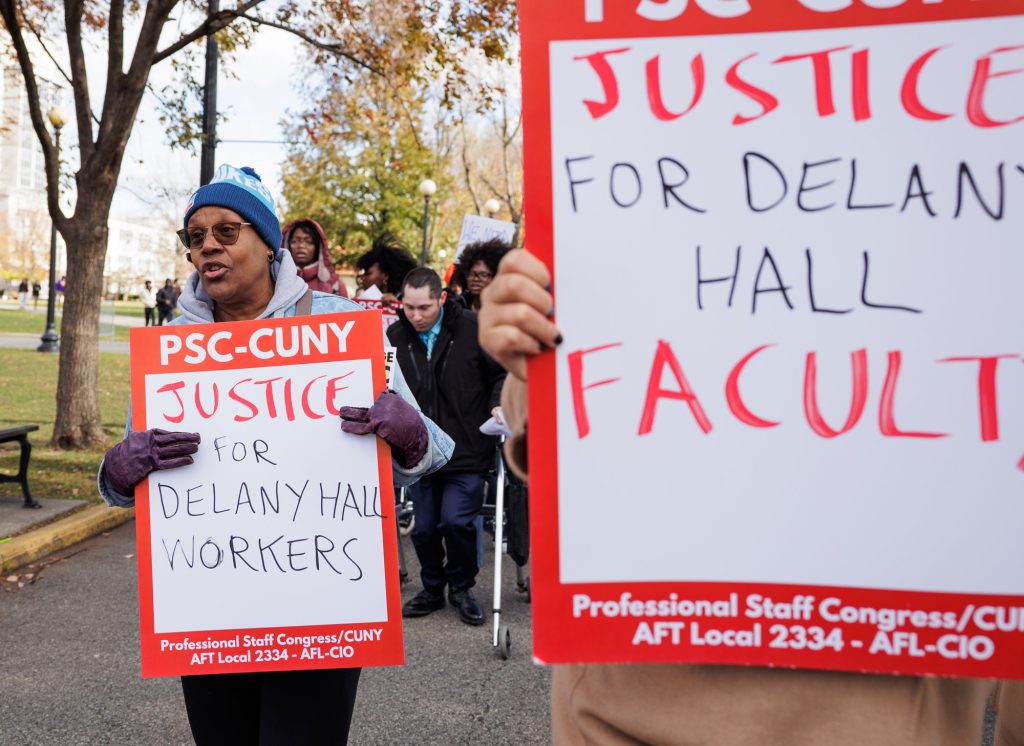
Faculty, staff and students demonstrate for safety and health at Queens College. (Credit: Paul Frangipane)
Both spoke to Clarion on November 17 during a rally on the Queens College quad, where faculty, staff and students marched to demand safe working conditions as PSC officials participated in a grievance hearing with the college administration regarding the building work.
UNION LETTER
“The situation is emblematic of environmental racism, as th
ese construction hazards have disproportionately injured Delany community members, who are primarily people of color,” said a union sign-on letter. “Moreover, the Queens College administration has repeatedly diminished the Delany community’s evidence and experiences of harm. Even as employees documented and reported serious respiratory illness together with recurrent dust and polluted air, the administration dragged its feet. Queens College’s leaders were not transparent about the construction’s potential risks, nor have they taken appropriate steps to protect the health of employees and students, such as providing a timely and adequate relocation plan and restricting access to the building.”
The PSC’s Health and Safety Watchdogs have been centrally involved.
“The activism at Queens College has been incredible. When the HS Watchdogs were called to QC and first met with members at Delany, I was struck by the power and organic leadership of our members there,” said Laura Meltzer, an alumni association coordinator at the School of Labor and Urban Studies and a member of the watchdogs. “Construction was ongoing, and members were told the work was happening outside of work hours, but the dust from this work was evident – on the windowsills, chairs, carpets and more. Plastered on the door were two notices: a sign announcing ‘Asbestos Abatement’ and a flyer encouraging students to sign up for CUNY Alerts to know when the college is open.”
MEMBER POWER
She called out the Queens College administration: “On the one hand, staff and students have gotten the all-clear that it is safe to work on-site, and on the other, walk-throughs and members’ day-to-day experiences show otherwise,” she said.
Meltzer added, “Without the strength and continued perseverance of our members at Delany Hall, this terrible situation would be unnavigable. It was their direction and leadership which sounded the alarm on this unsafe environment. We can learn a lot from the power fostered in the Delany community.”
PSC members from the Queens College chapter spoke out at the CUNY Board of Trustees hearing in October to demand that the central administration step in and take action. They are below.
Glib replies
Since June 2025, substantial construction – including asbestos abatement – has been underway at Delany Hall. Despite the inherent health risks that arise from any construction project, especially one involving the disruption of asbestos, the Queens College administration has failed to ensure that proper protocols are being followed to protect those in and around the building. No plans were made for workers or students to be relocated. They were working in extreme cold, with ungodly amounts of construction noise in the background, and with layers of dust coating furnishings, computers and walls, and breathing polluted air. As a result, workers and students in the building started feeling ill, having asthma attacks and experiencing shortness of breath, among other symptoms.
ADMIN UNCARING
Staff who tried to report these conditions and problems to the administration were provided glib replies that appeared to be copied and pasted from rote templates. Throughout this process, department heads in Delany Hall were never called to a meeting with the administration. Eventually the staff were relocated, but this was only a testament to their advocacy and the persistence of the workers.
CUNY must do whatever it can to ensure that health and safety are top priorities on all of our campuses, including at Queens College. CUNY must ensure that faculty and staff do not move back into Delany Hall until documented evidence proves that it is safe. Transparency, accountability and proper communication must be reinstituted to build back trust between workers and the administration.
Annie Tummino
Assistant Professor, Library
Admin response?
The University’s central leadership must provide clear directives to colleges about how to manage construction projects safely. I am very worried about the health and safety of Queens College students, faculty and staff who work in Delany Hall. Over the summer, they were subject to unchecked construction dust attendant to a remodeling project that began in June 2025.
At a town hall on October 22, 2025, about 100 Delany community members gathered and many testified about the hazardous labor conditions they suffered during the summer months, after construction – including asbestos abatement – started on their building.
Multiple staff members reported new respiratory illnesses resulting from dust exposure.
Students likewise shared that the dusty conditions exacerbated their asthma.
The situation is emblematic of environmental racism, as these construction hazards have disproportionately injured Delany community members, who are primarily people of color.
Moreover, the Queens College administration has repeatedly diminished the Delany community’s evidence and experiences of harm. Even as employees documented and reported serious respiratory illness together with recurrent dust and polluted air, the administration dragged its feet. Queens College’s leaders were not transparent about the construction’s potential risks, nor have they taken appropriate steps to protect the health of employees and students, such as providing a timely and adequate relocation plan and restricting access to the building.
FOLLOWING STEPS
CUNY must ensure that the following steps are taken before Delany Hall can be reopened and staff and students can return:
- Comprehensive environmental testing by an independent third party to assess air quality and contamination levels in Delany Hall, with results shared transparently with all building occupants.
- Complete professional cleaning of the entire building, including all offices, common areas, HVAC systems, vents, lighting fixtures and overhead plumbing – with documentation provided.
- Full HVAC system repair and testing to ensure proper ventilation and air filtration throughout the building, plus room air purifiers for all Delany staff and faculty who request them for offices and common spaces.
- Extermination services to address rodent infestation caused by construction processes.
Natalie Bump Vena
Assistant Professor, Urban Studies
No notice
Delany Hall is home to the SEEK program, College Now, Africana Studies, the Center for Ethnic, Racial and Religious Understanding (CERRU), and the Office of Compliance and Education Lab Classroom. SEEK occupies 90% of Delany Hall, and the program’s 65-plus faculty and staff serve over 500 students. When contrasting how these and other departments have been treated in similar projects, I see disregard for “second-class citizens,” if not outright racism.
CUNY Central is ultimately responsible for ensuring the health and safety of CUNY employees and students on CUNY campuses. To that end, the University’s central leadership must provide clear directives to colleges about how to manage construction projects safely.
José Miguel Martínez Torrejón
Distinguished Professor, Hispanic Languages and Literatures
Published: December 11, 2025