New York City’s transit system is the lifeline of our education system — yet for thousands of CUNY students, simply getting to class has become an unaffordable burden.
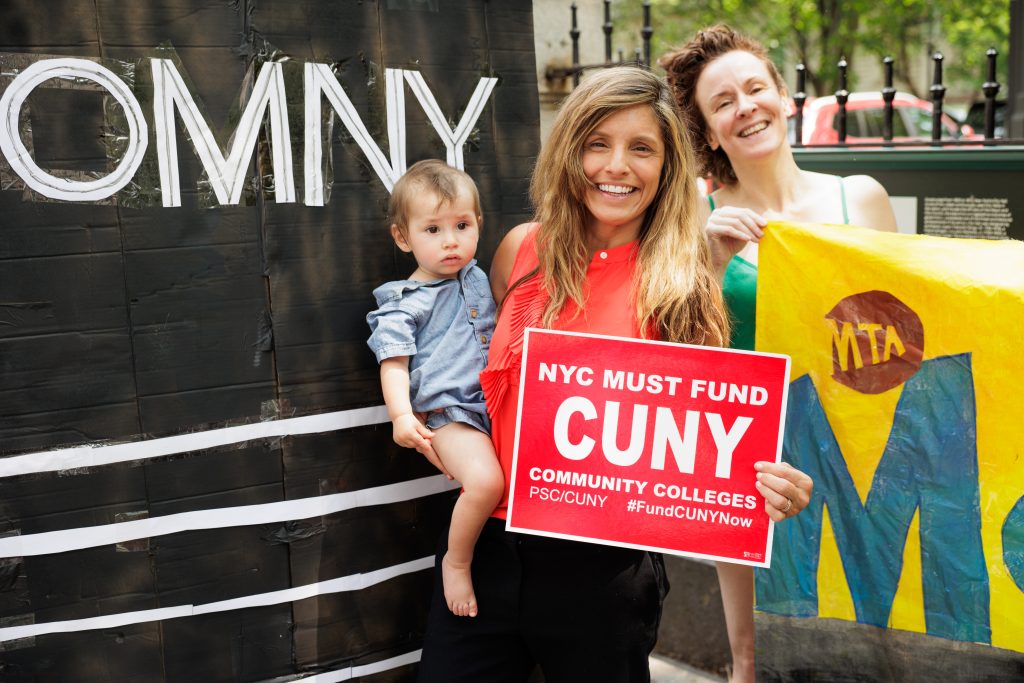
Heather James, PSC legislative chair, advocating for student transit support (Credit: Paul Frangipane).
In January 2026, subway and bus fares rose again, climbing from $2.90 to $3.00 per ride. For many New Yorkers, that increase may seem small. But for students, commuting five days a week — often across boroughs — the costs add up quickly. Each swipe becomes a calculation: Do I pay for the ride, or do I buy groceries? Do I go to class, or skip a meal?
Students should never have to make that choice.
According to the Community Service Society of New York, 90% of CUNY community college students rely on public transit to reach campus, and the cost of fares is one of the biggest barriers to completing a degree. CUNY is a commuter system by design. Unlike residential colleges, our campuses depend on buses, subways, and ferries to connect students to opportunity.
But not all commutes are equal. At Queens College, where one of us is a student, many students take the subway to Forest Hills, transfer to the Q64 bus, and then walk up to 20 minutes to reach campus. The NYPIRG Straphangers Campaign has talked to students at Queensborough Community College and the College of Staten Island who say that they take similarly complex trips involving multiple modes of transit. For students balancing part-time jobs, caregiving responsibilities, and rising living costs, every additional transfer — and every additional fare — becomes another obstacle to education.
New York City already recognizes that transportation access is essential for younger students. Public school students receive OMNY cards for free that allow them to travel between home and school at no cost. Those cards help over 1.5 million students stay connected to their education every year. But college students — many of whom face similar or even greater financial pressures — are left out.
That disparity is increasingly hard to justify.
CUNY students are overwhelmingly low-income, first-generation, or working students. Even with financial aid or part-time jobs, the rising cost of transportation places a heavy strain on our budgets. Programs like Fair Fares, which provide half-price transit to eligible New Yorkers, are important steps forward — and advocates with the Straphangers Campaign have pushed to expand eligibility and outreach. Still, many students fall just outside qualifying income thresholds or struggle to navigate the application process.
A broader solution is needed.
Expanding free or reduced-cost OMNY cards to CUNY students would remove one of the most immediate barriers to higher education in New York City. Just as free OMNY cards help K-12 students get to school, a similar program for college students would help ensure that transit access does not determine who earns a degree.
At the same time, existing student OMNY programs should reflect the realities of students’ lives. The MTA limits trips, and cards can be flagged, deactivated, and confiscated from students when used for other purposes. Students may have needs that are not being considered, for example, commutes to local libraries, grocery stores, internships, and pharmacies. Education does not happen only inside a classroom — and transportation policy should recognize that.
City leaders are already discussing bold ideas to make transit more accessible, including proposals to expand free bus service. Those conversations offer an opportunity to center students in the future of public transportation policy. Investing in free or reduced-cost OMNY cards for CUNY students would not just help individuals — it would strengthen the city’s workforce, economy, and educational equity.
New York prides itself on being a city where opportunity is accessible to all. But opportunity means little if students cannot afford to get to class.
No one should have to choose between dinner and the fare.
Adler Dougherty is an intern with the New York Public Interest Research Group and a Queens College student studying English. In the Fall 2025 semester, Adler focused on local mass transportation needs with the NYPIRG Straphangers Campaign. Adler hopes to be an English educator in higher education upon graduation.
Natasha Elder is the regional director for equity and resiliency projects with the NYPIRG Straphangers Campaign, where she organizes CUNY and SUNY students to advocate for more reliable, affordable public transportation across New York state.
Published: March 10, 2026