
At the end of June, while spending part of my summer vacation on a trip to France, my partner and I stopped by a Montmartre field office of the Confédération Générale du Travail (CGT), one of the major confederations of labor unions in France. I had long admired the CGT from afar for its militant leadership in France’s famously robust labor movement. Thanks to the labor movement and the legacies of the Front Populaire government in the 1930s, French workers generally work less and live longer than we do in the United States. Recently, as the Macron government attempts to roll back workers’ rights and force unpopular neoliberalism and austerity onto the French people, the CGT has played a leading role since 2023 in organizing and mobilizing millions of workers against a government plan to raise the French retirement age from 62 to 64.
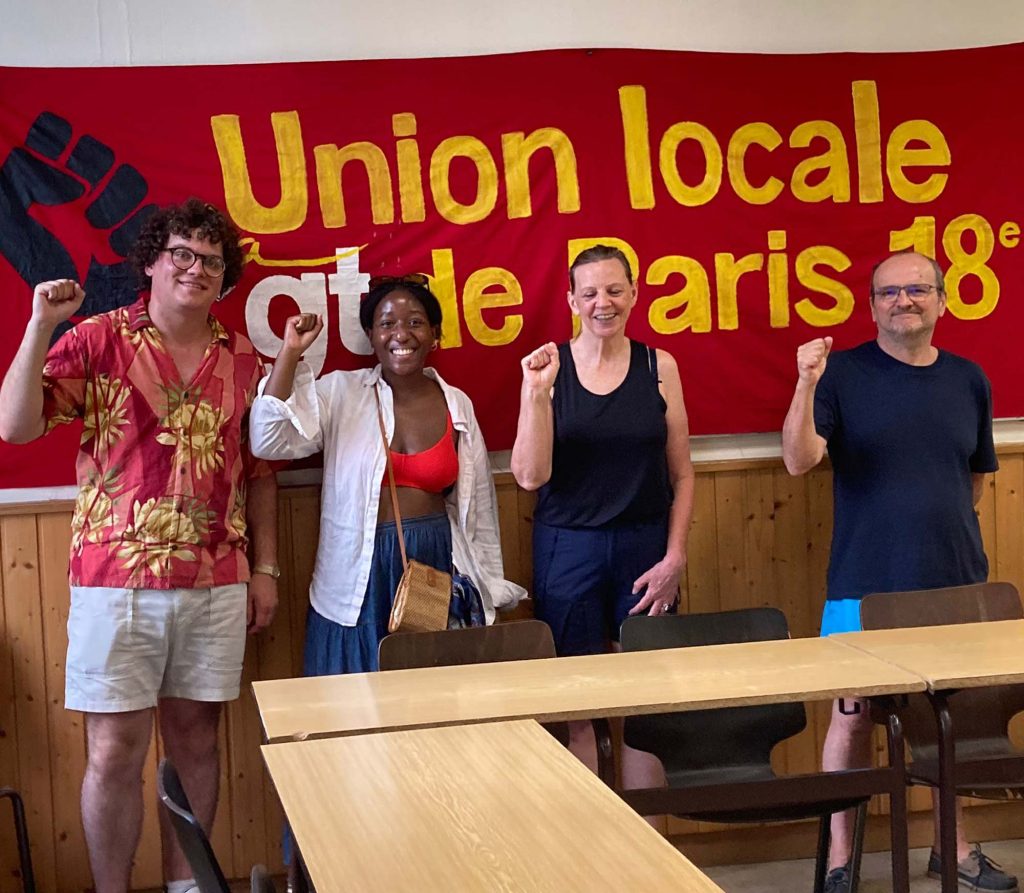
Paul Brown, at left, brought some lessons home from Europe.
RETIREMENT
While the struggle for a dignified retirement continues in France, there have been some major successes in the past two years. Last June, when Macron suddenly dissolved parliament to cynically dare the French public to hand power to the growing far right, the CGT took part in the rapid four-week electoral mobilization around the Nouveau Front Populaire coalition, which managed to win a plurality of seats in the National Assembly, thereby blocking the far right from power and delivering a resounding message that the French public does not want fascism or austerity. Thanks to continued pressure – from the Nouveau Front Populaire in government and the CGT and others in the workplaces and streets – there is growing hope that the increase in retirement age can be defeated as the Macron government struggles to impose it.
With this in mind, I knew I wanted to try to meet some CGT members while in France to express solidarity. I didn’t know what to expect walking in unannounced, but the CGT staff there were very welcoming and thrilled to find out I was a union member from New York City. The local’s secretary, Nancy, had been similarly following U.S. news from afar, and expressed excitement at the recent upset victory of PSC-endorsed Zohran Mamdani in the Democratic mayoral primary. I explained to her about how I and many other PSC members organized within our neighborhoods and our workplaces to spread not only word about his campaign, but hope that his pro-worker policies could actually win and deliver for working New Yorkers.
Sadly, though, most of the news our CGT siblings have been following from the U.S. concerns the increasing authoritarianism and racist ICE crackdowns that are aiming to stoke fear in our communities and workplaces. I was shocked to learn from Nancy that France has recently been experiencing its own anti-immigration crackdowns, led by right-wing Interior Minister Bruno Retailleau. Just a week prior to my visit, 4,000 heavily armed police and soldiers were deployed to bus and rail terminals around Paris to arrest and intimidate migrants, predominantly from Africa or the Middle East. It was a sobering reminder that the grave problems we are currently facing are not exclusive to the United States.
We were able to share strategies in addition to solidarity with our CGT comrades. I spoke about the ways that PSC members have been pushing back, from member education about our rights to refuse collaboration or entry to immigration authorities without a judicial warrant, to the PSC’s Immigrant Solidarity Working Group’s efforts to end ICE recruitment on CUNY campuses and the recent organization of member-led court support for migrant New Yorkers. While our union should be proud of this work, I also learned many additional strategies we could and should pursue from the CGT’s lead.
EXPANDING PRESENCE
In Montmartre, a Paris neighborhood with a large immigrant community, that particular CGT field office has expanded its work to helping non-member migrants navigate legal processes to obtain work papers, and has also opened its office space to multiple local community organizing groups. I found this inspiring, and urge the PSC to allocate more resources to direct support of immigrants – not only on, but off campus, too. I believe we can also do more in establishing union spaces as the centerpieces of a coordinated broad front of resistance to the dual threats of neoliberal austerity and crypto-fascist authoritarianism that we face in this country.
In the end, we exchanged buttons from our respective unions, as well as contact information to keep in touch. Whether across the Atlantic in France, or across the borders in Canada and Mexico, the international working class must work together to fight for the life we all deserve. We are always stronger in unity.
Paul Brown is an adjunct lecturer in the science department at the Borough of Manhattan Community College.
Published: September 12, 2025