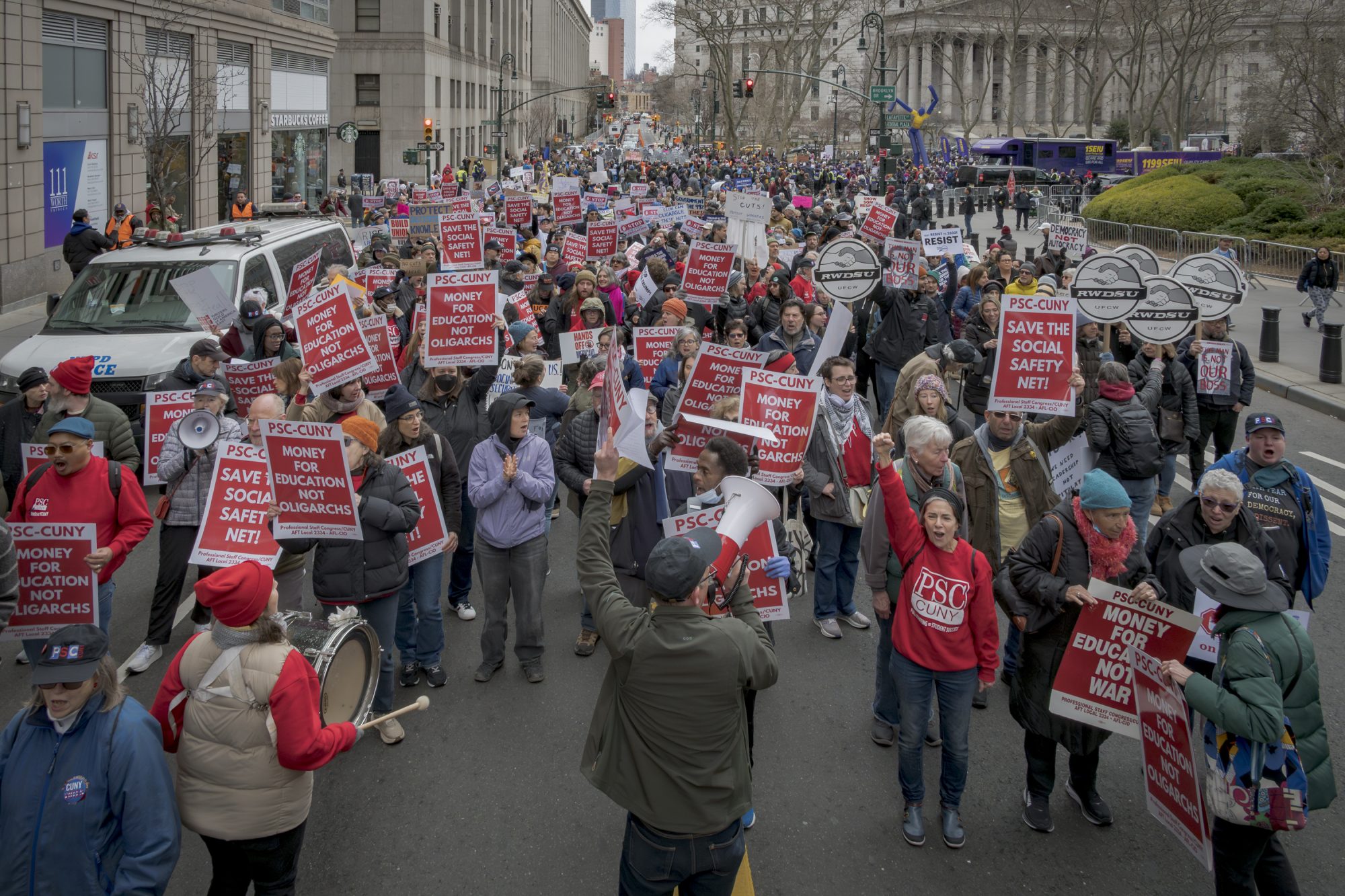
I left the University of Pennsylvania in 1991, after a decade there, to come to the CUNY Graduate Center. My mother was the youngest of 18 siblings, a Jewish refugee from Poland, and my father an orphan who fled Poland. They both arrived at Ellis Island in 1921 at the age of seven. Rose Hoffer and Yankel Yankelovich didn’t schlep here for their stories to be weaponized as a rationale for academic McCarthyism.
It seems particularly ironic and cruel that the House Committee on Education and the Workforce is holding hearings on university accountability and protecting students’ civil rights, while funding violent assaults abroad, most particularly in Gaza, and domestically on students who are international, Muslim or Latino; students with disabilities; low-income and working-class students; the undocumented; pro-Palestinian activists; queer and trans students. Where were the congressional hearings for Mahmoud Khalil, Rumeysa Ozturk and the countless others who fled and live in fear?
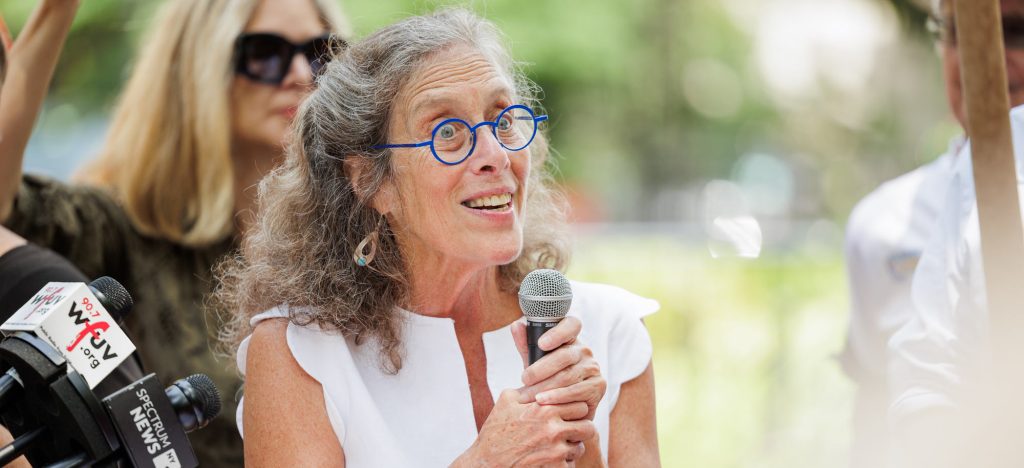
Michelle Fine at a rally against the new McCarthyism outside City Hall. (Credit: Paul Frangipane)
JEWISH VALUES
Let me be clear: I am a Jew at CUNY, and like thousands of other Jewish faculty, staff and students nationwide, I do not feel unsafe. I refuse to be complicit in your campaign to destroy public education.
This assault on higher education and on organized labor is not protecting Jews, any more than the vicious ICE attacks are about keeping communities safe. These hearings are foreplay to advancing an anti-intellectual, anti-worker, in fact anti-Jewish, anti-Black, anti-Muslim, anti-Latino, anti-LGBT regime that smells more like white Christian nationalism than challah.
Our elder sister, the always present Audre Lorde, reminded us that our silence will not protect us; so we say, “Not in our name.” We will not permit a resounding, and increasingly global (even among Jews) critique of Israel to be weaponized as antisemitic speech.
Outrageous acts of institutional violence have historically been enacted to “presumably” reduce antisemitism. In 1922, when City College was 73% Jewish, and Harvard was 20%, Harvard president Abbott Lawrence Lowell announced that he had a “Jewish problem,” which would be resolved with a quota. He was concerned that “there is a rapidly growing antisemitic feeling in this country, fraught with very great evils for Jews.” He elaborated that the antisemitic feeling among students was increasing and [!!!] growing in proportion to the increase in the number of Jews.” Oy!
Quotas were his answer to antisemitism on campus. (Thank you, Ronald Takaki.)
In my three minutes, I will pull from scholarship and biography. I am a scholar of education. I write books, teach and am often an expert witness in educational justice lawsuits; I think a lot about how to mobilize evidence to challenge dominant lies that are told about working-class institutions. More recently, I have been documenting the aggressive investment in what our late colleague Charles Mills would call epistemic ignorance: the federal mandate to not know or not teach. The voracious desire to whitewash decades of critical scholarship and teaching.
For students of CUNY history, we know that repression is a very painful but failed experiment; the desire to learn to engage with very different others is irrepressible. “They” (a promiscuous “they” that shifts in form but not desire over generations and context) can try to destroy education and trade unionism, render literacy illegal, ban books, censor words. And yet people will find ways to be educated – while enslaved, in prison, in internment camps, in occupied territories. To be free, queer and trans. To pursue their dreams of freedom. It’s an itch, a hunger, a yearning – education is an asymptote. People’s desires for dignity, freedom and education swell, even (maybe especially) when threatened. Censorship and hegemonic rule are never fully successful; ironically, they may just be provocations.
AUTHORITARIANISM
Education is an irritant to authoritarian control. Whether we consider the history of apartheid in South Africa, Chile during the Pinochet regime, modern-day Hungary, scholasticide in Palestine or repression in the U.S., we see the weak, desperate moves to cut the tongues and numb the minds within educational institutions – as if that could extinguish what Emily Dickinson called the ‘slow fuse of the possible’ lit by the imagination. Today we witness a dystopic carnival of strategies to destroy education, deny undocumented children access to Head Start, ban books, shutter universities, censor educators, fire provocative faculty, surveil libraries, destroy archives, tear down data-driven websites, police our language, infiltrate our boards of trustees, take over social media, privatize access and whiten the curriculum, summon our chancellors to DC.
When I think about academic accountability, I am reminded of the brilliant philosopher Maxine Greene, who called upon artists and teachers to provoke aesthetic awakenings and openings and refuse anesthetic numbing. That is of course in the marrow of CUNY.
It is often said that CUNY is the engine of economic mobility, but that’s not why faculty and staff stay, even as we are so badly underpaid. We stay because CUNY is infused with a radical imagination for the world. We protect democracy, dissent, dialogue; we conduct science and research to build a stronger city; we grow teachers, social workers, environmental scientists, nurses and police officers; we collaborate with city agencies, community organizations and activist movements. We are deeply accountable to the people of the city.
A few years ago, we hired a brilliant scholar who had been smeared by the anti-Palestinian right wing. Angry calls from Jewish donors threatening to withdraw their monies flooded the provost’s office. A few faculty volunteered to speak with the concerned philanthropists. In tones both angry and determined, one told us: “CUNY is the most antisemitic university in the country; Jews don’t feel safe.”
We explained: “To the contrary, CUNY is so Jewish. We have Jews of all flavors: Hasidic, Lubavitch, former Lubavitch, reform, socialist, agnostic, atheist; in Jewish studies, in Arab studies, in the union, heading up SJP. We are everywhere.” And we argue – indeed there are some heated Jew-on-Jew struggles that have tumbled into the courts; old Jews accusing young Jewish faculty of antisemitism because of pro-Palestine advocacy. It’s not fun, but it’s the work of democratic public education. University life is not safe: It is provocative, engaging, challenging. And more so as we have students taping professors, pardoned January 6 rioters in our classrooms, IDF soldiers, students from a range of political and religious perspectives.
OUR WORK
But this is our work. And these are our commitments to accountability – not through banishing, but engaging.
In the spring of 2024, as the encampment unfolded, I like so many in the community went up to City College. We brought our children and grandchildren to witness peaceful protest. There was art, discussions of gentrification, boycotts, the long history of nonviolent protest at CUNY.
For two days, I facilitated a small group on the green with a simple ask: What are the questions in your heart? People shared deep/hard questions: How do I teach when my class has so many Orthodox Jews and Muslims? What’s a genocide? Does “Palestine will be free from the river to the sea” mean the extermination of the Jews? What’s antisemitism? What’s a Semite? What is anti-Zionism? Can we talk about hostages and the Palestinian prisoners at the same time? The air was filled with songs and melodies in Yiddish, Arabic and Spanish. Shabbat dinners, seders, prayer circles. Deep political education. This is the work of the PSC, of community, and of education for and with the public.
At the Graduate Center, three Orthodox Jewish students have separately found their way to my office, each asking just for a space to speak the unspeakable. One admitted, “I have so many questions, and I can’t ask them in my home community – they call me self-hating or antisemitic; it’s why women shouldn’t be educated.”
STUDENTS
Muslim students come by or email and report fear and censorship for wearing hijab or keffiyeh – these students don’t bring their grievances to public safety or University administrators. It’s difficult to measure anti-Arab and anti-Muslim acts of discrimination with self-surveys or incident reports, when students rightly fear that a complaint will double back on them. This is our work at CUNY – and I promise you a large majority of CUNY workers are engaged in this labor.
In the spring of 2024, the evening of the brutal police raid on the encampment, many in the CUNY community traveled down to One Police Plaza to stand with our students who had been beaten and arrested. We stood together not because we all agreed, but because we knew our students were dedicated to a justice mission bigger than themselves.
And yet, as Washington launches an investigation into CUNY, our own CUNY administration has terminated four adjunct faculty and suspended one student – for reasons unspecified, with chairs uninformed – tied to political speech out of the classroom.
We hold ourselves accountable to serious scholarship, to teaching with heart, to various struggles for justice and to CUNY – a gorgeous, messy, democratic and sprawling community of people, ideas, debates, protests and movements. Gentle and yet fierce, we neither engage in anticipatory obedience nor cower in the face of threats; when our students stand for a world not yet achieved, we stand beside them and then hold complicated conversations.
This campaign against CUNY is just one more chapter in the long history of CUNY struggle. We’ve got this. CUNY is a force of nature. CUNY can’t be stopped.
Michelle Fine is a distinguished professor of psychology, urban education, liberal studies, women’s and gender studies and American studies at the Graduate Center.
Published: September 12, 2025